
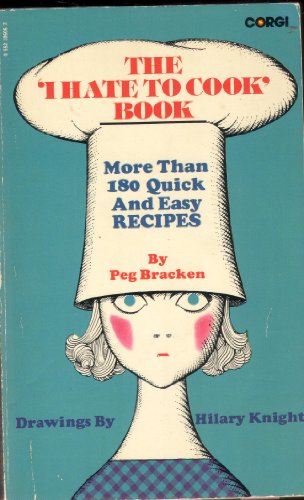
I was sorting through my cookbooks, trying to whittle them down to a more reasonable collection, when I came across my mother’s old copy of I Hate to Cook Book. It’s been around as long as I can remember, first on my mother’s cookbook shelf and now mine. I sat down that evening to browse through it and found it delightfully snarky and fun.
Curious, I did some research on Ms. Bracken and discovered a compelling backstory. (Full disclosure: while some of the writing below is mine, I also cut and paste from various articles written about her over the years.)
In 1960, Peg Bracken was working ten-hour days as a copy writer for an advertising agency She came home to the same trap facing millions of women every single evening. — Dinner.
Dinner in those days meant from-scratch production that she was expected to create with joy. Women’s magazines insisted cooking should be both a creative outlet, and an expression of love for one’s family.
Peg Bracken, forty-two years old, was exhausted, and completely out of that particular brand of joy.
She had a daughter to raise, bills to pay, and a career in a male-dominated industry where she had to be twice as good to be considered half as competent. After proving herself in boardrooms and client meetings, she was supposed to come home and transform into an entirely different woman —one who found deep spiritual fulfillment in pot roasts and casseroles.
The performance was exhausting. And she wasn’t alone. One night, over drinks, Bracken had an idea.
She asked her group of friends to share their real recipes. Not the elaborate dishes they made for dinner parties. Not the complicated meals from the magazines that required seventeen ingredients and three hours. The actual recipes they used on Tuesday nights when they were tired, hungry and just needed dinner done.
The shortcuts. The corner-cutting. The throw-it-together-and-call-it-good meals that kept them sane. Her friends started talking, and Bracken started writing. What emerged wasn’t just a collection of recipes. It was a cooking revolution wrapped in humor and honesty.
…let it cook five minutes while you light a cigarette and stare sullenly at the sink.
Condensed soups figure heavily in I Hate to Cook. So do canned and frozen vegetables, as well as Parmesan cheese, paprika, and parsley because, according to Bracken, “even if you hate to cook, you don’t always want this fact to show.” Using garnishes, she reasoned, “still shows you’re trying.” Most importantly, all the recipes could be prepped in 15 minutes or less
Do you know what the really basic trouble here is?, she asked her readers, It is your guilt complex. This is the thing you really need to lick. And it isn’t easy. We live in a cooking-happy age. You watch your friends redoing their kitchens and hoarding their pennies for glamorous cooking equipment and new cookbooks called Eggplant Comes to the Party or Let’s Waltz into the Kitchen, and presently you begin to feel un-American.
(Substitute “Instagram” for “new cookbooks” and this could also apply to the present day.)
Here’s the introduction:
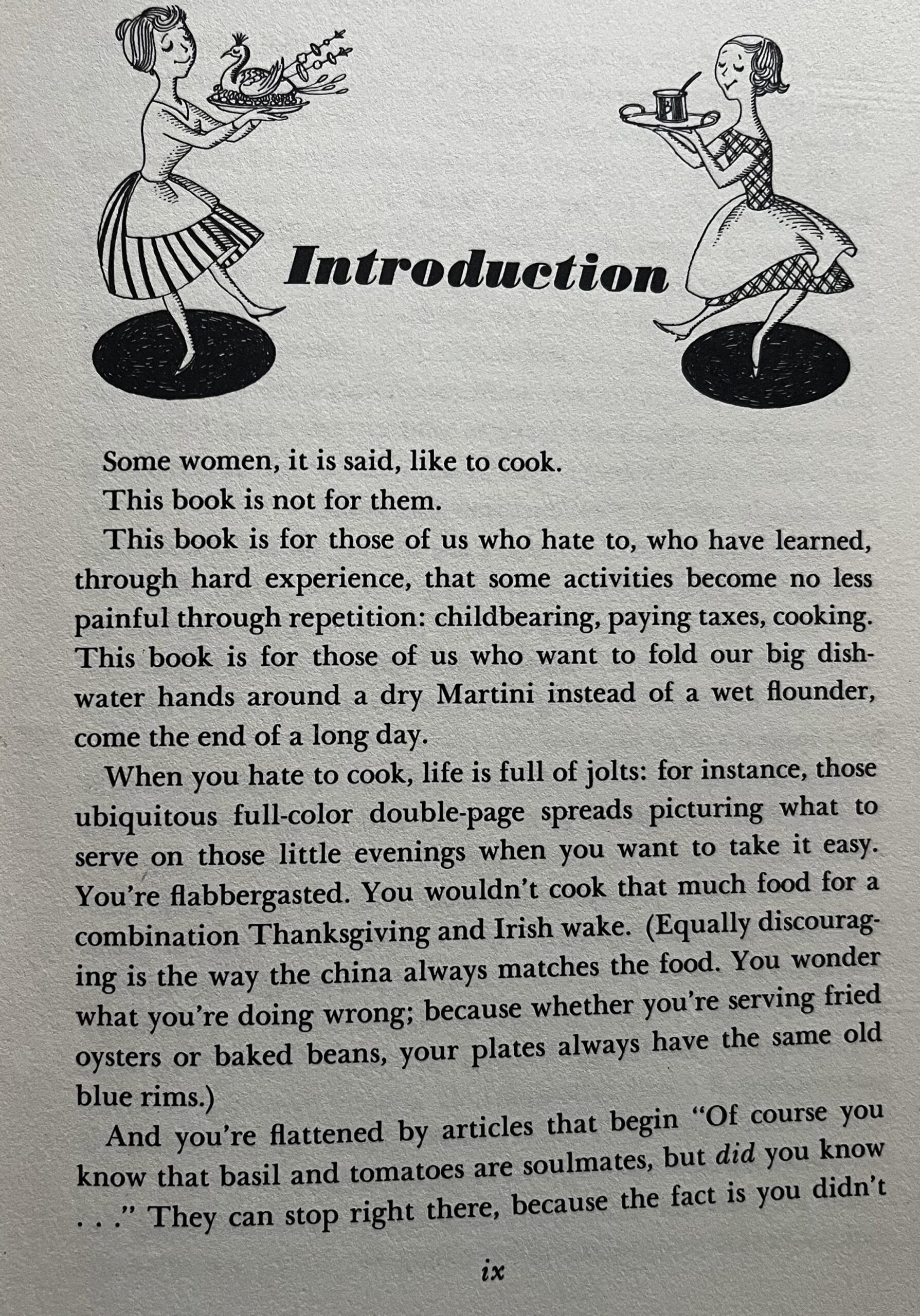
As I browsed thorough the recipes — none really appealed — they haven’t really held up. Even Ms. Bracken conceded they were more serviceable than great. (The book was reprinted in 2010 but had only modest sales.)
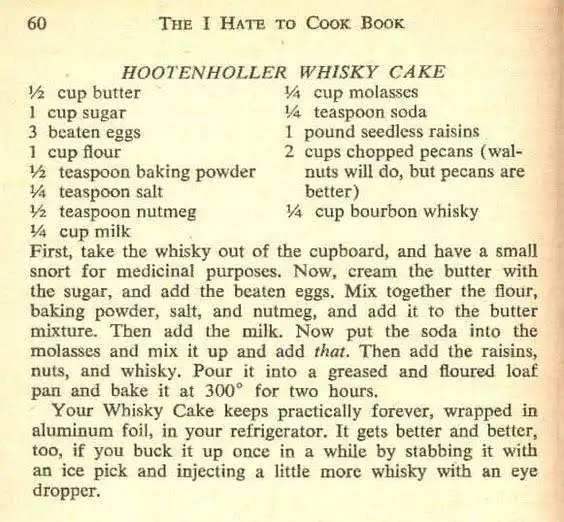
Here ‘s a sample recipe that is both weird and funny:
As I closed I Hate to Cook, I realized that perhaps what Ms. Bracken did was give women in the 60’s permission. Permission to admit they were tired. Permission to take shortcuts. Permission to prioritize your own sanity over elaborate meal preparation.
This breaking away from the standards set for women of this generation was reflected by Betty Friedan who would publish “The Feminine Mystique” in 1963. Then there was Erma Bombeck and Jean Kerr of the “Please Don’t Eat The Daisies” fame.
Ms. Bracken’s humor, while dated, does capture a time when there weren’t all the options we have today – meals ready in minutes, home delivery, and meal preparation services. Reading through this little book was a good way to understand this generation of women and the expectations society put upon them.
The I Hate to Cook Book is readily available – my library has both physical and digital copies and used copies are easy obtained.
I’m so happy to find this! I raised a family with this cookbook and ots tasty healthy and QUICK recipes. My books were stolen a while back and I’m happy to know this one is still around and being enjoyed.
I remember her commercial for Birdseye frozen vegetables. She identified herself and the title of her book and I thought, ” My mother could have written that”.
Thanks for this recommendation because I DO hate to cook!! Even if I only use a couple recipes, sounds like a good read!
Pam Martin