-
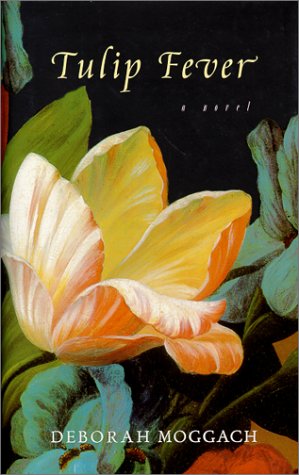
Tulip Fever by Deborah Moggach
 I read Tulip Fever years ago en route to a holiday in the Netherlands. I wanted to learn about the tulip frenzy of the 1630’s, when bulb prices soared beyond anyone’s imagined riches. I also wanted to read about the golden age of the Dutch masters. What I wasn’t expecting was that I would be treated to a rollicking great story… complete with a sprinkling of sex and a bit of a mystery.
Set in 1636 Amsterdam, Tulip Fever is a novel of passion and deception. It is the time of the tulip craze and the Dutch were enjoying great wealth. Sophia is the young wife of Cornelis Sandvoort, a prosperous older merchant. She agreed to the marriage only because he funded her poor family’s immigration to America. Their marriage has not produced a child, so Cornelis decides to immortalize themselves by having their portrait painted. He hires Jan van Loos, an up and coming young artist. Not only does the portrait sitting bring some excitement into their dull household routine, it brings a secret love affair for Sophia and Jan. Their relationship is carried on with the complicity of the household maid, Maria who has her own secrets.
Ms. Moggach intertwines the story and her characters with the 17th century Amsterdam tulip mania and it’s eventual crash (can we say dot.com folks?). There are lies, secrets, betrayals, and plot twists that keep the reader totally immersed. Then, if you’re like me, you’ll gasp as the consequences reverberate into the various characters fates, positions, wealth, and lives.
Tulip Fever has been recently adapted into a film, which I saw recently. I have to admit I really enjoyed the film and thought it was actually a very good adaptation of the book.
The film has Dame Judi Dench as a somewhat disreputable nun and the screenplay was written by Tom Stoppard. It is visually stunning and the costumes are amazing. But I have to wonder at the 17th century fashionista who came up with these.

So which am I recommending? Well, the answer is both — Tulip Fever the book and Tulip Fever the film. Do both, I say. Film trailer HERE.
-
Big ~~ Really Big ~~ Book Sale
If you’re barmy about books and in the Bay Area…
Here it is…
The Largest Used Book Sale on the West Coast!
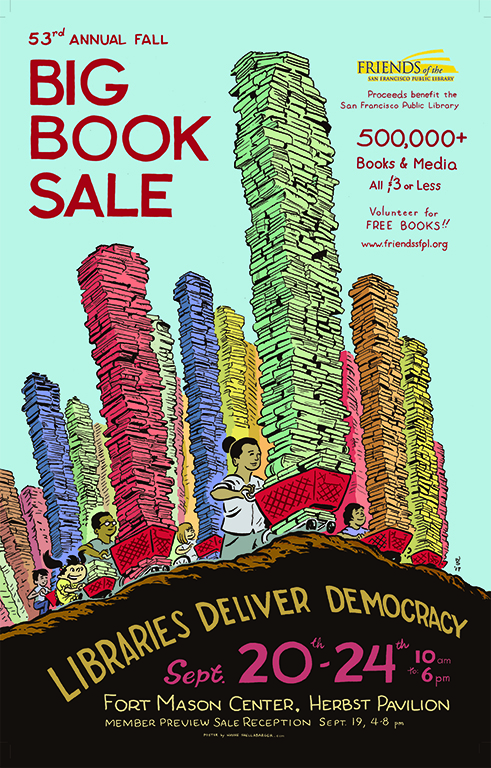
The 53rd Annual Big Book Sale will be held at the Fort Mason Festival Pavilion from September 20th – 24th, from 10 a.m. to 6 p.m.
There will be a Preview Sale for members on September 19th 4-8 p.m.
This year’s Big Book Sale will have over a half-a-million (yes, you read that right – 500,000 +) books and media. All priced at $3 or less.
And everything goes for $1 on the last day of the sale, Sunday, September 24th.
All to benefit the San Francisco Public Library and its invaluable community programs.
-
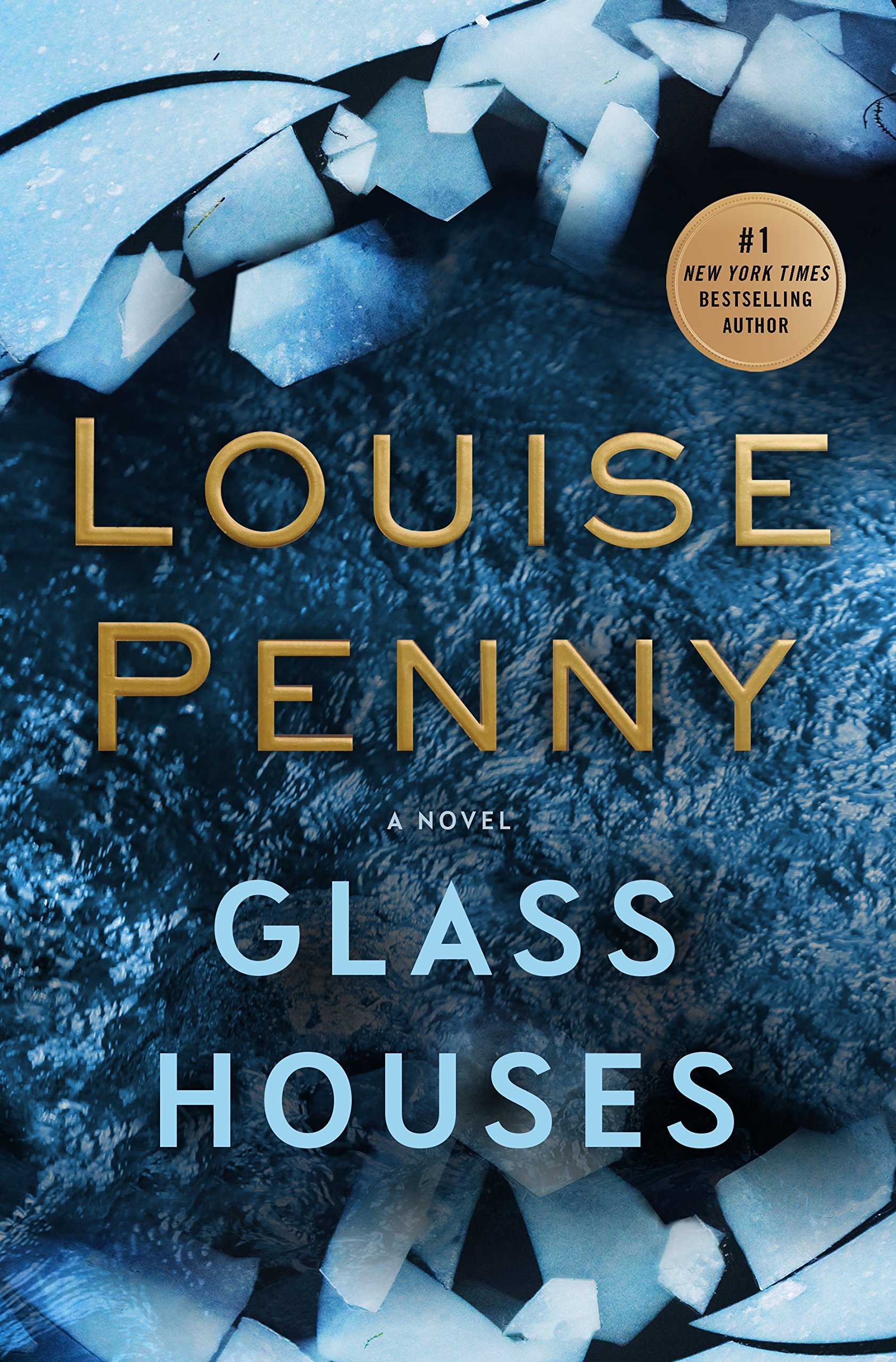
Glass Houses by Louise Penny
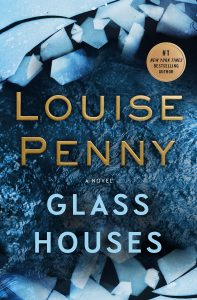
Lucky old me, I was granted an advanced reading copy of Glass Houses and read it in three days. I could have read it in a day, but had to slow myself from ripping through this newest gripping mystery from Louise Penny.
As many of you know by now, I’m a fan — I’ve read every one of Ms. Penny’s Chief Superintendent Gamache novels and that I can’t stop raving about her characters, multi-layed plots, and often gorgeous writing.
Ms. Penny was a CBC journalist and in interviews she says this experience gave her insight into people at their most vile, but also she got to witness acts of incredible forgiveness. As such, her mysteries involve dark human acts, but balance this evil with mankind’s redeeming graces. Not only am I a fan of her poetic phrasing and intelligent writing, but also her luscious food descriptions. (She says she writes with a pile of cookbooks on one side and poetry books on the other.)
Each of Ms. Penny’s books has a theme and in Glass Houses it’s conscience~~ having a conscience, acting on your conscience, avoiding your conscience, and the consequences therein.
A mysterious dark hooded and caped figure appears on the village green of Three Pines town square. The figure stands, unmoving for several days and upsets the entire village. There is nothing Gamache can do as the figure just stands, but he is also concerned. Turns out this figure is a “Cobrador del frac” – a Spanish debt collector with roots in the Middle Ages. The Cobrador is meant to publicly shame debtors by stalking them and reminding them of their indebtedness. But the villagers have no idea who the Cobrador is meant to intimidate.
Glass Houses has a bit of a new style, Ms. Penny goes back and forth in time using Gamache on the stand in court as a conduit for unraveling the mystery of the Cobrador and subsequent murder in Three Pines.
But Gamache has more to deal with than the murder, he is simultaneously planning a secretive massive drug operation on the US/Canadian border. He must tread carefully, as he’s still not sure who he can trust, after uncovering rampant corruption within the Sûreté du Quebec.
Once again, Ms. Penny weaves thoughtful prose with historical references. She uses the phrase “burn the boats”, during Gamache’s drug operations, which was how Cortez prevented his armies from retreating to Spain. And poor Gamache continually has the children’s rhyme “ashes, ashes, they all fall down” running through his mind, which gives the reader not only the same brain worm, but an extra layer of suspense to the throat clenching last few chapters.
The Three Pines regulars don’t play a large part in Glass Houses, but Clara has a showing of her portraits of each of the villagers and the paintings reveal a wonderful insight for each of them.
Thank goodness Ruth* and her foul-mouthed duck are still causing trouble, there’s plenty of mouthwatering food, and cozy evenings at Myrna’s bookstore with cocoa and cookies.
There now, stop — that’s all I’ll tell you about Glass Houses – no spoilers here.
As with any of Ms. Penny’s mysteries — you’ll fall hard for the characters and the imaginary Three Pines, you’ll laugh and cringe at the village mishaps and misunderstandings, you’ll be deeply invested in the solution of the crime, and you will never– ever be bored.
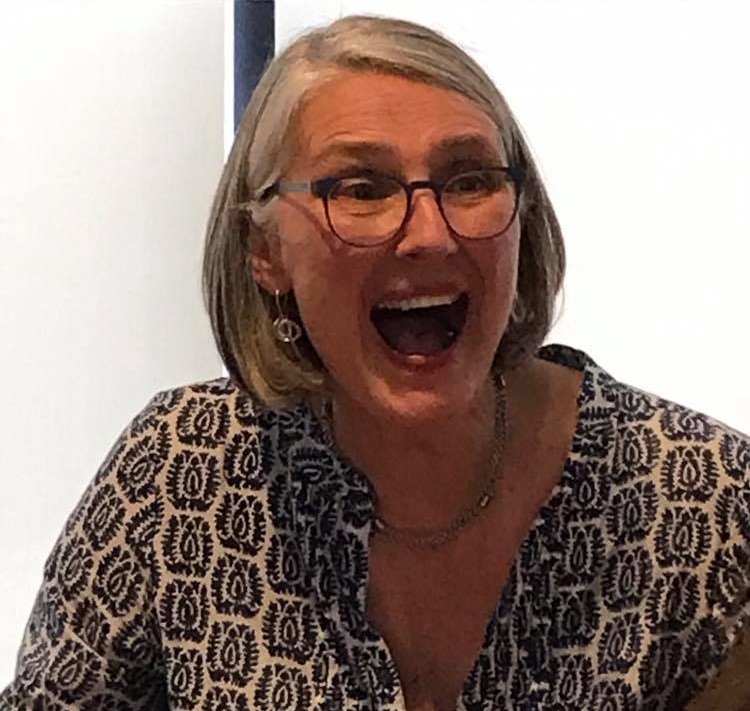
I told you I went to see Ms. Penny on book tour yesterday, well this photo perfectly captures her spirit and personality.
“Surprised by Joy”.
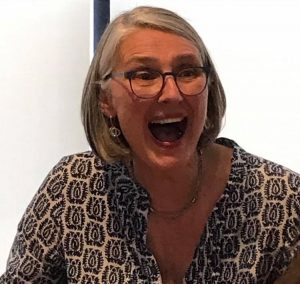
*Ms. Penny quote: “Ruth is the Greek chorus of the village of Three Pines.”
Thank you to Minotaur Books for a digital advanced readers copy via Netgalley.
-
Seeing Ms. Louise Penny
We’re having a blinking heat wave, so who (or what) could entice me away from my relatively cooler ocean breeze over to Book Passage in Marin where it’s a gazillion degrees?
Okay, you’ve already guessed the answer… Louise Penny of course. She’s on book tour for her newest book Glass Houses which came out just a few days ago.
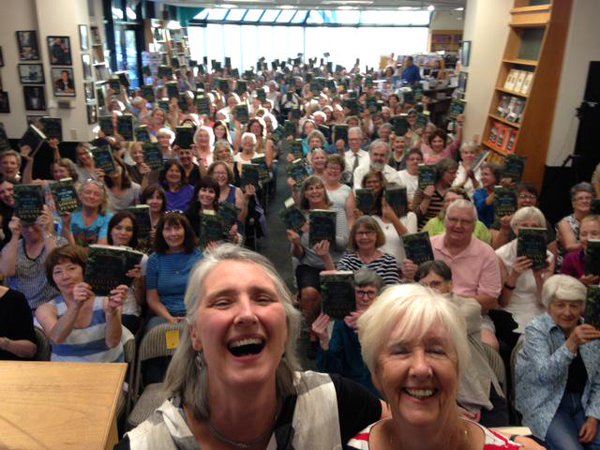
The store was packed for this appearance and I was told it had been sold out for days. It was hot and sticky but not one of us minded because Ms. Penny was upbeat, witty, and as always, gracious.
Here’s how crowded it was (I’m not in the photo — I’ve learned to sit up front left on the window ledge- where it’s less claustrophobic).
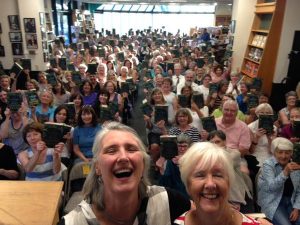
Fellow mystery writer and Ms. Penny’s good friend Rhys Bowen introduced Ms. Penny and it was great fun. If you look closely you can see the sweat on everyone’s faces. Air conditioning just couldn’t handle the hordes of Ms. Penny’s fans.
I’m back home now admiring my beautiful autographed copy of Glass Houses.
But, never fear you lucky Barmy fans ~~I’ve already read it.
So tune in over the weekend, when I promise to give you the full BookBarmy review – without spoilers.
But right now, I’ve got to get me some ice tea. It’s now late afternoon and it’s even hot out out here by the ocean.
Later gator.
-
Some housekeeping

Technical Update
Thank you to all the BookBarmy Newsletter Subscribers out there. You should know we are having problems with the newsletter delivery system. Bigger brains than mine are working on the issue (or issues) and I am assured that all will be well soon. Until the problem is fixed, rest assured BookBarmy has not gone anywhere. Still here, still posting – you’ll just have to check back here yourselves every few days or so.
If you’re not a subscriber and in future, would like to receive a simple email notice when there is a new BookBarmy post you can sign up below right.
 The Great British Baking Show Update
There’s been a major shake up at one of my favorite series –The Great British Baking Show —The Great British Bake Off as it’s called in the U.K. (it had to be changed here because Pillsbury owns the rights to the term “bake off”) will be going to Channel 4, the British commercial network, after the Bake Off production company accepted a higher offer to leave the BBC. Mary Barry and the two comic announcers Sue Perkins and Mel Giedroyc — left in protest. Only Paul Hollywood will stay with the show as it moves British networks.
Being the geek that I am, I’ve done my research and PBS has bought season five which they will air here next summer. So all is not lost.
In the meantime, try and catch at least the final episode of Season four which aired on PBS recently. In the final challenge of the final episode they prepare an extravagant picnic basket fit for the Queen. It’s tension filled as the contestants have to complete a mind boggling range of items — a chocolate cake, quiches, sausage rolls, little cakes – it goes on and on, quite amazing really. … and in the end there were three …

 Reading Update
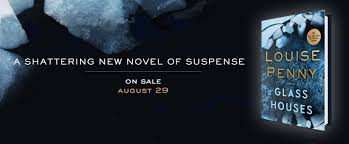
Yes, my prettys, I am absorbed into Glass Houses, Louise Penny’s newest novel, which comes out next week.
At the risk of being repetitive, I urge you call in sick that day, cancel your appointments, get thee to your local bookstore and find a place to read undisturbed. All I will say is, your money and time will be well spent.
In the meantime, here is a silly interview from this morning’s talk shows. Poor Ms. Penny barely gets a chance to speak and the brash “American-ness” of the interview itself made me squirm. And what’s with the oh-so-not-clever “Penny Wise” caption throughout? But here you go. Video HERE
There — that’s all my housekeeping done – at least here on BookBarmy – around my home — not so much, because you see I am “with book”.
-
a political escape…
I’ve found an escape, a Camelot of political integrity…a place where the White House is doing the right things (mostly), making decisions with future generations in mind, and maintaining the governance of our Constitution as best they can.
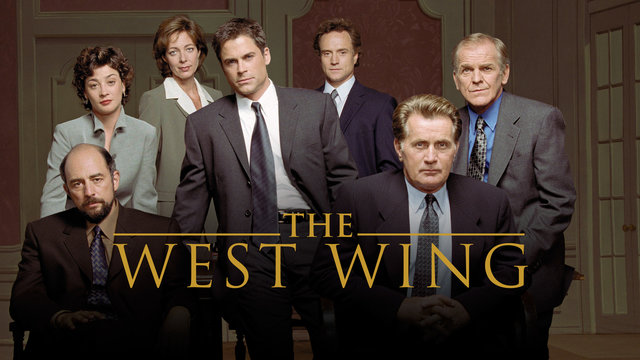
If you’re also in need of respite — come with me to the magical world of West Wing (on Netflix). Watch a few episodes of this extraordinary and beautifully written television series.
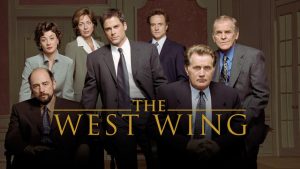
Yes, it’s a White House of imagination and sometimes over the top… but I highly recommend just an episode of West Wing ~~ here and there.
Choose any episode at random, see how it could be done.
At least for me, it keeps some perspective when I see the activities in the actual West Wing and today’s White House.
Now, now ~~ before you lecture and accuse me of hiding my head in the sand — I’m active in local politics and am supporting my political party towards both the midterms and 2020. I’m not copping out, I’m not giving up on our government or our country — but egads — every so often, a gal needs a break.

-
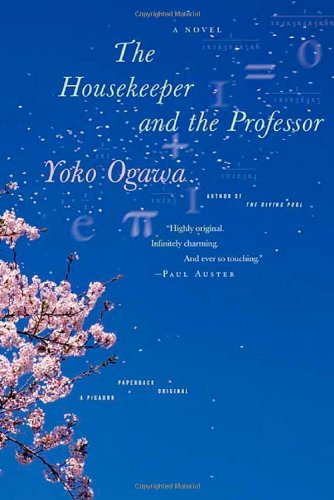
The Housekeeper and the Professor by Yoko Ogawa
 True confession time ~~ I flunked Algebra II, still can’t do most multiplication tables, and freeze when confronted with compound interest rates. So I’ve long avoided The Housekeeper and the Professor – a book about math. I knew of this Japanese novel, even gave a copy to my mathematician sister. But I continued to avoid it like my old Algebra text book (and, yes the cover is imprinted in mind and still makes me slightly nauseous).
The other week, I stopped in my library branch during one of my walks and someone had abandoned this slim Japanese novel on a table, so I picked it up just to browse. Bet you know where this is going…
From the inside cover:
He is a brilliant math Professor with a peculiar problem―ever since a traumatic head injury, he has lived with only eighty minutes of short-term memory.
She is an astute young Housekeeper―with a ten-year-old son―who is hired to care for the Professor.
And every morning, as the Professor and the Housekeeper are introduced to each other anew, a strange and beautiful relationship blossoms between them. Though he cannot hold memories for long (his brain is like a tape that begins to erase itself every eighty minutes), the Professor’s mind is still alive with elegant equations from the past. And the numbers, in all of their articulate order, reveal a sheltering and poetic world to both the Housekeeper and her young son.Before you knew it, I was two chapters in and had checked it out to bring home.
The Housekeeper and the Professor, set in Japan, is about a brilliant math professor who, because of an accident, has a memory span of only 80 minutes. He is difficult and his sister-in-law has tried many housekeepers. Finally, our narrator winds up being placed with the Professor. She brings her young son with her the first day, and the Professor immediately calls him ‘Root’ because his flat head looks like the sign for square root.

The new housekeeper enjoys taking care of the Professor and his cottage, and Root comes every day after school. But how do you create a relationship when a memory lasts only 80 minutes? The Professor manages, as best he can, by pinning notes and photos on his suit. But we soon see that it also takes the compassion of the new housekeeper:
Somehow, I had never quite understood what it meant for him to wake up alone each morning to this cruel revelation.
“I’m your housekeeper “, I said, when the sobs had subsided for a moment. “I’m here to help you.” He looked up at me through his tears. “My son will come this evening. We call him Root, because his head is flat. You gave him that name.” I pointed to the picture on his jacket.
The housekeeper, with him all day, starts to become fascinated with the Professor’s work. He is still a renowned mathematician and wins prizes for solving intricate problems for various math journals. She starts working on simple math problems with the professor as her guide. The novel goes into discussions of factoids, prime numbers, abundant and deficient numbers, much of which made my eyes cross, but didn’t dissuade me from continuing with this unusual novel.
The bond between the Professor and Root grows deeper and each becomes important to the other. The Professor helps with Root’s homework and Root urges the Professor to fix the radio so they can listen to the baseball games together. Turns out they like the same team and start avidly following the games and compounding the all-important baseball statistics. Again, with the math.
But I must say, even this arithmetically impaired reader enjoyed some of the math-ridden sections. Who knew prime numbers could be interesting? Which, kudos to Ms. Ogawa (and the translation) is extremely hard for an author to pull off.
Finally the three attend a baseball game which proves to be tricky given the Professor’s memory issues. This passage vividly brings to life the love of baseball:
We were mostly silent as we walked through the grounds to the stadium and stood in the crowded passageway leading to our seats. The Professor was no doubt shocked to find himself in a place so utterly different from his usual surroundings, and Root was overcome with excitement at the prospect of seeing his beloved Tigers. They both seemed to have lost the power of speech and merely stared around in awe. “Is everything okay?”, I asked from time to time, and the Professor would nod and grip Root’s hand tightly. As we reach the top of the stairs that lead to the seats above third base, all three of us let out a cry. The diamond in all its grandeur was laid out before us — the soft dark earth of the infield,, the spotless bases, the straight white lines, and the manicured grass. The evening sky seemed so close you could touch it and at that moment, as if they had been awaiting our arrival, the lights came on. The stadium looked like a spaceship descended from the heavens.
The translation is beautifully done and allows English readers to see how Ms. Ogawa paints with words. And, like a spare Japanese painting, there doesn’t seem to be much going on — but there is much to interpret from The Housekeeper and the Professor.
This is a lyrical, but quiet story. There’s the interrelated connections between people, the world of numbers and ultimately the universe. The novel reminds us about the joy in the daily little things experienced with new eyes — over and over again — a cup of tea, the sound of the rain on the windows, a chat about baseball.
But, what has stayed with me — especially during the news these past few days — was the beauty and strength of the relationship between the Housekeeper, Root and the Professor — a relationship built upon nothing but respect and consideration for other humans.
The Housekeeper and the Professor is one of those original books which reaffirms the delight found when reading something totally and wonderfully unique.
-
On Vacation ~~ sort of
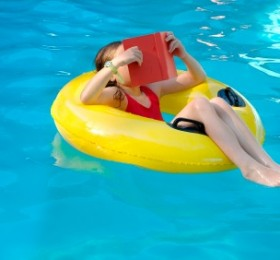
Here at Book Barmy, we’re away right now. House, dog, pool, and BBQ sitting for friends in the East Bay. It’s tough work, but Husband and I are managing.
Perfect timing — weather is in the low 80’s and sunny while back in the city it’s a damp and foggy 56…
It’s well known here in the Bay Area that 30 miles = 30 degrees
The pool sitting is especially tiresome.
back next week
-
Books of books
There’s an endless number of books about books and I gravitate to them like a moth to flame. As I’ve said before on this blog, it’s a sickness I tell you, and I just can’t help myself.
This intrigue, for me anyway, is all in the shared pleasure. What are others reading? What books have they liked, nay loved? Please discuss. How do they read – favorite nook, coffee shop, bed? Tell me more. How do they keep track and record their thoughts on the books they’ve read?
But most interesting is why people read.
Over the last few months (in between other reading), I’ve devoured three such reads, from different authors, and each with different viewpoints on the importance of books and reading in their lives.
+++++++++++++++++++++++++++++++++++++++++++++++
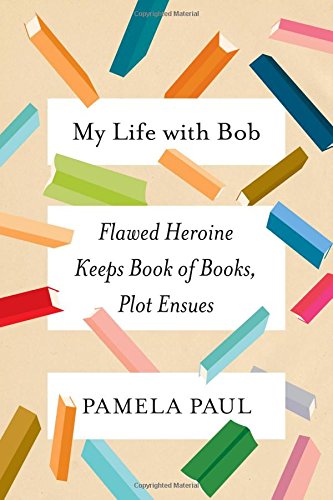
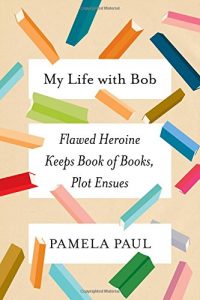 My Life with Bob, by Pamela Paul
Ms. Paul is the editor of the New York Times Book Review and has keep ‘Bob’ — her Book Of Books — by her side since high school. How could I not instantly like someone who has kept a journal of everything she has read for 28 years? Talk about kindred spirits.
My Life with Bob is a memoir, cum literary critique with short chapters that reflect on a childhood where being “such a reader” proved to be sometimes lonely and to college where she berates herself for not having read Trollope or the Greek plays – “oh, the shame of being under read”.
Each chapter recounts pivotal points in her life, from divorce to the death of her father, where reading gave her strength, encouragement, solace or just plain escapism. She charts her life through her list of books in Bob and sees how she was formed by reading– from finding herself as a teenager through books, to ultimately a career in the book trade.
In my Book of Books, I can see the way these choices line up and read the signs along the way that reveal those decisions. Here, a novel selected with deliberation; the next, a matter of circumstance. This one was assigned, but that one a book I was dying to read. My mother-in-law gave me that book. This other one was found in the common room of a New England bed-and-breakfast. All of those choices.
Ms. Paul is funny and poignant and I found myself chuckling with her insights and admissions. After an easy, uncomplicated birth, she arranges to stay an extra day in the hospital, just so she could finish her book.
Ms. Paul takes us on her journey to becoming a major player in the book review world and how when overjoyed at a promotion from children’s book editor to chief editor of the Book Review, her children were dismayed and thought she’d been demoted.
My Life with Bob is for anyone who is a reader before almost anything else and will inspire you to start keep track of your reading thoughts.
I only wish I kept a book of books since high school. Alas, my written records only go back to 2000, when a dear friend gave me my first book journal. But I have happy memories of my early reading and the books I loved — My Friend Flicka, Anne of Green Gables, Beautiful Joe, Heidi and, of course, Little Women.
But I digress, here we go with some more books to add to your reading list.
+++++++++++++++++++++++++++++++++++++++++++++++
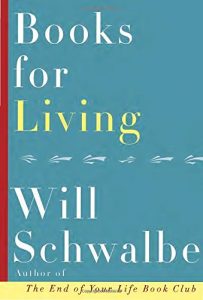 Books for Living, by Will Schwalbe
Mr. Schwalbe, is the author of the best seller – The End of Your Life Book Club, which documents the books he and his mother read as she lay dying in the hospital. (Resisted reading it, thought it might be too heartbreaking, but now maybe I’ll give it a try.) The author now takes to the page to address how books can fit with the the noise and distractions of our modern world.
In his introduction he writes that reading is “a respite from the relentlessness of technology” and that at the heart of our over-connectiveness is fear —
–fear that we are missing out on something. Wherever we are, there’s someone somewhere doing or seeing or eating or listening to something better.
He goes on to surmise that this brings on a loneliness that separates us from ourselves — and that by reading we can open our minds and grow into our own possibilities of life and living. (Not to mention a un-plugged hike in nature.)
Each chapter covers a topic in which books and reading played a key role in his life. Everything from ‘Embracing Mediocrity’ to ‘Admiring Greatness’ — there’s a beautiful chapter on loosing a childhood friend and how re-reading David Copperfield and his loss of Dora gave him comfort.
Mr. Schwalbe introduced this reader to the Chinese philosopher Lin Yutang and his famous book, The Importance of Living “is about the need to slow down and enjoy life. And, it is about the importance of books and reading.” (Don’t worry, it’s been added to my TBR list.)
It is clear that the author carries his heartbreak with him — the loss of his mother and dear departed friends:
We can’t do much for the people we’ve lost, but we can remember them and we can read for them: the books they loved, and books we think they might have chosen.
Mr. Schwalbe covers a wide range of books from many genres — The Odyssey, The Girl on the Train, The Little Prince, and one of my favorites, Anne Morrow Lindberg’s – A Gift From the Sea. He even finds a place in his reading life for cookbooks, like me, he recognizes they can be far more than just recipe collections.
The appendix for Books for Living lists just over 150 authors, books, plays, poems, stories, and journal articles which Mr. Schwalbe references in Books for Living. You definitely be adding books to your own TBR list. A most enjoyable read for any bibliophile.
While Mr. Schwalbe and I share much when it comes to reading, I was delighted that he is also considered odd — as we both are known to start conversations with — “What are you reading?”
An advanced reading copy was provided by Alfred A. Knopf
+++++++++++++++++++++++++++++++++++++++++++++++
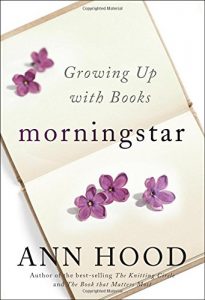 Morningstar, by Ann Hood
This delightful little book tells of Ms. Hood’s coming of age and how reading shaped her. She breaks the book into ten chapters or lessons — each centering on a book that changed her outlook, built new dreams, or taught her valuable lessons.
The first chapter, or Lesson 1, is entitled How to Dream, and centers on Marjorie Morningstar by Herman Wouk. (Thus the title “Morningstar”.) Ms. Hood read the book as a teenager trapped in a Rhode Island mill town. Marjorie Morningstar allowed her to dream of something bigger. She re-reads it every year:
Maybe that’s why I reread it every year. Maybe, as time beats me up and grief or loneliness or a new kind of bittersweet melancholy take hold, I need to remind myself to keep going, keep reaching, to not forget the girl who believed she could have everything and anything at all.
Like the other two books on books, I felt a kinship Ms. Hood, but this time because of our similar ages. I found myself recognizing her descriptions of growing up in the 60’s & 70’s — with the Viet Nam war on television, girls-only home economics classes, and listening to Simon and Garfunkel. There was the confusion of the world breaking open with the women’s movement, communes, hippies, civil rights — all contrasted with our girl scout activities and mothers having dinner ready for dad’s homecoming each day. We were both girls who hid from this confusion by escaping into the other world(s) of books.
Upon being discovered secretly reading Little Women during class, her elementary school teacher asks her to stay at recess:
“You’re reading Little Women?” she asked, looking at the book in my hands. I nodded. “And you understand it?”, she asked. Again I nodded. Then she asked me tell her what the book was about. At this, I began to talk, about Marmie and the March sisters the plays they put on, about Laurie next door and vain Amy and Jo who wanted to be a writer and how Beth died. I told her it was about family but also about war and dreams and writing and…”And”, I said, “everything. It’s about everything.” Now it was Miss Nolan who nodded. She paused, then pointed to the books that lined the bookshelves in the back of the classroom. “I don’t want you to go out to recess anymore”, she said. “I want to you to stay inside and read all those books”.
(I never had the fortune of such a teacher letting me skip recess or P.E. – sighs of envy.)
Ms. Hood grew up without books at home, and she tells of going to the local library and checking out whichever books were the biggest, (Anna Karenina, Les Miserables) so she could get the most reading per book. There’s a section where a bookstore opens in a mall close by and she revels in the possibility to buy and own a book of her very own.
In Lesson 8: How to Have Sex, Ms. Hood recounts reading The Harrad Experiment which opened her mind about sex and the sexual revolution — where sex didn’t have to become intertwined with love and marriage. (I vaguely remember reading a borrowed copy in high school, and found it both embarrassing and eye opening.)
Ms. Hood could be describing many bookish children growing up, we all felt this way at one time or another:
How can I describe what reading gave to me? An escape from my lonely school days, where girls seemed to speak a language I didn’t understand. A glimpse into the possibilities of words and stories. A curiosity about the world and about people – the young Amelia Earhart seeing her first plane, Helen Keller’s silent world, Nancy Drew solving mysteries, David Copperfield surviving the streets of Victorian London.
But, fear not, the author enjoys pure pleasure reading:
Even now I like to sometimes indulge in the guilty pleasure of reading a book that literary snobs would never consider reading. And I enjoy them, those paperbacks I don’t mind leaving behind on an airplane. They make long flights pass pleasantly. I don’t have to marvel at the use of language or metaphor or puzzle over how the author pulled off such a mind-bogglingly intricate plot. I just read it and forget it, perhaps a habit I learned back in high school when I read any book I could get my hands on.
Morningstar is a lovely book and it reminds us that books can form a childhood – give escape from confusions – spark dreams of bigger things and open us to other worlds.
A digital advanced readers copy was provided by W.W. Norton & Company via NetGalley.
+++++++++++++++++++++++++++++++++++++++++++++++++
So there you go, BookBarmy fans, three more books about books to re-read, books you haven’t read, books you need to read, books you may want to read, books to consider reading…
But, no, no I’m not crazy… really..

-
My Biggest Fan
Happy Birthday to Book Barmy’s biggest fan
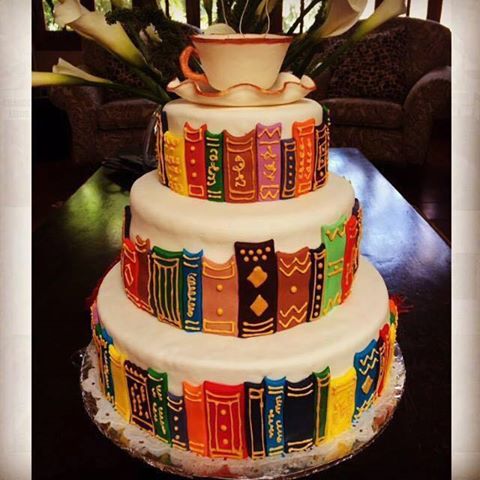
My Mom
~~ who taught me to read, shared my tears over Little Women, bought me the newest Nancy Drews, planned outings that included used book stores, gritted her teeth during my Rod McKuen stage, and has always encouraged and shared my love of reading.
Happy Birthday Mom – all my barmy-ness comes from you ~~ and I wouldn’t have it any other way.
I love you