-
The Long Way Home by Louise Penny
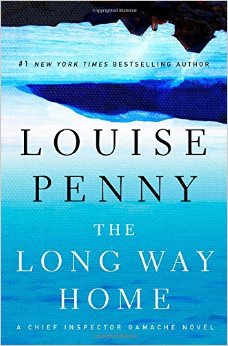
Here I am again, recommending another intelligent and well-written mystery series. This time by a Canadian writer. These (as with Deborah Crombie) shall and should be read in sequence (Still Life is the first).
Louise Penny is a former CBC journalist and her well-honed story telling craft makes each of her novels a gem. The series largely focuses in and around the picturesque Canadian village of Three Pines, filled with idiosyncratic inhabitants — but these are no typical “cozy” mysteries. The characters have depth, humor and pathos and the plots are often intricately complex and psychological. I eagerly await each and every one of her novels. So I blissfully delved into The Long Way Home, the 10th in her series.
The Long Way Home finds Chief Inspector Gamache now retired in Three Pines hoping to relax and recover from the horrors he experienced (yes you must read the earlier novels to truly understand the context). He and his wife, Reine-Marie, are enjoying village life – breakfasts at the bistro, browsing at the bookstore, dinners with friends – when one of their friends, Clara, asks Gamache to help locate her estranged and now missing husband. Clara and Gamache are joined by Reine-Marie, Myrna, the bookstore owner, his ex-Sargent De Beauvior, and the ever-cranky poet Ruth.
This unlikely crew of investigators find themselves in the Canadian region of Charlevoix, a place of harsh beauty along the St. Lawrence river, which has attracted artists for centuries. The mystery orbits around paintings of the beautiful landscape and Canadian artists. You can see some of the artwork here. This novel is fairly steeped in art – even the cover of the book feels and looks like a canvas. Part of the mystery also refers to a place in Scotland dubiously named “The Garden of Cosmic Speculation”, it really does exist and looks fascinating – check it out here. As always, with Ms. Penny’s novels, I find myself making a list of things to Google.
Back to the story — this is a markedly more philosophical and somber novel which deliberately mirrors Gamache’s introspection since his retirement from the force. Much of the book is psychologically driven and I grew tired of Clara’s tormented artist self pity. The artistic process and angst is discussed ad nauseum and is used as motive where it really doesn’t make sense. There is some repetition and reiteration — OK-OK we get the Balm of Gilead reference already! Basically, I longed for the plot to step more lively, if you please.
There were moments of the old charm and humor (nearly not enough for this reader):
“Ergo, he painted them on his return to Canada,” said Clara.
“Ergo?” asked Myrna.
“Don’t tell me you’ve never wanted to use it,” said Clara.
“Not now that I hear how it really sounds.”
Don’t get me wrong, I enjoyed this book and it retains Ms. Penny’s gorgeous writing. I was happy to revisit the Three Pines, its characters (including one foul-mouthed duck), glimpse into Gamache’s new life (he reads each morning on a bench overlooking the village) and share in the non-stop cozy tea breaks and good meals – does that Bistro ever close?
The Long Way Home is still an excellent read, just not on par with Ms. Penny’s previous novels. I remain a steadfast fan and will eagerly await Ms. Penny’s next installment in this smart, original series.
One big rant: Come on Ms. Penny you’re better than this book’s melodramatic ending!
(I am hoping Ms. Penny doesn’t fall into a series black hole ala Elizabeth George — whose mysteries, in my opinion, lost their way after she killed off Helen.)
-
Death Comes To Pemberley – Masterpiece tonight
Tonight on PBS Masterpiece – Death Comes to Pemberley.
I didn’t get to P. D. James’ novel of the same name, it’s still in my TBR
mountainstack of books, and while I usually prefer to read the book before seeing a film or show, I’m not going to miss this!
Post-show thought: Let’s bring back the empire-waist dress – so flattering for any woman of normal (OK slightly above normal) size.
-
And so it goes…
See previous post – of course it becomes a Waterstone’s marketing event.
-
When being locked up is a good thing….
Check out the article on Savidge Reads blog
http://savidgereads.wordpress.com/
Most of you will have undoubtedly heard about the luck misfortune of David Willis who suffered the amazing awful ordeal of being accidentally locked into the Trafalgar Square store of Waterstones for a few hours before, having tweeted, he was rescued. The most amazing thing I found about this story was that he actually told anyone that he was stuck in there, I wouldn’t have. If you haven’t been to the Trafalgar Square branch of Waterstones it is one of my favourites, floors and floors of books, loads of stationery, comfy armchairs and a wonderful cafe and restaurant. It would be a dream to spend a night, let alone two hours, stuck in there. We have all surely had that thought of hiding somewhere in a bookshop and waiting to be locked in haven’t we? I would have had a good old wander through the store and picked up some books to read, made a cocktail or two at the bar and headed for a comfy sofa for the evening. I certainly wouldn’t do this…
A man was accidentally locked in a Waterstones Bookstore after closing time.
I agree with Savidge, I certainly wouldn’t call to be rescued – books, a cafe/bar (really a bar? Note to self: visit this bookstore next trip to London) bathrooms, armchairs – WHY, oh why, call to get rescued?
On a similar vein: Does anyone else watch folks on television going into prison (low security) and secretly think “wow not so bad, three meals a day and just think of all the reading time”?
-
To Dwell in Darkness by Deborah Crombie

I have followed this series from the first installment, A Share of Death in 1995, and have eagerly awaited each new installment in Ms. Crombie’s intelligent, well-crafted British mystery series.
Now if you are unfamiliar with Deborah Crombie – you will enjoy this latest mystery in her series, but I urge you to go right now to your library and check out a Share of Death. Then read each of her series in order… I’ll wait right here until you do so.
OK now you’re with me on the series and her latest, To Dwell in Darkness, does not disappoint.
From the Back Cover:
Recently transferred to the London borough of Camden from Scotland Yard headquarters, detective superintendent Duncan Kincaid and his new murder investigation team are called to a deadly bombing at historic St. Pancras International Station. By fortunate coincidence, detective sergeant Melody Talbot, Gemma’s trusted colleague, witnesses the explosion. The victim was taking part in an organized protest, yet the other group members swear the young man only meant to set off a smoke bomb. As Kincaid begins to gather the facts, he finds that every piece of the puzzle yields an unexpected pattern, including the disappearance of a mysterious bystander.
The bombing isn’t the only mystery troubling Kincaid. He’s still questioning the reasons behind his transfer, and when his former boss continues to avoid him, those suspicions deepen.
—————————————
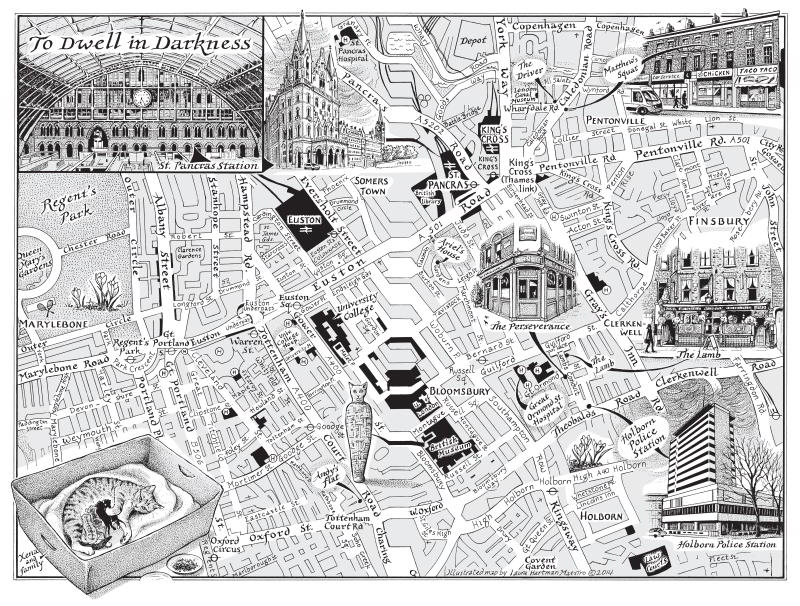
Ms. Crombie does her research and always chooses a lesser-known London area site to center her mysteries – in this case, St. Pancras train station. As a special treat, the hard copy books include hand-illustrated maps of said location. Here’s a sample – click to view larger.
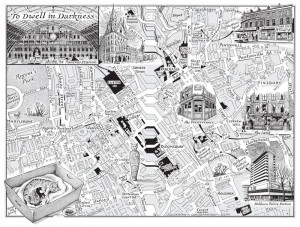
St. Pancras is the setting for a very current and news-worthy event – a public bombing…and the perpetrators aren’t who they seem. Duncan Kincaid has been demoted from his high-powered post with Scotland Yard and transferred to Holburn. D.I. Gemma Jones is investigating the kidnapping, rape and murder of a 12 year old girl. Melody Talbot plays a key role in this case, while jugging a new relationship, and there are kittens!
Sounds like a mess, but as in all Ms. Crombie’s novels the pacing is superb, while she builds tension yet gives us breaks with glimpses into the loving family of Duncan and Gemma. Their relationship continues to delight and I just adore the descriptions of their home life – so chaotic (did I mention a litter of abandoned kittens?) yet warm.
In the previous installment(Sound of Broken Glass) we were left hanging on why Duncan was demoted and transferred — this installment does not resolve that or even shed any light on that question. That’s twice now, where I’ve turned the last page/last chapter only to face the “about the author” blurb…totally surprised there wasn’t more .
I fear Ms. Crombie may be using the television series trick – stringing us along to her next new book — but that’s alright with me. I’ll go anywhere she wants to take me.
-
Three Things you Need to Know About Rockets by Jessica A. Fox

Jessica Fox was living in Hollywood, an ambitious 26-year-old film-maker with a high-stress job at NASA. Working late one night, craving another life, she was seized by a moment of inspiration and tapped “second hand bookshop Scotland” into Google. She clicked the first link she saw.
A month later, she arrived 2,000 miles across the Atlantic in Wigtown, on the west coast of Scotland, and knocked on the door of the bookshop she would be living in for the next month .
This book had me from the above back cover copy. Could it be because it takes place in a bookstore or because I spent time in Scotland during college and still have a soft spot for its enchantment or a certain young Scotsman? Nonetheless, this memoir is a fun, escapist read…and you’ve got to admire a writer who dares bring such a title to a publisher.
It takes awhile for the story to take off (i.e. going to Scotland), but the background of L.A., NASA, and film writing was interesting. Her melt-down and eventual lay off were nicely developed. But I was finally glued to the book once Jessica is actually in Scotland, working at the bookstore and experiencing much of what I did – deciphering the accents, dealing with “American” stereotypical reactions, experiencing the gorgeous countryside and getting to know and understand the hard to get to know and understand people.
Jessica’s voice starts out a bit youngish — after all she is in her twenties, but at times she seemed adolescent in her actions and thoughts. Her boyfriend Euan is a whiny, wimpy – dare I say – nutso boyfriend, whom I would have dumped, fast. But Jessica forges ahead with trying to make the relationship work – despite his passive-aggressive behavior. I found myself rooting for her while also secretly hoping she tells him off and slams the door behind her. It’s a slow delight, to watch her mature during her time in Scotland, her reactions to things, her voice, her moods all grow and enlarge as the book progresses. That’s a real challenge in memoir writing — to realistically reflect one’s own voice expanding and growing.
I underlined some great sentences: ” Grant’s house was something he was constantly working at but never quite completing — like Sisyphus attempting DIY”; “You’re so American, always wanting to talk about feelings”; “(Outings) reminded me of childhood where outings, no matter where or with whom, were filled with possibility and opportunity for excitement.”.
A small joy — each chapter starts with a quote from a book and its location in the Wigtown bookstore – (aptly named “The Bookshop”).
In the end nothing is totally resolved – except she is staying in Scotland. An enjoyable memoir whose storyline interested me on many levels – her NASA career, adapting to Scotland, the used bookstore, the town, and of course the story of her relationships with not only her crazy boyfriend, but also the quiet and hard-working locals. I also enjoyed the very realistic glimpse into rural Scotland and the used book business in Wigtown.
-
“Doorways to Wonder”
This will make you smile. About the magic of reading and imagination…
-
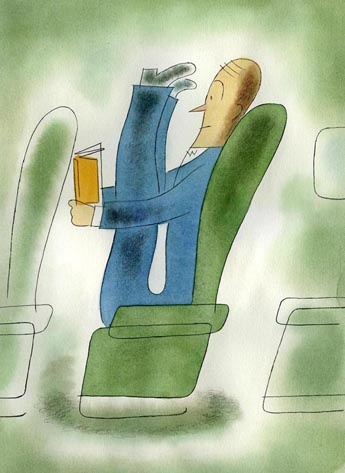
So true — ha!
“Reading on the plane” by Marc Rosenthal
-
The Book of You by Claire Kendal
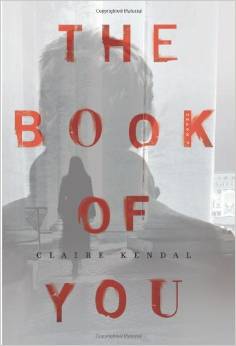
His name is Rafe, and he is everywhere Clarissa turns. What could have been a formula stalker thriller, is luckily so much more. It’s a creepy, often graphic read, and with my husband out of town, I checked the door was locked and read with several lights on in the house.
Clarissa, as the main character, develops as the book progresses. She hides, cowers and seems vulnerable, but the reader will cheer the bravery in her relentless gathering of evidence against Rafe. Upon police advice, she keeps a small journal “The Book of You” detailing every stalking move Rafe makes. And while repulsed, she also keeps all his “gifts” and lurid photos – all in the hopes of gathering enough evidence to have him arrested. The story is told interspersed between her journal entries and current time.
The stalking soon becomes part of her everyday as she attends jury duty, meets another man and tries to carry on a normal life. She keeps Rafe’s stalking, her journal and her fear a secret from everyone – adding to the suspense of the book.
Most compelling was how the author, little by little, lets the reader fall into the mind and feelings of a stalking victim, how they try and maintain normalcy, how their lives are turned into a mine field of psychological terror, and how even the simple things that brought them joy (Clarissa’s sewing) can be made dirty. This is what sets this debut thriller apart from the standard. The ending was so good, I raced through the last few chapters and then the next morning re-read them to savor the twists of the plotting.
In several instances the narrative breaks down and defies logic, and the dialogue can be stilted and poorly crafted – especially from the neighbor lady — “You think I’m just a sweet old lady, Clarissa, a kindly spinster who knows nothing and has experienced nothing….” arghhh.
But those two minor critiques did not stop me from devouring this chilling read and it still lingers in my mind.
Advanced Reading Copy provided by Harper Collins
-
We Are All Completely Beside Ourselves by Karen Joy Fowler
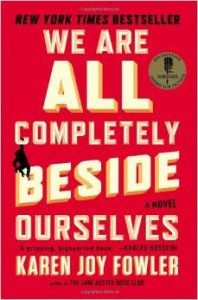
I’d been hearing the raving reviews of this novel, and so was thrilled to receive an Netgalley review copy. I started the novel and was immediately bogged down. The novel begins in the center of the story and through flashbacks the secrets are revealed. I stuck with it and learning the (not-so-secret) surprise that our narrator Rosemary was raised with a “sister” Fern who happened to be a chimp and disappeared when Rosemary was five years old.
This reveal turned out to be the most interesting part of the novel
Now I was intrigued but still having trouble slogging through the flashbacks, and overly complex story lines.
I get that this unusual chimp fostering experiment had a long armed impact on various members of the family — especially Rosemary and often the writing is magical, funny and warm — but I could not finish this book.
I had trouble relating to any of the characters and found the this ever-churning tale of family loss, coming of age, and animal abuse extremely sad. Beware — the last part of the book involves gut-wrenching and sickening animal experiments and that is where I stopped reading.
Review copy provided by Penguin Group via NetGalley.