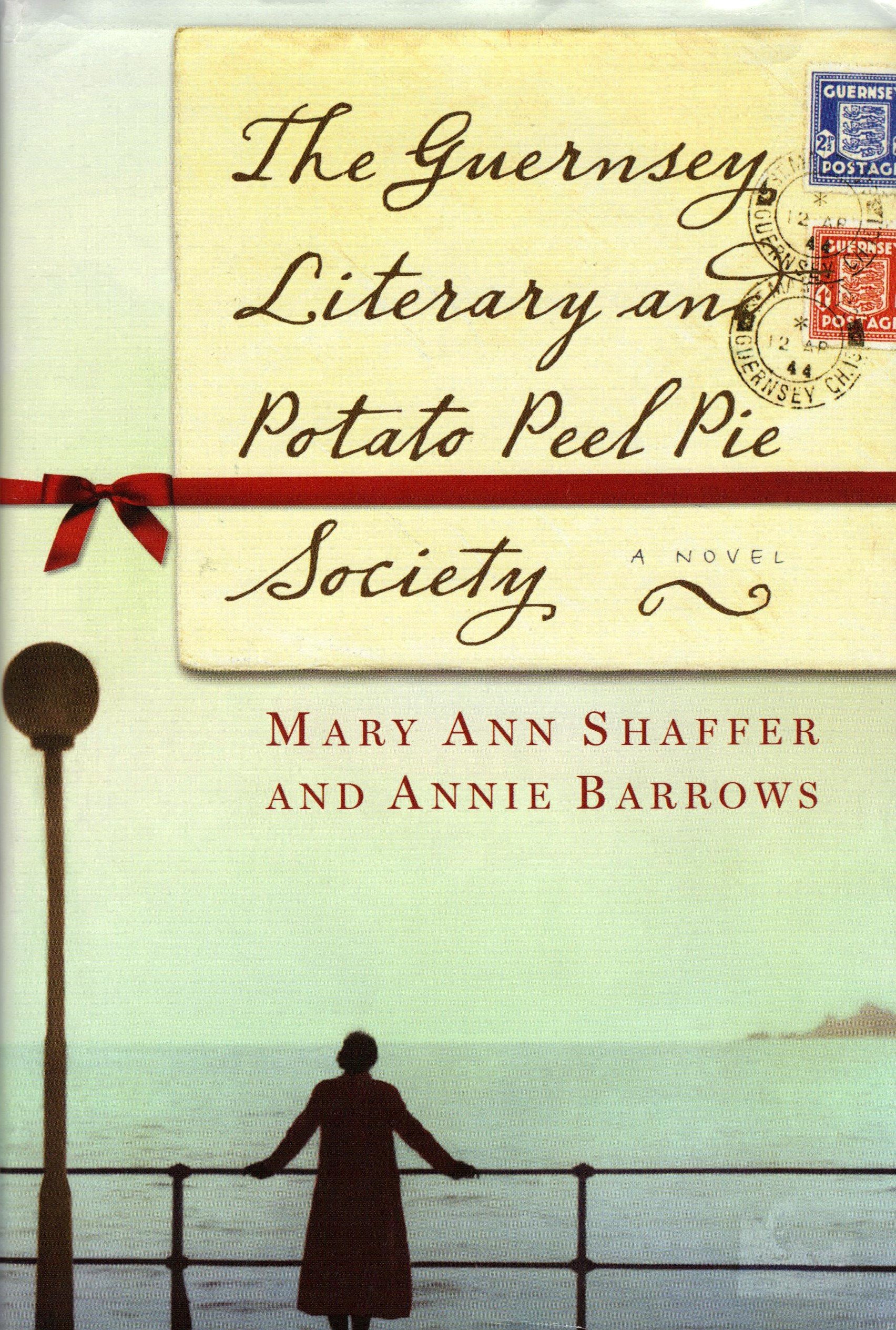
The Guernsey Literary & Potato Peel Pie Society

The Guernsey Literary & Potato Peel Pie Society

by Mary Ann Shaffer and Annie Barrows

There are beloved books I keep on my shelves just to re-read and The Guernsey Literary & Potato Peel Pie Society is just such a book.  Netflix is releasing a film based on the book, so last night I reached for my copy to read — yet again.

This morning, I woke with the realization I’d never talked about this epistolary novel here on Book Barmy.  By now, I’m sure you have already read this bestseller.   But just in case, let me tell about about this this little gem just to tempt you into reading it (or re-reading) before the film debuts.

Mary Ann Shaffer spent years doing background research for The Guernsey Literary & Potato Peel Pie Society but sadly passed away just after the first draft manuscript went to the publishers.  Her daughter, Annie Barrows, an author herself, completed the final editing.

Juliet Ashton, is a 32-year-old author and survivor of WWII London. She’s struggling to find a subject for her next book when she receives a letter from a stranger on isle of Guernsey which was occupied by the Germans during the war.  Mr. Dawsey Adams tells that a used book by Charles Lamb called `Selected Essays of Elia’, kept him sane during the war.  Turns out this tattered volume was once owned by Juliet and her address was written in the jacket cover.  (Only in a book lovers world would this not be considered stalking.) 

He goes on to tell her that the residents of Guernsey — namely the members of  The Guernsey Literary and Potato Peel Pie Society — are starved for books and could Juliet help him find other books on Charles Lamb.

Thus begins this wonderful story and a correspondence which grows to include a number of characters who lived through the German occupation and were all, for the most part, members of the Guernsey Literary and Potato Peel Pie Society (I’ll let you discover the origins of the intriguing title).  The society includes pig farmers to phrenologists (you learn more about Phrenology in your reading)  — all literature lovers who outsmart the Germans.   The letters are witty, poignant, and for this reader, eye-opening.  Although it’s probably common knowledge to most (especially those in the UK), somehow I never knew Guernsey was occupied during the war.

Although the subject matter is serious — the Nazi occupation of Guernsey and the resulting cruelty inflicted on the residents of the beautiful island — (here’s where the author’s in-depth research shines*)— the manner in which the story is told endears the reader to each and every character.

So if you haven’t yet read The Guernsey Literary and Potato Peel Pie Society, get yourself a copy by hook or crook, because I agree with Juliet Ashton’s prediction:

There is some secret sort of homing instinct in books that brings them to their perfect readers.

The film starts airing on Netflix in early August. I’ll give it a try, but it looks like it might be a bit overly-romantic — trust me the book is much more — much richer.    Film trailer HERE


*I gave a copy to a friend who was a child in Germany during WWII, and she said the bulk of the book rang true, however some of the German marching scenes were not technically correct — something about inappropriate goose-stepping.

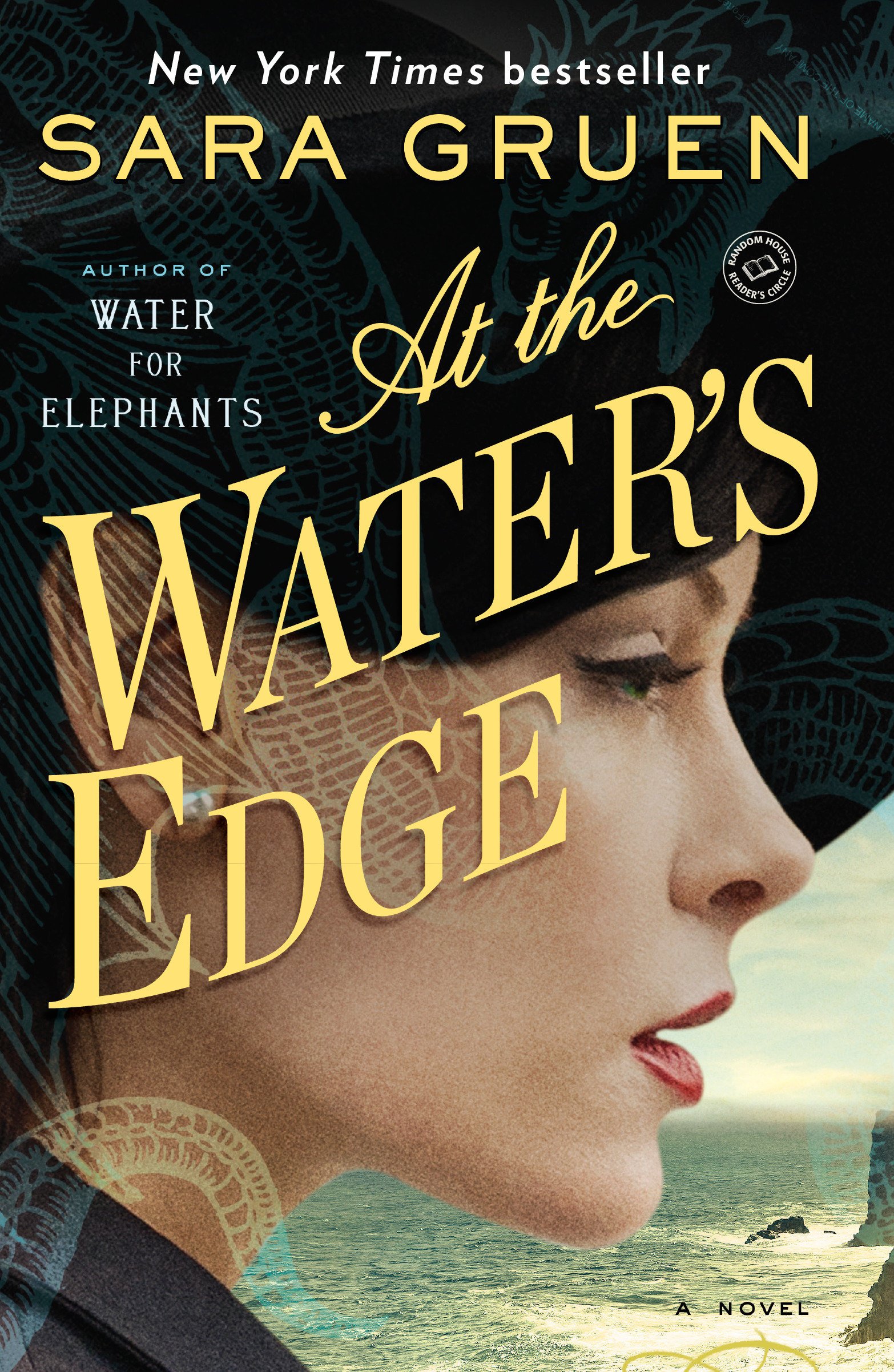
At the Water’s Edge by Sara Gruen

How do I decide which books to take on holiday? My requirements:  They must be an easy read, yet intelligent enough to hold my interest when I’m sure to be reading in fits and starts.  I read At the Water’s Edge while galloping across Central Europe and it fit the bill beautifully.

From the blurb:

After disgracing themselves at a high society New Year’s Eve party in Philadelphia in 1944, Madeline Hyde and her husband, Ellis, are cut off financially by his father, a former army colonel who is already ashamed of his son’s inability to serve in the war. When Ellis and his best friend, Hank, decide that the only way to regain the Colonel’s favor is to succeed where the Colonel very publicly failed—by hunting down the famous Loch Ness monster—Maddie reluctantly follows them across the Atlantic, leaving her sheltered world behind.

WWII is raging and yet this unlikely trio arranges passage across the Atlantic sailing through U-boats to a small Scottish village on the shores of Loch Ness.  The only inn falls far below their usual standards, there is no electricity at night, there are severe food shortages, and rations on what little food is available. 

Ellis and Hank are unwilling to adapt to the war-time conditions, expecting room cleaning, laundry service, and extravagant meals after their outings attempting to photograph the Loch Ness Monster.

Maddie, happily left behind during the men’s outings, starts to become friendly with the two young women who work in the inn and begins to see beyond her wealthy Philadelphia background.  Maddie soon dons an apron and helps out around the inn, grows even fonder of her new friends — and especially the rugged Scotsman inn manager.

Meanwhile, our hapless American males grow even more obnoxious as they set out to interview locals who have reportedly seen “Nessie”.  The villagers are having none of these monster seekers. They have no interest in helping out, so tell conflicting stories and give wildly inaccurate locations.  As Ellis and Hank continue to fail in their quest, they drink excessively, stay out for days, and there are repercussions, not only to the marriage and their friendship– but throughout the village.  Maddie grew on me, just as she did with the Scottish villagers. And the range of village characters were well drawn and unique.

This novel isn’t just about a Scottish village or searching for the Loch Ness Monster — there’s a hint of murder, a haunted castle, ghosts, a war story, superstitions, abuse and romance– and in the end — good versus evil.

I’ll admit there were some downright silly elements to the book. Normally I would roll my eyes but for some reason I was able to forgive them in this story.  (See above — requirements for books when I travel.)

While the ending is a bit predictable, and sometimes the characters were either a bit all-too-good or all-bad, but this historical romance was a fun read with a beautiful setting and compelling story line.

Good vacation reading.


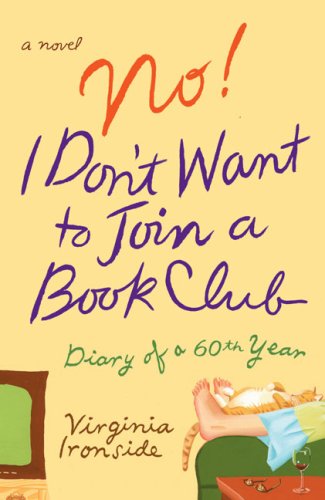
No! I Don’t Want to Join a Book Club by Virginia Ironside

A joke birthday gift from a friend, No! I Don’t Want to Join a Book Club languished on my shelf for several years now.  I plucked it out the other evening, needing a break from a serious read.

Virginia Ironside is a British humor writer well known for her writings about getting older.   She’s also an agony aunt (British for advice columnist) with a column in the Independent, and once had a one-woman show,’Growing Old Disgracefully’.

In this novel/fictionalized diary, Marie has just turned sixty and decides to chronicle her life. Often funny, sometimes a bit sad, and usually snarky, this book has a cover blurb that calls it an AARP-issued ‘Bridget Jones Diary’.  

She has a curmudgeonly outlook on growing old gracefully,

~~ or not:

The thing is: I don’t want to join a book group to keep young and stimulated.  I don’t want to be young and stimulated anymore.

I’ve done fascinated, I’ve done curious.  I want to wind down,  I want to have the blissful relief of not being interested.  Like being able to spend a day doing nothing instead of being obliged to cram it with diversionary activity to avoid guilt and anxiety.

Ms. Ironside uses the diary format to up the humor.  She calls memory lapses CRAFT moments  —  as in ‘can’t remember a f***ing thing’.  She journals about a party discussion wherein no one can remember an actress’s name from a famous film.   Then two days later, this appears as the single entry, ‘Glenn Close’.

Here she argues with a friend, who talks about getting older as a time to have adventures and learn new things:  Marie just wants to put her feet up and ‘start doing old things’.

That’s what’s so great about getting old. You no longer have to think about going to university, or go bungee jumping. It’s a huge release! I’ve been feeling guilty about not learning another language for most of my adult life. At last I find that now, being old, I don’t have to! There aren’t enough years left to speak it. It’d be pointless!

Marie’s life is constantly changing and evolving, there’s the arrival of a grandson, and the loss of some dear friends.   And, although she hasn’t had sex in five years, she doesn’t lose sleep over it. She’s thinking of giving it up – unless a nice, rich and attractive crush from her childhood can change her mind.

This novel is an honest look at life as we age and, at times, I found it both touching and humorous.

However, half way through, the journal format starts to loose it’s charm and her continued grumpy treatises on the same points became tiresome.

Ms. Ironside has much more to say about being old (sorry, older) as there are two other books the Marie series all with equally funny titles:  No I Don’t Need Reading Glasses and No Thanks, I’m Quite Happy Standing.

The title cracked me up, but sadly No! I Don’t Want to Join a Bookclub got put aside unfinished.  Marie (and the author) would be OK with that, she would understand and give me a high five — it’s our age –we don’t have to finish a book or go bungee jumping.


N.B.:  While we’re on the subject of humorous essays on aging, I found Nora Ephron’s “I Feel Bad About my Neck” and “I Remember Nothing” ever so much better, and well worth whatever free time you have when not learning Swahili.

A Lowcountry Heart by Pat Conroy

Have I told your about Pat Conroy?  I’m a card-carrying adoring fan. 

Mr. Conroy wrote books unlike anyone else, he was a magician storyteller and wove tales that explored the many layers of human nature. Fearless in his writing, his perfect wording could give any character or life event a voice — the frail families of the old South, uncertain love, the angst of loyal and betrayed friendship, the pain of suicide, and the infinity of human flaws  — really, just awe-inspiring.

Cancer took him quickly in 2016, at age 70.

A Lowcountry Heart is a collection of his blog entries, articles, speeches and letters but also contains writings and eulogies by those that loved him.  But fear not, this slender volume never treads into the saccharine, but instead is a joyful reflection of his life and times. Mr. Conroy shares his time in Vietnam, teachers in his life, his beloved Citadel, his adored second wife, and of course his love for the South Carolina lowcountry –the lifeblood of his books and his life.

When his publishers advised him that he should start a blog, Mr. Conroy hated the idea but then took it as a challenge. He used it as both a journal and a way to reach out to his readers. His blog posts always began with “Hey out there,” and closed with “Great love…”.

Unlike many authors Mr. Conroy loved book tours and especially meeting with his readers.

It (book tours) is part of the covenant I sign with Doubleday that I’ll do everything possible to help the sell the book, including not getting drunk on tour or embarrassing my publishing company with my cutting-up on the road. I go out to sell books and it has become one of the greatest things about being a writer during my lifetime. No writer should turn down the chance of meeting the readers of his work.

His book signings often went late into the night because he wanted to speak personally, and at length, with each reader. They opened up to Mr. Conroy because he asked, “so, what’s your story?”.  (I wonder what story I would’ve told…)

Mr. Conroy could have easily been a Southern ‘good old boy’, but it turns out he was a role model of humanity and progressiveness.  He actively supported racial equality, even having a public meeting with Dr. Martin Luther King at a time when race was still a heated issue in southern society.  On learning that a stranger and fellow southerner was dying of AIDS, Conroy went to be at his side so he wouldn’t die alone. Once, accidentally in a gay bar, he danced with a man because his mother raised him not to hurt anyone’s feelings.

His wife and fellow author, Cassandra King  wrote the introduction to A Lowcountry Heart — a beautiful piece of writing I read several times.

The book also contains his 2001 Citadel commencement speech — I’ll just say, I found myself trying to read it through my tears.

Mr. Conroy is likely best known for his books (and the films based on his books);  The Lords of Discipline, The Prince of Tides and  The Great Santini. 

But instead, get thee to your favorite library or bookstore read my favorites; The River is Wide, Beach Music, and South of Broad. 

I’ll leave you with this, perhaps the most compelling part of this collection; Mr. Conroy is buried on a small island off the coast of South Carolina , in a modest cemetery of a Gullah Baptist church among a community that “graciously allowed a non-Baptist, non-African American writer to rest among them.”


A digital review copy was kindly provided by Doubleday Books/Nan A. Talese via NetGalley

A Picture is Worth a Thousand Words

I’ve been gathering some picture books to tell you about all at once. This winter, I enjoyed these visually enchanting escapes which took me from the streets of New York, to France, and even wartime England.


Intrigued? 


Well, grab a beverage of choice and sit right down next to me and let’s look at them together.

~~~~~~~~~~~~~~~~~~~~~~~~~~~~~~~~~~~~~~~~~~~~~~~~~~

Going Into Town

A Love Letter to New York

by Roz Chast

When Ms. Chast’s daughter was preparing to move to Manhattan for college, Ms. Chast wrote up a tongue-in-cheek guide book with tips for suburbanites navigating the city. This little booklet turned into Going Into Town: A Love Letter to New York which is a cartoon book about all the things Ms. Chast appreciates — or doesn’t— in the city she loves.

I love Ms. Chast’s work and always chuckle at her cartoons in the New Yorker magazine, on greeting cards, or her books. Remember THIS?

This book is a collection of  stories and visuals — the “overheard and the overseen”, on the streets of New York — and Ms. Chast is her usual funny and cynical self.

She starts with a brief background on how she and her family moved out of the city to the suburbs for the better schools and the chance to have actual trees.  But the downside was that her daughter had no city skills when venturing to university in the city.

There’s an introduction to the geography of Manhattan

Diners are all but extinct, hawks aren’t, Uber cars outnumber taxis, and in GENERAL:
3 blocks = 1 avenue
20 blocks/7 avenues = 1 mile
even streets run east, odd run west, crosstown run east-west

Going Into Town then goes on to describe the people you’ll encounter, with special warnings about the tourists…

It is evident throughout the book that poor Ms. Chast greatly misses living in the city.  There’s a section on the things to do from the obvious Broadway musicals and gallery openings to the more obscure — “best hat on a dog contest”.  She advocates looking — really looking  — as you walk around — freshly seen through her quirky visual lens.


While Ms. Chast may have wanted to give her daughter a straightforward guide to the city, she can’t help herself and interrupts the narrative with delightful digressions about such things as the quirky stores that sell nothing but ribbon or enticing off-brand lipstick.

or the city’s great variety of standpipes,

As the title says, this is Ms. Chast’s very own love story to New York:

I feel about Manhattan the way I feel about a book, a TV series, a movie, a play, an artist, a song, a food, a whatever that I love. I want to tell you about it so that maybe you will love it, too. I’m not worried about it being ‘ruined’ by too many people ‘discovering’ it. Manhattan’s been ruined since 1626 , when Peter Minuit bought it from Native Americans for $24.00.

And, if like me, you’re stuck on the opposite coast – you’ll have a hankering to follow the author’s advice:

One of the greatest things you can do in life is walk around New York


~~~~~~~~~~~~~~~~~~~~~~~~~~~~~~~~~~~~~~~~~~~~~~~~~~

France is a Feast

A Photographic Journey of Paul and Julia Child

by Alex Prud’ Homme & Katied Pratt


From the coauthor of My Life in France, this volume is a collection of the photographs taken by Paul Child during his and Julia Child’s years in France.

This is a sometimes fascinating look at the lesser-known Paul Child, who in fact, was a talented artist, photographer, painter, lithographer, woodworker, metalsmith, stained glass expert, writer and poet.

Here’s just a sample of his fine photographic eye:

But Paul also delighted in photographing Julia:

She[Julia] was ten years younger than Paul, and not well known at the time, but she was a sunny, questing, powerful personality who had a profound impact on her husband’s evolution.  He adored her and photographed her constantly; without realizing it at the time, he was chronicling her rise from a fumbling know-nothing in the kitchen to an accomplished cook and author, and America’s first celebrity TV chef.


Because of my slight obsession with Julia Child, I found myself lingering on those iconic photos:

My Life In France was one of my favorite books about Julia and Paul’s life in France and I had high hopes for this photographic essay.  However, their relationship is sketched over and the often pedantic writing is focused on Paul Child, his career and interests. The final pages are devoted to the Child’s move back to Cambridge and Paul’s decline which Julia handled with courage and grace.  Don’t get me wrong, I wanted to know more about Paul Child but I often lost interest. Perhaps he will always remain in Julia’s shadow.

The photographs are fascinating and France is a Feast for the eyes, but alas, not the writing.

~~~~~~~~~~~~~~~~~~~~~~~~~~~~~~~~~~~~~~~~~~~~~~~~

A Fine Romance

Falling in love with the English Countryside

by Susan Branch

A friend gave me an Amazon gift card for Christmas and I quickly ordered A Fine Romance.  I had longingly thumbed through this beautiful book in a little bookstore ages ago and added to my list of “someday books”.  Well, this past January was that someday.

This is not a travel guide, there is no agenda here other than to entertain and delight the reader  A Fine Romance is a hand-written, illustrated chronicle of Ms. Branch’s visit to England with her husband.  I lingered over almost every page — each watercolor is a tiny jewel — all interspersed with photographs, her reflections and observations

Here I’ll show you:


I read bits of this book each morning (with the obligatory cup of tea) in order to slowly savor the experience of going along as they roam the English countryside.

The book opens with the story of how the divorced Ms. Branch met Joe, which proved a bit tedious as well as, well, creepy.  Here’s the creepy bit; on one of their first dates, she asked for two hotel rooms but behind her back he reserves only one. She’s surprised,unsure but just goes along with it. (Say what? Ever heard of respect for boundaries?)

This little niggle in no way detracts from the charm of the book (I just had to make that comment).

Apparently Ms. Branch has a huge following and has an impressive website with recipes, events and merchandise which sports her watercolors on everything from calendars to party favors.  A bit over the top for my taste, but take a look HERE to see what you think.  She also has a BLOG which I enjoy, especially the travel entries, just to admire their elegant travel style — always accompanied by a great deal of luggage.

A Fine Romance is not only for Anglophiles, but for anyone who likes pretty villages, cozy cups of tea, and beautiful gardens.  Part travelogue, part diary, part sketchbook, part personal scrapbook —  A Fine Romance is just wonderful.

~~~~~~~~~~~~~~~~~~~~~~~~~~~~~~~~~~~~~~~~~~~~~~~~~~


The War Brides Scrapbook

by Caroline Preston


I loved Ms. Preston’s previous novel, The Scrapbook of Frankie Pratt ,a gift from my sister.  So I had to purchase another “someday” book — her newest scrapbook novel, The War Bride’s Scrapbook.

It is 1941 and Lila has graduated from Sweet Briar without the two things her mother expected; making connections with moneyed friends and a rich fiancee.  Instead she came home with a magna cum laude and an art degree. Her true passion is architecture, but there’s little opportunity for women in the field.  She goes to work instead for her father’s insurance business.  She meets and falls hard for enlisted soldier Perry Weld and, after a three week whirlwind romance and marriage, he has shipped out.

Following the advice in a woman’s magazine,

Lila starts a ‘War Bride’s Scrapbook’ in which she chronicles their two-year separation — through their letters, but also tickets, menus, food labels, and newspaper articles.

This ‘story in pictures’ is told through this scrapbook device, as we get to know the characters and their experiences both at home and in war-time Europe. 

Just take a look at this visual and literary feast.

Lila matures into a strong independent woman who eventually gets accepted into the male-dominated Harvard architecture school and onto a career of her own.

Ms. Preston uses this scrapbook to give us a insight into the issues of the time — the changing roles and societal expectations for women, PTSD, the atomic bomb, and even the Japanese American imprisonment.

Many of the visuals are from Ms. Preston’s own collection of vintage scrapbooks and ephemera, but she also did a fair share of research and borrowed items from other artifact collectors.

The War Brides Scrapbook brims with vivid characters and a brilliantly laid-out collection of WWII-era ephemera.

~~~~~~~~~~~~~~~~~~~~~~~~~~~~~~~~~~~~~~~~~~~~~~~~~~~

Whew, congratulations  you made it through this long post.  So now, we’ll have to return to the real world of grown-up books -most, sadly without pictures.

Italian Fever by Valerie Martin

Back in January, I tended my yearly ritual of cleaning out my books.  Not a task for the faint of heart, as it involves days of books stacked on the floors of various rooms, books teetering off my bedside table, and overflowing bags destined for donation to the library.  I always end up with a pile of books on probation ~~ books I want to peruse a bit before deciding their fate.

Italian Fever made its way into this probation pile and I don’t remember where I got it, but I did remember why.  It reminded of some of my favorite novels that transported me to the warm and beautiful Italian countryside – Summer’s Lease by John Mortimer, The Enchanted April, and of course, A Room With a View.

So one rainy night, I opened Italian Fever to determine its destiny.  While the novel wasn’t up to the caliber of the fore-mentioned novels, it did hold my interest and did envelope me in the atmosphere of the hot, sunny Tuscan countryside.

Our main character is Lucy, who is a New York based assistant to the famous US novelist, now based in Italy.   She harbors a deep resentment of DV’s success, despite his mediocre writing,  but her role has always been to coddle him along to finished manuscripts.  However, as we learn in the prologue, DV has died while walking at night and Lucy is sent to Italy to settle his affairs — including retrieving his latest potential blockbuster manuscript.

When viewing the photos of his body, Lucy notes signs that he may have been beaten to death.   Near his house in Tuscany she encounters a faintly sinister family of aristocrats: the elegant Antonio, his mother, his fiery but elderly father. Lucy seeks evidence of their involvement in DV’s death and the disappearance of his lover Catherine.  The local police are typically holding something back and not aiding in any further investigations.

At first, I thought Ms. Martin was giving us a typical amateur sleuth solving a crime in a foreign land — but no, not really.  There are surprising, but sometimes flimsy tangents in Italian Fever –as it twists from a mystery, into the Gothic, turns romantic adventure, with a bit of art history and, finally, a underlying ghost story.

The setting provides a beautiful backdrop to this unconventional story line, and for a few hours on that rainy night I was vicariously driving round the Tuscan countryside, window shopping in Rome, and gazing at Piero della Francesca’s fresco, The Resurrection.

Lucy winds up getting ill and the descriptions of being sick in a foreign country are some of the best passages in the novel. Her fever brings on bad dreams and disorientation which leads her to believe she is hearing ghosts and crimes being plotted.

Upon her recovery, Lucy, who has a sharp sense of humor, but lousy taste in men, allows herself to be taken in by the cliched Italian lover, Massimo — ignoring the much finer Antonio Cini.  There’s some hot romance and a stereotypical break up.

Much more is discovered about DV, his death, the missing manuscript, Catherine —  and I kept expecting a thrilling climax but alas, it did not transpire.  Having traveled along the many twisty roads of the plot, I didn’t find any depth of drama or suspense. 

As I turned the last page of Italian Fever, I decided that, yes, for a few house, I’d taken a pleasant journey to Italy with some beautiful sights, met some interesting characters, but nothing really memorable happened.


Once I stole a book…

It’s Throwback Thursday, when I rave about a book I read years ago.


The Known World

by Edward P. Jones

Once dear readers, I accidentally stole a book.  Stuck in an airport in 2004, I was of course browsing in the book store, magazine in one hand, this hefty paperback in the other.  I panicked when my long delayed flight was suddenly announced and quickly paid the cashier for the magazine, both of us oblivious to the book under my arm.  As I galloped to the gate, I mindlessly tossed the book in my bag.  Once I got on the plane, and looked at my receipt I realized the error of my ways.  I tempered my guilt by recounting the money I’d spent at this book chain (they have since gone out of business, probably due to thievery like mine). 

Turns out this lucre kept me fascinated for the entire cross country flight.  I barely looked up when the food was served. (Just imagine, once even coach passengers were served a meal on cross country plane trips.)

This Pulitzer Prize winning novel centers on a family of free blacks who run a plantation in pre-Civil War Virginia.  The Southern slave culture was so deeply embedded, that it was not considered odd (or even ironic) when freed blacks became slave holders themselves;  a little know part of American history.

Henry Townsend is a young black man living in Virginia 20 years before the Civil War — a free son of parents who were freed slaves. His father, a skilled woodworker, holds strong convictions regarding the evils of slavery.  But Henry grows up to idolize a white plantation owner and the most powerful slave-owner in the county. Much to his father’s horror, Henry purchases his own plantation and keeps black slaves.  When Henry dies unexpectedly, his widow Caldonia struggles to hang on to his legacy, but things start to unravel as the plantation slaves start to break the bonds of their servitude.

These slaves (like some others of the time) were able to buy their freedom by working in off-the-plantation enterprises such as builders, artisans, and agronomists which allowed them to earn cash. They could then pay for their own freedom as well as the price demanded for their wives and children (at full market value no less) .

The Known World is unique and some thought it a difficult read.  The novel is not chronological, but follows thematic arcs, often going back and forth in time and recounting different versions of the story line.   I didn’t find it confusing — I enjoyed being told a riveting story from several different points of view.  Mr. Jones has provided a handy list of the numerous characters in the back of the book, but I never needed it. Somehow each of the many characters are richly rendered and fleshed out.  Each character had a fine-tuned personality and it was easy to keep them separate, as I got to know each so well.

 “The Known World” is an apt title, as it represents the limiting life of a few plantations which comprised the entire world for the slaves. One master may sell a slave to a nearby neighbor; another one is freed and moves in close proximity to his former master, so that their universe rarely grew larger. Even traveling on an errand from one neighbor to another, or from the plantation to town, required the written permission of the owner. 

I can understand why Mr. Jones won the Pulitzer for this novel.  His ear for dialog, eye for detail and command of the language was a joy to this reader, against the bleak backdrop of slavery and the grim ways in which power/greed so easily corrupt.

I highly recommend The Known World, filled with rich stories and a sense of place so real, so honest – you’ll find it difficult to believe you’re reading fiction.

A copy of this novel was unknowingly provided by a large anonymous book chain, which has since gone out of business.

A Wrinkle in Time by Madeleine L’Engle

When I was growing up in the suburbs of Washington D.C. I was allowed to go to my neighborhood library on my own ~~ an often needed escape from my younger siblings.  I adored the Aspen Hill Library and would wander the shelves, library card itching in my pocket.

I often visited the popular YA (young adult) shelves, but never really understood the appeal coming from home with Little Women, Black Beauty and Little House on the Prairie at my disposal.  I tried and dismissed Judy Blume, V. C. Andrews, and the insipid Beverly Cleary series (see I was a critic even back then).

But there was one YA book I checked out over and over again.

A Wrinkle in Time by Madeleine L’Engle opens with the classic line…

It was a dark and stormy night…

Published in 1962, this Newbery Medal classic is part science fiction, part time travel tale and I was mesmerized.  I could easily relate to Meg who doesn’t fit in at school and going through an awkward stage with unruly hair and braces.

Meg’s father has disappeared during a scientific trip and she, her little brother, and family friend Calvin are whisked away to find him.  Three strange women with mysterious talents help them follow their quest – Mrs. Which, Mrs. Who and Mrs. Whatsit. And the reader is off on an adventure like no other.

Back in the 60’s, as I read this book over and over again, the appeal was not only the riveting story, but the intelligent way it spoke to young readers — with quotes from Latin, complicated mathematical and scientific theories — but also the respect and self-confidence it gave girls (and boys).  Meg is shown how to be herself and reassured that it is a good thing to be different from anyone else.  She is called upon to be brave beyond her wildest dreams, survive different species, experience new cultures, and use her brain to overcome obstacles.  In other words — everything I wanted to be and do.

Ms. L’Engle wrote A Wrinkle in Time in the shadow of the cold war and upon re-reading this wonderful story, I now see the obvious references that mirror the 1960’s fear of communism — over my head at age 10.

A Wrinkle in Time has been made into a Disney film which opens today.  It stars Reese Witherspoon, Oprah Winfrey and other big names.  It might actually be good, and now that I’ve just re-read the book, I can give myself permission to go see it.

If you haven’t read A Wrinkle in Time lately, I suggest you re-read it.

If you’re like me you’ll not only enjoy the adventure once again — but have a new admiration for how it influenced young readers to be bold, fearless, but mostly to have confidence in always being themselves.

Film Trailer HERE

How to Stop Time by Matt Haig

What, you say? Not another time travel novel here at Book Barmy?

Maybe or maybe not – stick with me here, this one is different.

In How to Stop Time, Mr. Haig has conjured up a unique spin on the typical time travel novel — namely a tale centered around the ability (or curse) to live a very, very long time.

Tom Hazard, (full name Estienne Thomas Ambroise Christophe Hazard) was born in 1599 and suffers from a rare genetic condition that makes him age very slowly.  He has been alive for the last 400 or more years.  The book opens with this wonderful first line:

I am old. That is the first thing to tell you. The thing you are least likely to believe.

Over the centuries, Tom has lived many lives and because of his longevity, many of those lives were filled with love, but also heartbreak and loss.

On the positive side Tom got to work at the Globe Theatre with William Shakespeare, rubbed elbows with F. Scott Fitzgerald, and sailed with Captain Cook, all while avoiding anyone who grows suspicious of his glacial aging process.

Tom is recruited into the Albatross Society which pledges to protect people with his disease.  The only stipulation is that he has to change lives every eight years and he is given this warning:

 “The first rule is that you don’t fall in love,” he said… “There are other rules too, but that is the main one. No falling in love. No staying in love. No daydreaming of love. If you stick to this you will just about be okay”.

In an effort to make up for the no love rule, Tom is reassured:

“You are, of course, allowed to love food and music and champagne and rare sunny afternoons in October. You can love the sight of waterfalls and the smell of old books, but the love of people is off limits.”

But all Tom wants is to live a normal life and find his long lost daughter who also suffers from the same genetic condition.  When the book opens, Tom has settled into teaching at a London high school, and of course he chooses to teach history, because:

It [history] isn’t something you need to bring alive, because it already is alive. Everything we say, do and see is only because of what has gone before.

He adopts a dog and finds himself attracted to the French teacher Camille, but he must resist because of the society rules.  Soon it is time to take on another persona, and move on to yet another life and another adventure.

That’s all the plot I’ll give away from this engrossing tale.

Mr. Haig transports the reader back and forth in history. But, he doesn’t beautify — instead he unveils the filthy, muddy, smelly reality of earlier times.  We see Shakespeare writing his beautiful works against the backdrop of crime, bigotry and disease.  Tom plays the lute in the marketplace right beside animal filth.  Everyone drinks ale, because the water might kill you.

For me the most interesting part of How to Stop Time, was the irrationality of the human experience. People throughout history have always hurt others, made stupid mistakes, been egocentric, and continue to do so — over and over and over again. And important note, we haven’t become wiser over time:

The lesson is that ignorance and superstition are things that can rise up, inside almost anyone, at any moment. And what starts as a doubt in a mind can swiftly become an act in the world.

Which brings one to ponder long after the last page.  How would you live — how would you act —  and mostly how would you feel —  knowing you could live almost forever?

How to Stop Time is handsomely written and filled with the bittersweet truth of the human experience — our capacity to endure pain, inflict hurt, but also our ability to love beyond any limits, even those of time.  All while carelessly bumbling through our ever-so-short lifespans.


A digital review copy was provided by Viking via Net Galley.  

Lillian Boxfish Takes a Walk by Kathleen Rooney

Sometimes a book cries out, nay screams, to be read.  Thus was the case with Lillian Boxfish Takes a Walk.

Early in 2017, the publishers sent me a digital advanced reading copy, then one of my Book Barmy followers wrote me urging me to read it, also Powell’s Bookstore named it one of the best books of 2017, and finally — surprise! A brand new hardback copy arrived from my friend Peter as a New Year’s gift.  And here dear readers — here is the clincher:

I really do think you’ll enjoy it.  It’s beautifully written . . .  witty, pithy, upliftingly sad in a weird way.  Lillian is someone you want to take to lunch and drink lots of manhattans.  

(the note from Peter, my smart, literate friend and Book Barmy follower.)


So I sat myself down, pushed all my other books aside and opened up Lillian Boxfish. And Peter was right, because by page 15, Lillian had become one of my favorite characters… But I’m getting ahead of myself.

Let’s start again shall we?

It’s New Year’s Eve 1984 and 85-year-old Lillian Boxfish is about to take a walk — a long walk. But first, she applies Helena Rubinstein’s Orange Fire lipstick (long ago discontinued-she stocked up), dons her beautiful, forty-year-old fur coat (still a classic) and a pulls on a pair of boots (sensible but stylish).  Lillian then takes to the streets of New York, she has planned a long walk, an adventure really, to mark the end of the year — Domenico’s for a do-over on a dinner that ended badly years ago.

She leaves her beloved Murray Hill apartment, where she has lived alone for most of her life,

Alone, but not lonely; in the state of being solitary but not the condition of wishing myself otherwise. Solitude enrobed me like a long, warm coat.

That is the crux of this character-driven novel.  Lillian walks (and walks, and walks) through New York City while reflecting on her life. The novel shifts seamlessly between past and present tense unified by Lillian’s witty voice.

Lillian recalls her days as an advertising copywriter and the inner-workings of Macy’s in the 1930’s. Fascinating, as she became one of the highest paid women in advertising.  She specialized in humorous jingles and dabbles with poetry on the side.  But, she couldn’t avoid the challenges of a career woman in a man’s world.

After falling for and marrying her true love, Max, she becomes pregnant and Macy’s management, like all male-dominated corporations at the time, forces her to quit her career.  Lillian does her best to adapt to the stifling role of housewife and mother to their son Johnny, she has some of her poetry published, and does some freelance advertising work — but soon the marriage starts to crumble and so does Lillian.

All these bittersweet reminiscences take place while Lillian continues her walk in late night New York.  Her observations of New York City are a tribute to her love for the city throughout her life.  There is danger  in the air as she walks — this is just after the subway vigilante killings — and everyone she meets is concerned for her safety.  But our Lillian cares not.  She wants, no needs, to walk. She is strong and fit, still walking miles around the city most days. She especially needs to walk this last night of 1984 ~~she even has a name for it  ~~ Solvitur ambulando: It is solved by walking.

As we walk with Lillian we are part of her musings ~~

On the changes in advertising:

Given that the majority of communication to which we are subjected in a day consists of advertising, if nearly all of that advertising insists on regarding us as pampered children, what does that do to us?

And how fame has doomed true character:

People who command respect are never as widely known as people who command attention.

But Lillian is not a grumbler, she has core values worth emulating:

…my true religion is actually civility.  Please note that I do not call my faith ‘politeness’.  That’s part of it, yes, but I say ‘civility’ because I believe that good manners are essential to the preservation of humanity — one’s own and others’ — but only to the extend that civility is honest and reasonable, not merely the mindless handmaiden of propriety.

The author, Ms. Rooney has given us a great gift with Lillian Boxfish.  She has passion for life, despite the cruel blows life dealt her.

The point of living in this world is just to stay interested.

I bet you’re thinking  — please, not another grumpy, yet cute, curmudgeon who imparts wisdom and kindness.  Trust me, there is nothing cute about Lillian Boxfish. She is a sassy, independent woman who has paid her dues, can often get depressed, but overcomes her life disappointments with classy elegance and a superior wit.

And, like Peter, I would give anything to meet up with Lillian for drinks – preferably at Domenico’s .

Lillian Boxfish Takes a Walk is exquisitely written and the author has a  superb vocabulary*.    This novel now has a permanent home on my bookshelf.  And it should be on yours too.

I plan to re-read it, if only to revel in how wonderful really good writing can be.

+++++++++++++++++++++++++++++++

*Pro-tip: I switched to my Kindle copy just so I could easily look up some unknown vocabulary.  But I also referred back to my beautiful hardback edition which includes a map of her walk. Bonus!

Ms. Rooney based Lillian Boxfish on the life of Margaret Fishback, who was the highest paid female advertising copywriter, in the 1930’s.  And it turns out all of the jingles quoted in the novel were actual advertising copy written by Ms. Fishback.


A digital review copy was provided by St. Martins Press via Netgalley. (sorry for taking so long to review it.)

Thanks to Peter for the hardback edition.