-
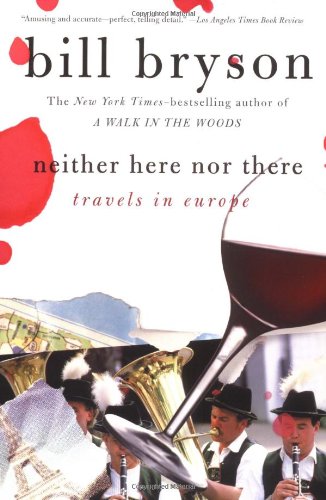
Neither Here Nor There by Bill Bryson
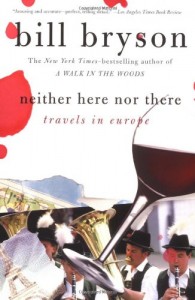 I was in need of a book that would give me an escape and make me laugh. That’s when I’m grateful for Bill Bryson.
Neither Here nor There is a book I keep to re-read in just such circumstances and when I opened it again the other day — it did the trick — I immediately started to giggle.
From the back cover:
Like many of his generation, Bill Bryson backpacked across Europe in the early seventies — in search of enlightenment, beer, and women. Twenty years later he decided to retrace the journey he undertook in the halcyon days of his youth. The result is Neither Here Nor There, an affectionate and riotously funny pilgrimage from the frozen wastes of Scandinavia to the chaotic tumult of Istanbul, with stops along the way in Europe’s most diverting and historic locales.
Mr. Bryson starts his mid-life crisis journey in Hammerfest, Norway (as far north as you can get in the world by public means of transport, he says) and re-traces his 1970 trip through Europe encountering language barriers, seedy train station hotels and delightful characters along the way.
I could quote this book for pages but will restrain myself to my favorites, get your hands on a copy and find your own:
The best than can be said for Norwegian television is that it gives you the sensation of a coma without the worry and inconvenience.
Romans park their cars the way I would park if I had just spilled a beaker of hydrochloric acid on my lap.
In the evening, I went looking for a restaurant. This is often a problem in Germany. For one thing, there’s a good chance that there will be three guys in lederhosen playing polka music, so you have to look carefully through the windows and question the proprietor closely to make sure that Willi and the Bavarian Boys won’t suddenly bound onto a little stage a half-past eight. It should have been written into the armistice treaty that the Germans would be required to lay down their accordions along with their arms.
The problem is that the pedestrian cross lights (in Paris) have been designed with the clear purpose of leaving the foreign visitor confused, humiliated, and, if all goes according to plan, dead.
She gave me one of those impassive Gallic (as in French) shrugs – the kind where the chin is dropped to belt level and the ears are pushed to the top of the head with the shoulders. It translates roughly as ‘Life is a bucket of shit, monsieur, I quite agree, and while I am prepared to acknowledge this fact I shall offer you no sympathy because monsieur, this is your bucket of shit’.
As you may have now surmised, Mr. Bryson is not afraid to be politically incorrect (he calls France’s population ‘Insufferably French) but he is also a devoted traveler and relishes the wonder and beauty of other cultures and lands.
One of the small marvels of my first trip to Europe was the discovery that the world could be so full of variety, that there were so many different ways of doing essentially identical things, like eating and drinking and buying movie tickets.
I arose each morning just after dawn, during that perfect hour when the air still has a fresh, unused feel to it, and watch the city (Rome) come awake — whistling shopkeepers sweeping up, pulling down awnings, pushing up shutters.
The Thomas Cook European Timetable is possibly the finest book ever produced. It is impossible to leaf through its five hundred pages of densely printed timetables without wanting to dump a double armload of clothes into an old Gladstone and just take off. Every page whispers romance: Montreux-Zweisimmen-Spiez-Interlacken or perhaps Beograd-Trieste-Venezia-Verona-Milano. Who could recite these names without experiencing a tug of excitement? Who could glance at such an itinerary and not want to climb aboard? (Sadly, this guide is no longer published or even on-line – they went out of business in 2013.)
This re-read made my travelers feet itchy. Mr. Byrson travels with open eyes, a sense of adventure, child-like wonder and a marvelous sense of humor. A required skill set for every traveler.
N.B. Neither Here nor There is also educational, you’ll learn important facts about each country. For example, did you know that Liechtenstein is the world’s largest producer of sausage skins and dentures?
N.B.2 Stay tuned, we’re planning a trip to Switzerland …hmm perhaps this itinerary — Montreux-Zweisimmen-Spiez-Interlacken
-
No words — just love
-
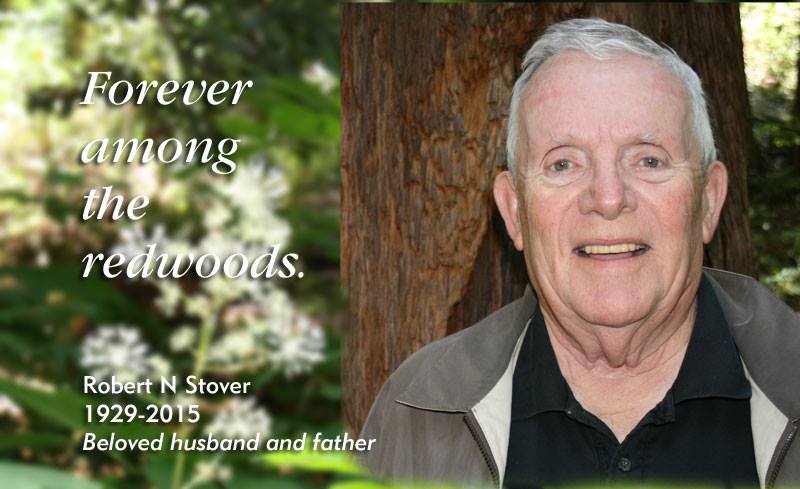
My Uncle Bob
 My dear Uncle Bob is dying.
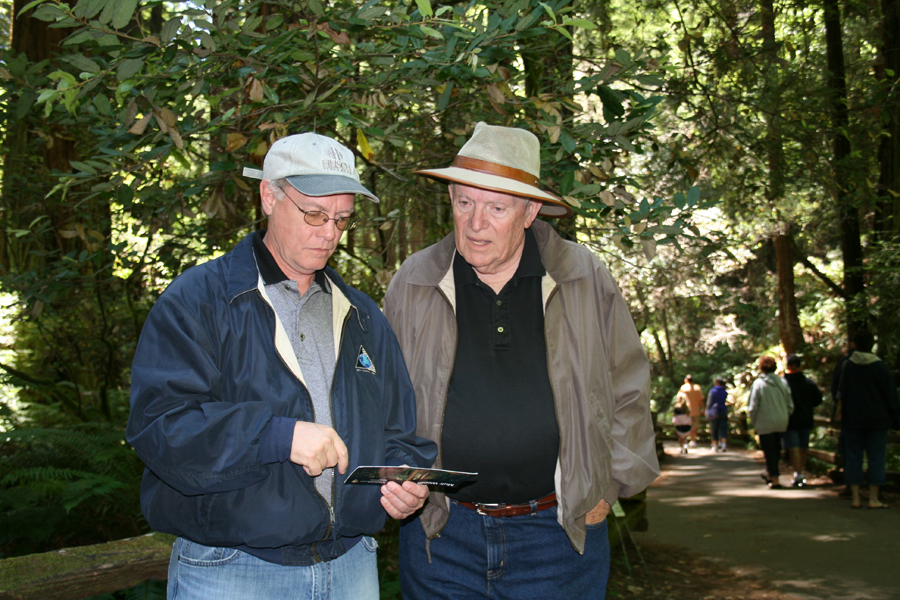
(this is Bob, on the right, with my husband in Muir Woods several years ago.)
Those are tough words to write…but having suffered the ravages of Alzheimer’s, the doctors tell us Bob is in his last days.
Connie — his lover, partner, best friend and wife has been with him every step of this horrible journey and she is steadfast with him even now — holding his hand, caressing his brow and giving him the little snippets of love he can still understand.
His son has been at his side, his sister (my mother) has reminisced with him almost daily about their childhood memories, friends and neighbors call in to discuss sports or his beloved dogs, but now there is nothing more to be done. It’s just a matter of time — so they say. Bob stopped eating and taking liquids days ago. Many have weighed in and pray he will go quickly rather than suffer any more — but I wonder.
Why is he still here?
I think Uncle Bob is hanging on – because he feels the enormous love surrounding him. Why not struggle to stay here in this world just a little bit longer? Why not, despite all odds, stay with his most beloved — just to feel those moments of connection -and perhaps even happiness?
None of us know what the dying feel in their last days, but I hope they know the love of all their cherished ones, both present and past, who surround them at the end.
Maybe Uncle Bob isn’t actually suffering as much as he is clinging to the world he just can’t say goodby to – at least not yet – no not quite yet OK?.
I love you Uncle Bob.
-
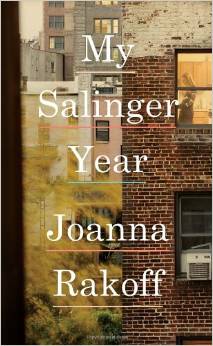
My Salinger Year Joanna Rakoff
 Lets be clear, this is not a memoir specifically about J. D. Salinger, nor another sordid tale of having had an affair with him (thank goodness)–this is a memoir of a young woman working at his literary agency in the mid 1990’s.
Alright I can hear your yawns from here, but I’m always interested in the inner workings of the publishing industry and so I decided to read this memoir by Joanna Rakoff.
It’s the mid 1990’s and Joanna is 23 years old, and much like in The Devil Wears Prada, she really has no experience or interest in publishing but is thrilled to land an “assistant” position at a literary agency – referred to as “The Agency”. This is one of those classy but underpaid positions that presumably one can brag about at dinner parties. Ms. Rakoff has never read anything by Salinger and she thinks when agency staff refer to “Jerry”, their star client, they mean Jerry Seinfield. In fact “Jerry” is their code name for J. D. (Jerome David) Salinger, the notoriously reclusive author.
This is an old-school literary agency. Here is a world of richly carpeted offices, no overhead florescent lighting — just shaded lamps, messengers, martini lunches and book-shelved lined hallways. Computers are only whispered about by the staff.
Joanna is given strict orders to never give out any information on Salinger and the agency must protect his privacy at all costs. Joanna’s main job is to answer Salinger’s many fan letters with a simple but curt form letter:
“Dear ___________
Many thanks for your recent letter to J.D. Salinger. As you may know, Mr. Salinger does not wish to receive mail from his readers. Thus, we cannot pass your kind note on to him. We thank you for you interest in Mr. Salinger’s books.Best, The Agency”
Her boss insists that Joanna type these letters out individually on a Selectric typewriter (using carbon paper) in order to give the fans a sense that an actual agency person has written back to them. Joanna must also answer her boss’s phone and if “Jerry”calls she is to keep it short and take a detailed message.
Joanna’s personal life is a mess, she lives with a ghastly boyfriend in a run-down apartment with no heat or a kitchen sink (?). She has, for no explanation, left the guy she really loves and he fled to California. Her parents have presented her with all her college bills unexpectedly unpaid and used her credit cards to rack up debt that Joanna must some how pay down. She’s broke financially and in her heart, so the agency is her only solace as Joanna is a lover of books, an avid reader and an aspiring poet.
There’s this lovely quote
On authors: The strange wonder of powerful writing, engaged in like some act of reflective devotion, and then, sent out, as on the wind, to find some home with unknown readers who in turn receive this revelation and transformation. Literature not as `escape’, literature as engagement.
It’s fun when Joanna steers away from the standard form letter and tries writing personal letters to the Salinger fans – with disastrous results. She hopes to become an agent and dips into the agency slush pile, finds an unknown author and tries to get her published. Also in the end, Joanna actually meets Salinger when he make a rare appearance at the agency offices.
That, my friends is about all that was interesting about this memoir. I’ve just saved you the chore of reading it yourselves. I did find some interesting parts about the inner workings of a literary agency – especially the care and feeding of Salinger himself. The grand event of finally getting one office computer for everyone to share was amusing and there’s some sly literary name dropping. This memoir covers a entire year of Ms. Rakoff’s life and it felt equally long to make it through this slow and overly-detailed story. One of the professional reviewers mentioned that this memoir started out as a much shorter magazine story and perhaps it should have stayed in that form.
Advanced review copy provided by Alfred A. Knopf
-
Same Time Next Year
Remember this? Click HERE
We just returned from the Heritage House Resort on the Mendocino coast where Same Time Next Year was filmed. This poor property has been through several owners since it foreclosed back in 2008. It finally re-opened, newly renovated, a couple of years ago and we’ve been wanting to stay there ever since. Our anniversary on Tuesday seemed the perfect excuse.
And now with apologies to family and friends back East, here are some photos — click to make larger.
Pay no attention to the short sleeved shirts and sunshine…OK?
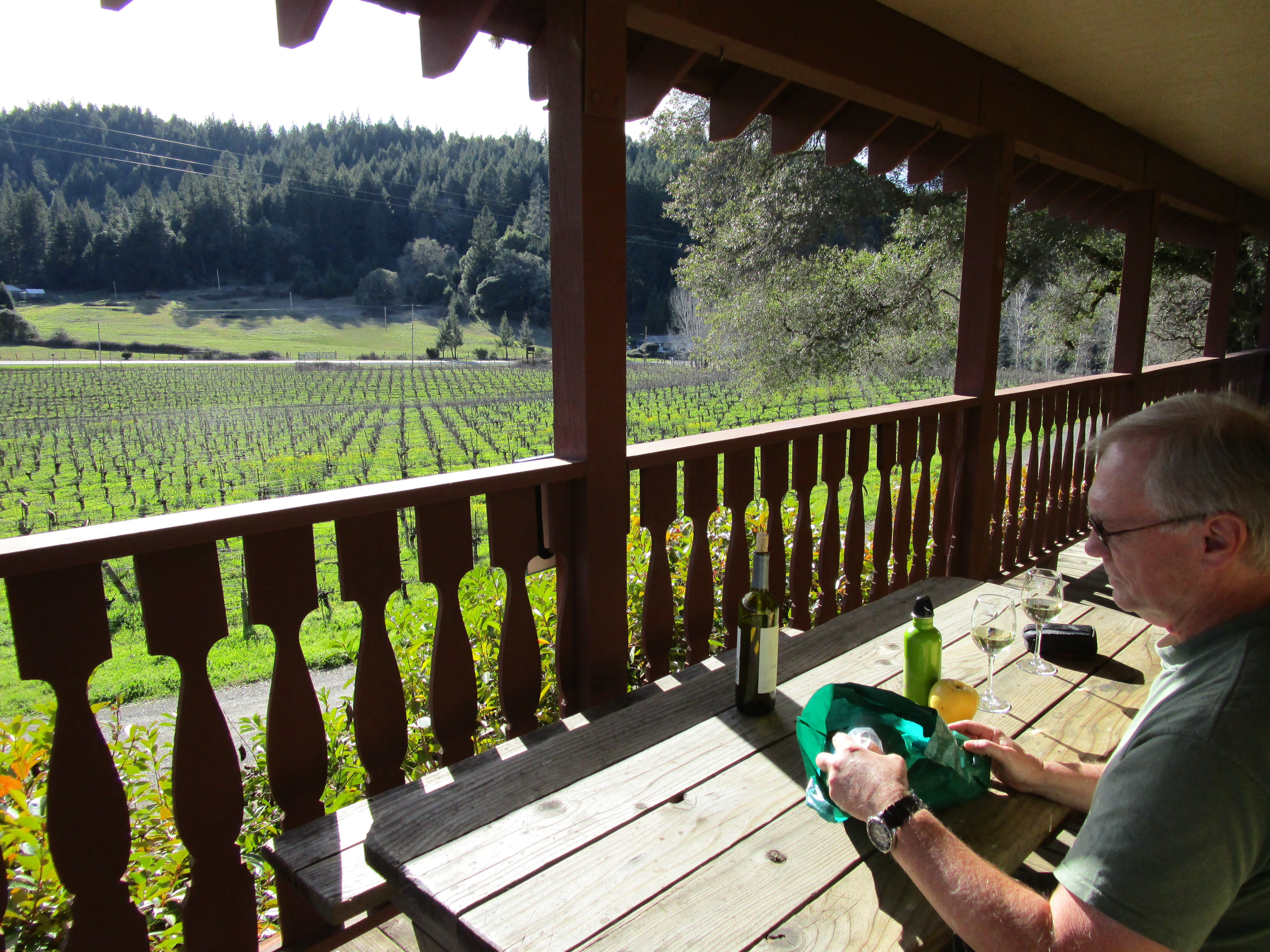
 On the way to Mendocino, we had a picnic lunch at a favorite vineyard in Anderson Valley.
 The view from our cottage. Second cottage down below on the left is where Same Time Next Year was filmed. BTW, they run the film nonstop on the TV’s in the rooms.
Glorious sunset from our deck.



 A hike the next day took us from the coast into pygmy forest and coastal woodland.


 Next morning we strolled around the 40+ acres that make up these beautiful grounds.


 Then a lovely drive home down Route 1.
Even saw sea lions. Click to make larger.
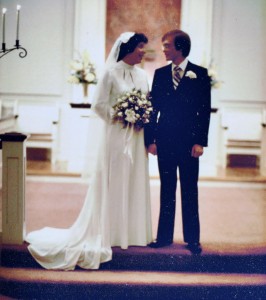
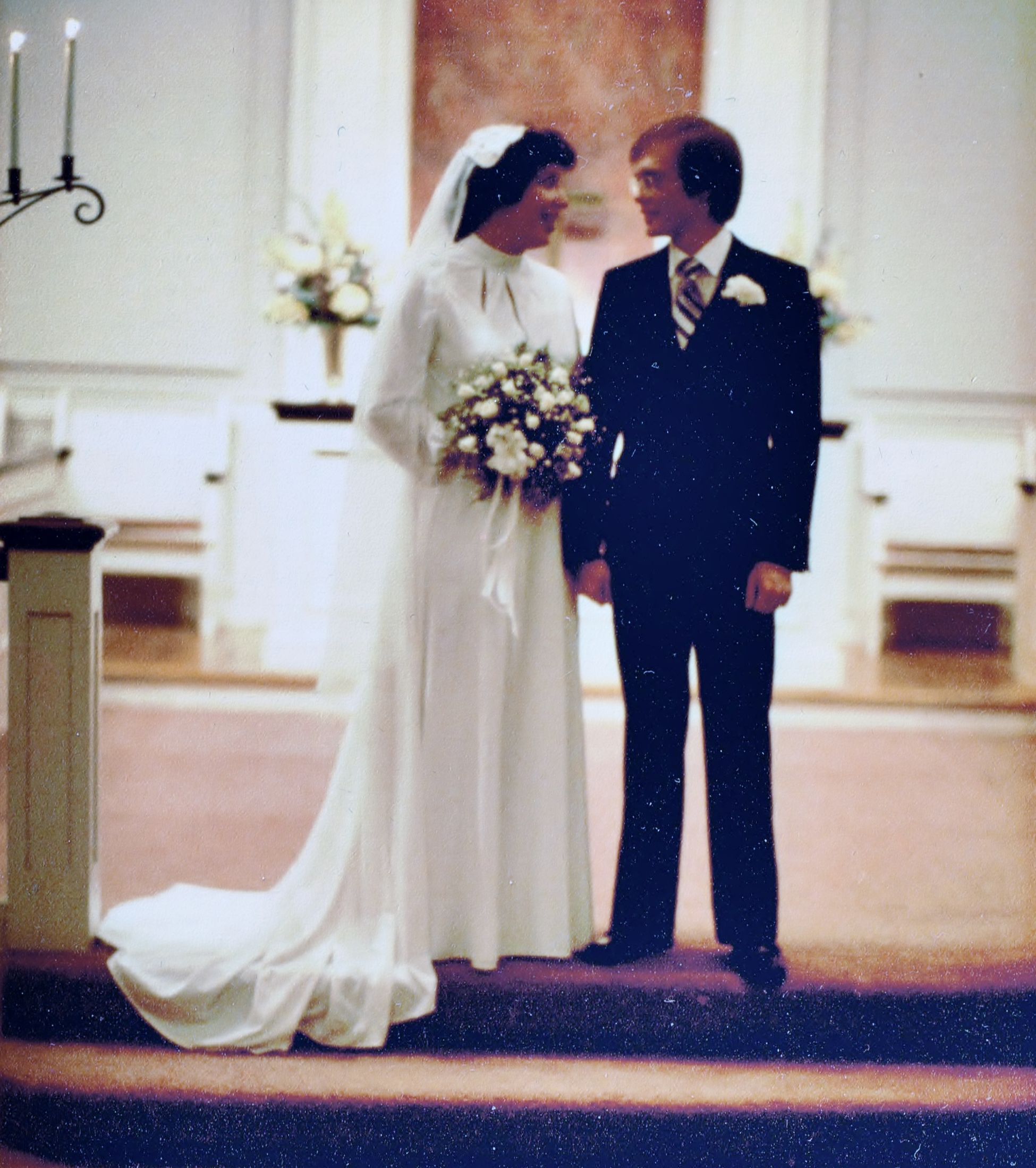
Happy Anniversary to my better half…let’s do this again, same time next year and every year after, OK?
circa 1979
-
The Great British Baking Show
 I first learned about this British show from one of my favorite book blogs: Stuck in a Book. Between book blogging, Simon has done recaps of every show airing in the U.K. The recaps were fun, but not having seen the show I couldn’t really understand the UK obsession –
until now…
Produced in the UK under the name The Great British Bake Off, The Great British Baking Show is now airing on PBS. After watching the opening episode (the show airs just before Downton Abby) I must confess — I’m hooked.
I’m not a fan of competitive cooking shows — here in America they tend to be glaringly star-studded, overly wrought and focused on the competition versus the actual food. They contrive to whip the contestants into hysteria and seem to encourage unnecessarily ruthless competition. Ugh, count me out.
So I was surprised to find myself both enthralled and charmed by this program. The Great British Baking Show takes place in a huge white tent oddly planted in the park at Downton Abbey. (The Earl and Countess of Highclere – the real Downton Abby – are certainty cashing in.)
The judges are the two pictured here, Paul and Mary, and there are two sidekicks, Mel and Sue who give instructions to the contestants with cringe-worthy puns. The competitors range in age (the youngest is 17), occupation (there’s a builder/contractor) and appearance (a few clearly lack a good dental plan) and yet, they are all very endearing.
The judges don’t overwhelm in these programs, they let the contestants and their baking shine as the stars of the show. Mary is especially kind while Paul can border on pedantic. The show is reserved, not frantic, and the drama is low-key but addictive. Even during the Baked Alaska challenge when their ice cream centers were melting in the heat of the tent, the contestants (with the exception of one poor guy) remained calm and collected.
There is a delightful British wit and charm throughout. Each challenge is given with a cheery “on your marks, get set, bake” and the judges advise the contestants with typical British understatement –“bakers need to be vigilant…”
This is a kinder, gentler cooking competition. There is a naturalness between contestants and judges. All the contestants smile genuinely when the others get accolades and each departing contestant gets hugs from both fellow contenders and the judges. This program actually cares about the baking process and respects the contestants as craftspeople.
Happily the recipes have been converted to American cooking measurements and temperatures (no need to convert “gas mark 6”) and can be found HERE.
See if you can view the shows from the beginning – via on-demand or on-line HERE – so you can watch the progress of each contestant, and if you’re like me you’ll find yourself rooting for all of them equally.
N.B.: Each contestant has their own cooking station equipped with stoves that have a clever slide away door that drops down and then slots out of the way underneath the oven — preventing those nasty shin bruisings –I want one!
-
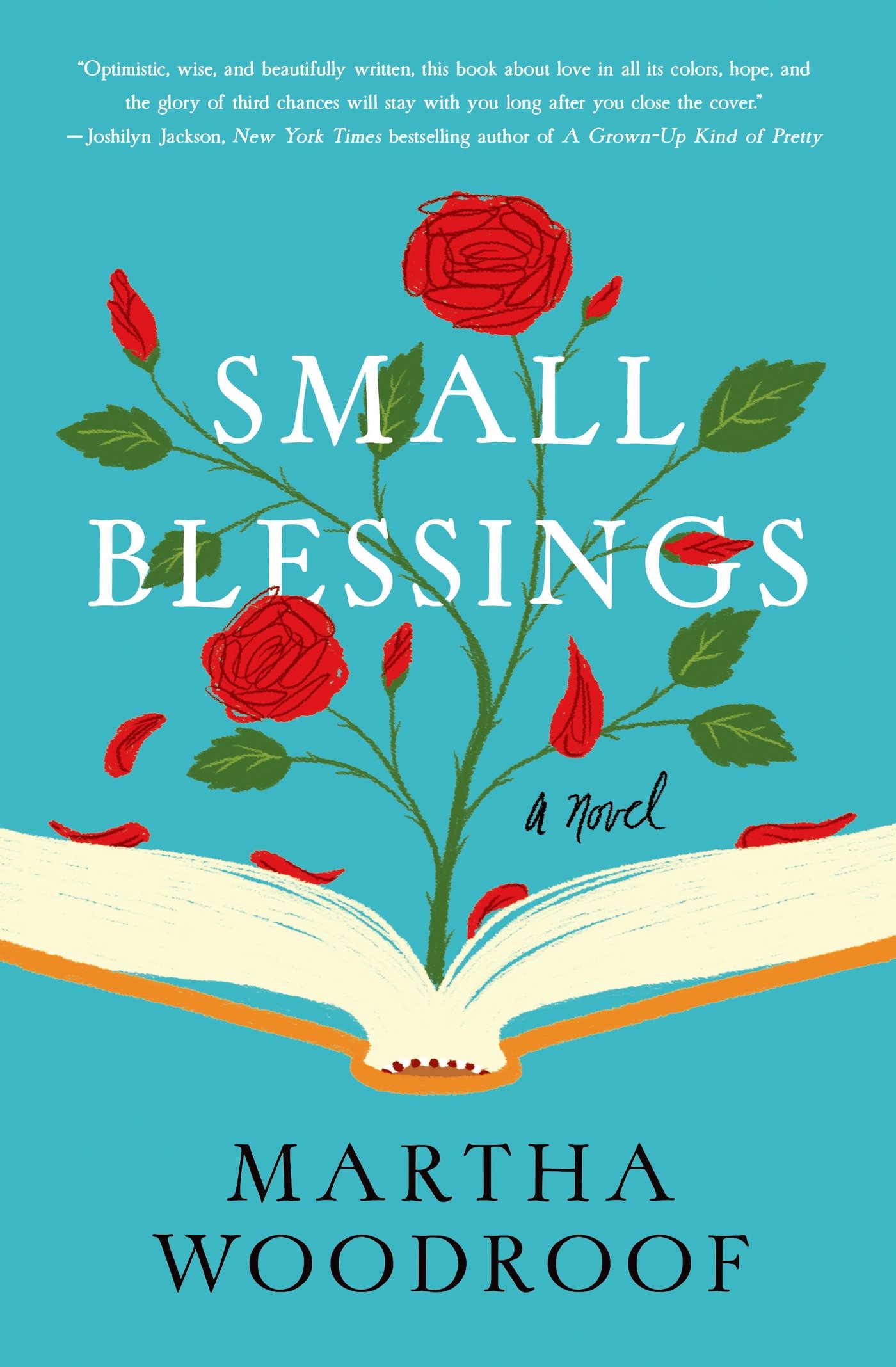
Small Blessings by Martha Woodroof
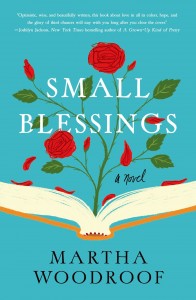
Small Blessings follows the intertwined lives of academics and their family members in a small Southern college town.
The above synopsis almost made me pass on this novel – sounded slightly mundane and I’m not a fan of academia novels.
Then, one Saturday morning, I heard Ms. Woodroof interviewed on NPR (she is a staff writer for NPR) and I warmed to her voice, attitude and that she’s a debut novelist at 67 years of age. (Approaching said decade myself, I seek any and all such bright, uplifting statistics, if you please)
I remembered I had Small Blessings on my Kindle and turned the first pages that evening — still convinced it would be a predictable read.
Yes, at first this is your average story: In a small, sleepy college town Tom Putnam, an English professor with a mentally troubled wife, is flatly going about his life when suddenly there is Rose, a lovely new employee of the campus bookstore. Tom and his wife are charmed by Rose and make plans for dinner.
Still thinking oh yes, a Lifetime movie plot is about to unwind, I carried on and wham! The story suddenly twists and turns. The characters become wholly unpredictable…and I found myself turning the pages and falling headlong into Ms. Woodroof’s atmospheric story.
Without giving away too much, Tom’s poor wife dies in an auto accident during the first few chapters, his mother-in-law, Agnes (my favorite character) becomes his ally. Tom falls a little bit more in love with Rose each day. At the same time, a past affair brings him Henry, a 10-year old boy, who may (or may not) be his son. Stir all this up with oddball (often drunk) supporting characters, a Southern town that knows everyone’s secrets, some melodrama and you’re in for a journey.
The campus atmosphere is beautifully rendered in an insulated Southern setting, but Ms. Woodroof also slyly lampoons the institution’s pretenses. The front lawns of the faculty housing are beautifully maintained for showing off to prospective students and parents, while the back yards grow weedy dependent on the faculty to tend – which they don’t.
I had my quibbles with Small Blessings. I found Tom Putnam to be almost catatonic in his passiveness, perhaps as an academic, he lives in his head – but at times I found it very irritating – especially in his marriage to Marjory: “Conscience was such a delicate balancing act. There was what he knew was right, what he ought to think was right, and what he wanted to do, all to be considered. It was the ultimate moral chess match, and it was the only game that mismatched married people got to play.”
The mental illness and death of Tom’s wife, Marjory are treated with a light, almost cavalier hand – as in this from Agnes, her mother: “Marjory is, I really do think, better off dead. I don’t know what dead is, of course, but it’s got to be more fun than my daughter’s life was.” and this later quote “the best thing she ever did in life was to give up on it. And that’s a bleak as a life can get.”
In the end, I found this an unpredictably candid and real storyline. Small Blessings teeters on the edge of soap-opera stereotype, but then surprises the reader with realism. The characters are flawed but ultimately loved. This is a story full of tragic events but it overflows with optimism. One of my favorite quotes: “When the going gets tough, the tough suck it up,” Agnes said. “The rest get run over.”
The outline of this novel screams “make me a TV movie!”, but if it is optioned, I hope they capture the story’s quirks and messiness.
Review copy provided by St. Martin’s Press via NetGalley.
-
(and we even know where some of them are)
 Throwback Thursday
From 2012 — celebrating bookstores with the best signage and sense(s) of humor. HERE
-
I Like Big Books — I Can Not Lie
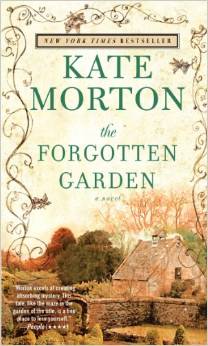
I love me a big ole historical novel, especially if it’s steeped in a mystery, set in an old house with an abandoned garden and filled with colorful and compelling characters. Kate Morton has written four such big, addictive books, of which I’ve only read two…but don’t worry her other two are not far behind on my list. I read the first book several years ago and just finished the second.
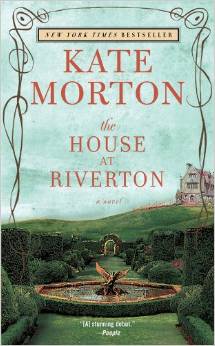
The House at Riverton, by Kate Morton
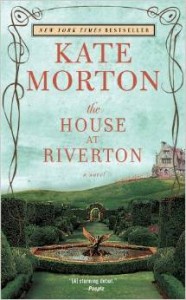 98 year old Grace tells her story to a young film maker documenting an unexplained death at Riverton House where Grace served as a maid 80 years before. Told in alternating narratives between past and present, I was in this book’s clutches after just a few pages.
Grace serves as maid to Hannah and Emmeline, two distinctly different sisters who are creepily close to one another. Grace is drawn into the the spoiled sisters web of deceit and secret games. And in 1924 Riverton and its inhabitants are shattered with a shocking suicide on the grounds. All the characters are vibrant and amply developed — there are dysfunctional aristocratic family members with a range of servants, each with their own foibles. And then there’s the glorious manor house of Riverton– a character in itself.
Often flashback narrative can be clunky. This is flashback done brilliantly. Deaths, affairs, missteps are reminisced by Grace telling her story, then the book seamlessly transports the reader back in time to Riverton and you’re there and it’s happening now.
Ms. Morton excels at period research and her attention to detail is superb. Other reviewers remarked that her historical detail bogged down the book, but I wholly disagree. I found the description of the table settings, the details of dressing for dinner, the lavish picnics all added to the richness of the story.
This is a long, sweeping story of class structure and struggle, betrayals, secrets and the devastation of WWI. I was glued throughout its wonderful twists and turns until the gasp-worthy ending. A big enchanting book to fill many a long winter evening.
###################################
The Forgotten Garden, by Kate Morton
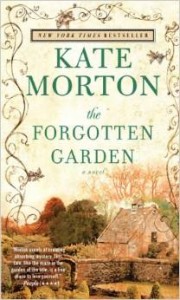 This is a classic fairy tale story: a little girl is abandoned on a ship bound for Australia. She hits her head while on the ship and looses her memory. All she has with her is a suitcase with a few clothes and a book of dark fairy tales written by a woman she remembers as the Authoress . Once in Australia, a dock worker and his wife take her in, name her Nell and raise her. Once the girl comes of age, she is told of her rightful identity and she returns to England to discover her people and her story.
 Her travels lead her to Blackhurst Manor and she starts to unravel the Mountrachet family’s secrets. She purchases a run down cottage and garden on their property makes it liveable, and carves out a life for herself. While Nell is still trying to solve the mystery of her past, her distraught daughter shows up, dumping her granddaughter Cassandra on her doorstep–permanently. Two generations later, the granddaughter Cassandra inherits the cottage and tries to discover her secrets. Sounds trite — Yes and No.
Ms. Morton takes a fairly well-worn story and weaves it into a rich and compelling story which spans generations, and multiple plots wherein secrets are kept and betrayals are just below the surface. While the English cottage and forgotten garden setting are idyllic (there’s even a maze and a Dickensian-like shop in the village) life is more difficult here and this is a darker story complete with poverty, sickness and workhouses.
At first, I was less enthralled with The Forgotten Garden and found it more difficult to keep the three perspectives and three time periods straight…I kept having to go back a few chapters to figure out where I was. Also Ms. Morton uses very similar names – Blackhurst Estate, Mrs. Blackwell and Mr. Blackwater (whoa I’m confused…). Luckily, by the time I’d read 5 or 6 chapters, things flowed more clearly and I was once again hooked to the end by this marvelous author and her writing.
In an interview, Ms. Morton admitted to a fondness of 19th century Gothic novels and her novels are indeed reminiscent of Daphne du Maurier, or even perhaps even Upstairs Downstairs and Downton Abbey.
Her next two books – The Distant Hours and The Secret Keeper happily await me on my shelf. Call me fool and shut the door because obviously I’m a fan.
-
Only He Knew My Page Number…
An oldie but goodie
All those perfume ads interrupting my Hallmark holiday movies…(don’t judge), reminded me of this gem from the Library of Congress.
Share with your book friends.
Now “let me read”.