-
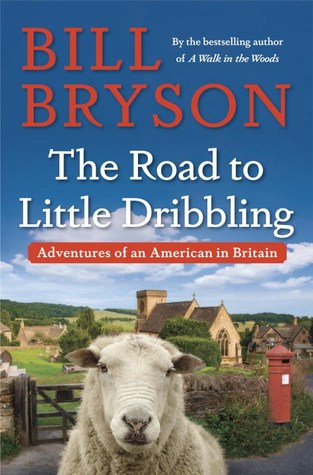
The Road to Little Dribbling by Bill Bryson
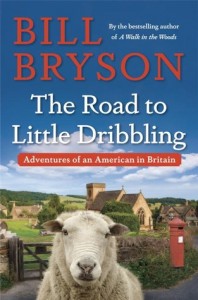 I’ve not posted here at Book Barmy for a bit, because I’ve been away. I’ve been to England, Scotland and Wales with one of my favorite pals, Bill Bryson.
You know of my fondness for Mr. Bryson’s writing and I that have happily devoured almost all his books. The Road to Little Dribbling is his newest and it updates his 1995 classic Notes from a Small Island, in which he takes a farewell journey around the United Kingdom before moving back to the United States with his family.
Now it’s 20 years later and Mr. Bryson is once again touring the U.K. but this time as a citizen – which in his mind gives him license to grumble — and grumble he does.
But, sorry, I’m getting ahead of myself. This trip of remembrance doesn’t exactly retrace his 1996 journey. This trip is planned as the most direct route from one end of the country to the other – and Mr. Bryson being Mr. Bryson chooses Bognor Regis a quaint village at the the Southernmost tip as his starting point and for his finale in the Northern reaches of a stormy Scotland, a village aptly named Cape Wrath.
I had a great time traveling through the UK with Bill (seems silly to keep calling him Mr. Bryson after all our time together). He is full of witty observations and has a delightfully wry sense of humor even in the face of travel troubles or disappointments. When revisiting one of his favorite seaside hotels…
The hotel still strived for an air of elegance, but it was based much more on memory than merit.
Nevertheless, Bill finds mostly delight in his rambles through small villages, bus trips along suburban sprawl and driving a rental car along endless tangled back lanes. I knew we were meant for each other when he thinks nothing of a four mile walk for a cup of tea in a picturesque Cornwall village:
It was all very fine, in the cafe I had a refreshing cup of tea and a lovely dry piece of cake – cautiously flavorful in the British style, satisfying, but not so delicious that you would want a second piece for a month or so.
We also share a fondness for those obscure, out of the way sites not on the itinerary of tour groups or travel guides. He visits Leighton House in London:
In terms of decor it feels a little like a cross between a pasha’s den and a New Orleans bordello. It is full of Arabic tiles, silk wallpapers, colorful ceramics, and lots of art, much of it involving bare-breasted young women, which I am always up for.
Nonetheless, a few major tourist sites, such as Stonehenge and the Natural History Museum are re-visited with Bill’s insightful and varying opinions on their changes in the past 20 years.
As always, when traveling with Bill there is much to learn. We visit Slapton Sands, an unknown and secret D-day rehearsal site – where Allied troops could practice coming ashore. Tragically, the Allied side neglected to line up protection for the exercise and nine German torpedo boats attacked and killed 749 American soldiers — all while Eisenhower helplessly watched the carnage.
Bill’s age, or dotage as he calls it, (he’s 64) sometimes raises its cranky head as this from inside one of the newer trains to traverse the U.K.
British train interiors used to be heavy and gloomy in a way that perfectly suited the dull, cheerless, stolid business of commuting. Now trains are full of bright oranges and reds. This one was rather annoyingly festive, like a children’s fairground ride. I felt as if I should have had a tiny steering wheel and little bell by my seat.
Upon discovering he was in the wrong town, due to an inaccurate train schedule
…so I went and stood in a long line and explained my problem to a man who had once answered a British Rail ad that said: “Wanted: cheerless bastard to deal with the public”.
My travel companion loves the quirky, small dusty museums often run by equally quirky British “societies” – from the Water Tower Appreciation Society to the Clay Pipe Research Institute. He even dips his toes into the fervent British obsession with trains, train routes and train-spotting. I must say some of his museum ventures bored me a bit, but it’s always fun to hear his commentary afterwards. In fact, my only quibble with this book – oops I mean journey – was that it got a bit dry and pedantic at times.
The Road to Little Dribbling* is not just about travel, it endearingly reveals how Bill came to England from Iowa, found a job, fell in love with a student nurse and eventually became a dual citizen. His early days in England are full of confusion and delight. You could buy ham or cheese sandwiches but not ham and cheese together – “perhaps just too tasty”, Bill reflects. And he delights in the fact that British post offices were bureaucracy gone mad;
…one could conduct 231 types of business in a typical post office at that time – from renewing (mandatory) television licenses to paying your car tax. All that was required that you be white-haired, hard of hearing and able to spend up to an hour hunting through a tiny coin purse for a 20p piece.
As a younger man, when he questioned the creaky British weights and measure system, the following conversation (supposedly) occurred (with Bill you never know where he has embroidered for humor):
“Of course they (weights and measures) make sense”, he said with a sniff. “Half a firkin is a jug, half a jug is a tot, half a tot is a titter, half a titter is a cock-droplet. What’s not logical about that?”
Bill goes on to ponder;
There really is no talking to them about it. Any more than why they think that cricket is worth five days of close attention or jam makes a cake delicious. It’s just the way they are.
As we close in on the final chapters in our journey with Bill, it becomes clear that despite his general crankiness about Britain, he truly loves the country and its people.
The pleasant fact is that the British are not much good at violent crime except in fiction, which is of course as it should be. Statistically, a Briton is more likely to die by almost any other means — including accidentally walking into a wall — than to be murdered. And if that’s not a happy thought, I don’t know what is.
+++
Once for a magazine article, I asked the the chief information officer at Ordinance Survey, the government department responsible for whatever geographic certainty Britain can muster, for a definitive figure for the the number of British islands and he disappeared for several days. Eventually, after much hunting around, he told me that the closest he could find to an official figure was 1,330, but he frankly doubted that that was anywhere near right. I think it’s rather charming that Britain doesn’t quite know how much of itself there is.
+++
I could only fit in the first three days (of a hiking trip with old friends), but that took us right across the Lake District – 42.4 miles. It was a murderous slog over craggy hills, but the weather was glorious and I don’t think I have ever encountered so much continuous beauty while clutching my heart and begging for mercy.
As always when writing about Bill Bryson’s books, I tend to over-quote endless passages from his books. But I can be excused because his writing is always so right on point – wry, funny and illuminating all at the same time. He’s a great travel companion and just let me quickly pack a bag, because I’ll go anywhere with him.
I’ll close with my favorite passage:
There is something in the pace and scale of British life – an appreciation of small pleasures, a kind of restraint with respect to greed, generally speaking — that makes life ineffably agreeable. The British really are the only people in the world who become genuinely excited when presented with a hot beverage and a small plain biscuit (cookie).
*There is no such place as Little Dribbling, Bill coined it to represent all the eccentrically named villages of Britain.
-
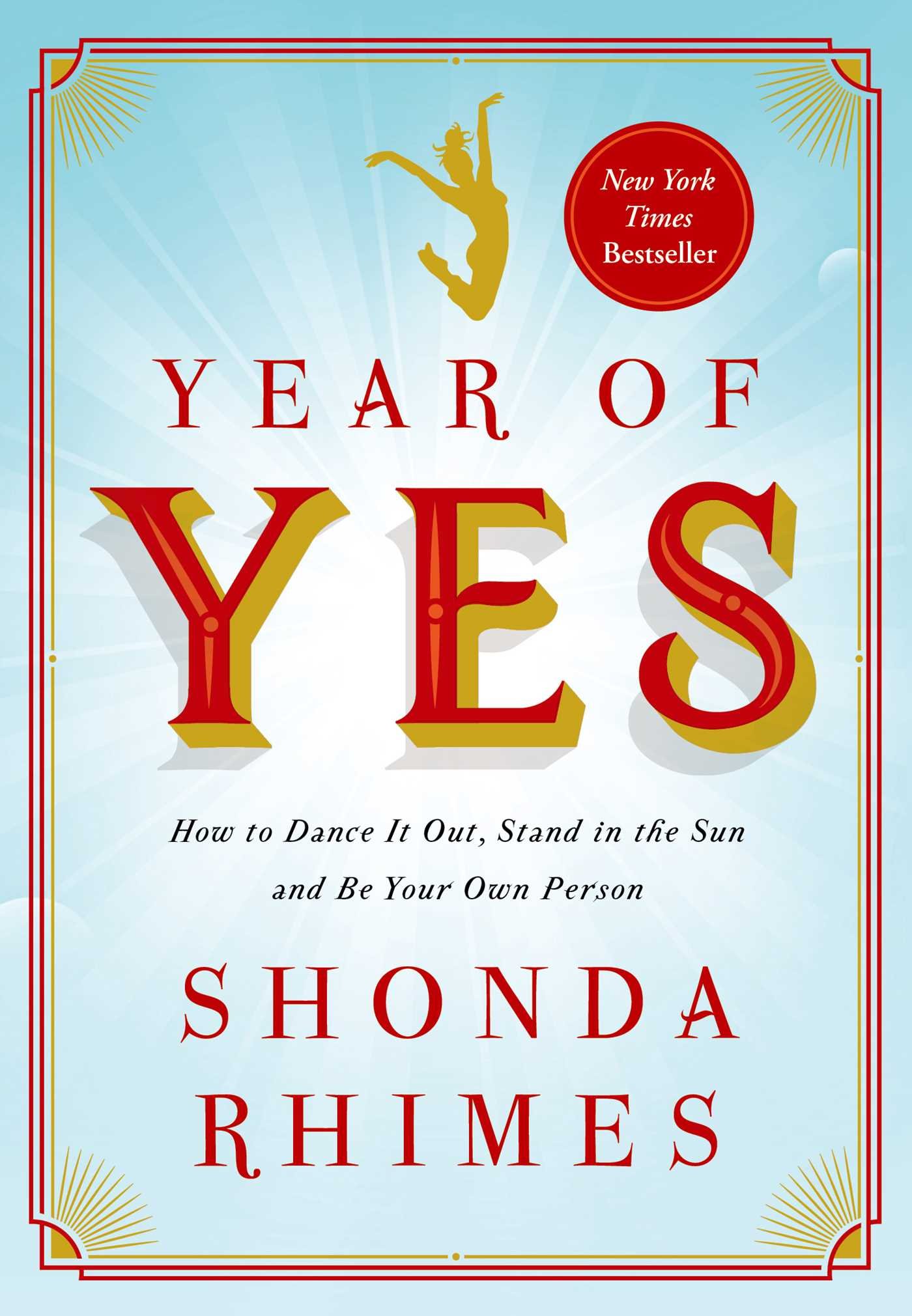
Year of Yes by Shonda Rhimes
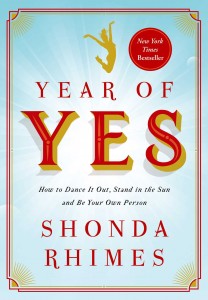 Year of Yes by Shonda Rhimes
I’m not usually one for “self help” books – especially celebrity ones. Still, one day, when I turned on NPR, Ms. Rhimes was being interviewed about her new book, Year of Yes. I was suddenly in rapt attention. She was witty, smart-mouthed, exceedingly down-to-earth and wow – a woman of color, and a driving force in the male-dominated world of network television.
Later that day, as a treat after teeth cleaning, I ducked into a favorite bookstore in the Marina and picked up Year Of Yes, certain it wouldn’t be for me, but 20 pages later, laughing out loud in the aisle, I had to buy it.
Shonda Rhimes is the creator and producer of Thursday night network television – Greys Anatomy, Private Practice, Scandal and How to Get Away with Murder. She claims she merely “makes stuff up for living” – which has made her a highly-respected television mogul and a multi-millionaire.
Although I was a fan of Grey’s Anatomy (until Sandra Oh left), I’ve never watched any of her other hit series. But I’ve always admired that all her shows feature characters whom reflect what she calls normalcy – all races, ages, sizes, sexual orientation and backgrounds. Creating and producing these ground breaking dramas we find out took guts, perseverance and some major rule breaking. No gentle “lean-in” for Ms. Rhimes — she kicked down doors, stereotypes, racism, sexism, and a few butts along the way — all in order to get her ground breaking, vibrantly diverse shows on air.
This part self-help – but mostly memoir reveals that as strong as Ms. Rhimes was at work, internally she was a shy introvert, was most comfortable writing alone in mismatched pajamas and wished to remain very far removed from the typical Hollywood hype.
When I first got a publicist, I told him and his team that my main reason for having a publicist was so that I never ever had to do any publicity. Everyone thought this was a joke, I was not joking.
Ms. Rhimes is a highly-educated, hard- working genius, raising three children as a single mom and a sister in a large competitive family – that seemed enough and protected her from having to say yes to things that made her uncomfortable.
Then, one Thanksgiving morning, her older sister angrily mutters that she never says yes to anything — not to social events, publicity, family affairs, or to having fun. This proved to be a turning point for Ms. Rhimes as she realized her excuse of being too busy with three prime-time television shows and raising her daughters on her own — was actually a cop-out. Ms. Rhimes began to discover that her “no’s” were preventing her from fully experiencing her life — trapping her in negativity and isolation.
So begins her scary year of saying yes. Yes to accepting compliments and the help she needs to balance her career with single motherhood and yes, to taking care of herself — which results in a 100+ lb weight loss.
Ms. Rhimes gives herself permission to answer the question “How do yo do it all?” with the honest answer – she doesn’t. She credits and idolizes her live-in nanny, makes no excuses when relying on Costco baked goods for school events (despite the other mothers’ home baked offerings) and gives herself permission to unashamedly practice “badassery”.
One chapter relates her decision to remain single and the hurt she causes the men she’s loved in her life. And to those who ask, she answers that their idea of a happily-ever-after ending is not the same as hers. Again, yes to her life choice(s).
It doesn’t mean she doesn’t say no…
No is a powerful word. To me, it’s the single most powerful word in the English language. Said clearly, strongly and with enough frequency and force, it can alter the course of history.
Her public calendar becomes full. She revels at sitting next to First Lady Michelle Obama at the Kennedy Center Honors – and realizes that, a year ago, she would have turned down this once-in-a-lifetime opportunity.
If you google Shondra Rhimes you can watch her interviews and public appearances with Oprah, Jimmy Kimmel, even a commencement address to her alumni at Dartmouth.
But, I believe her best speech is a short one, when she was awarded the Sherry Lansing Award for leadership. Here Ms. Rhimes credits the many, many women who came before, those who actually broke the glass ceiling so that women in the last 20 years could be successful. Recommended viewing HERE.
Trust me, Year of Yes is not a fluffy celebrity memoir with advice thrown in, Ms. Rhimes doesn’t preach or condescend. She touts a mean work ethic and her message is; you’ve just got to do it — the impossibly difficult, soul-breaking work; you can’t (and won’t) be able to do everything; you will make sacrifices; you’ll make mistakes – but no matter what, you continue to do the hard work.
Year of Yes is a quick read, it’s funny and down-to-earth, but don’t sell it short – within its short pages are the thought-provoking life lessons learned by a woman overcoming her fears, succeeding on her own terms and being comfortable with all of it. She ends the book with this:
I am different. I am original. And like everyone else, I am here to take up space in the universe. I do so with pride.
-
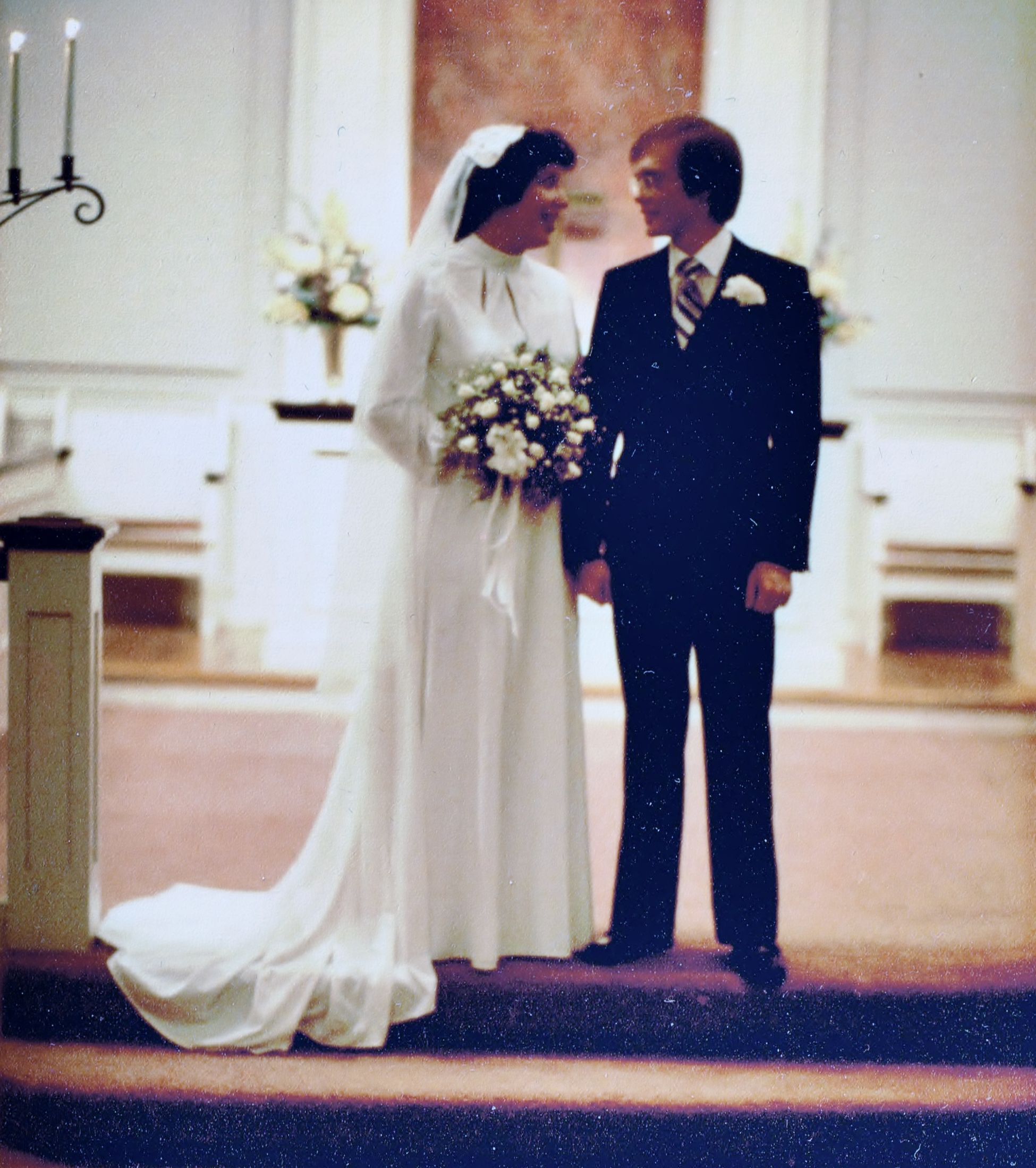
Falling in love ~~
Marriage requires falling in love many times, always with the same person.
(Mignon McLaughlin)
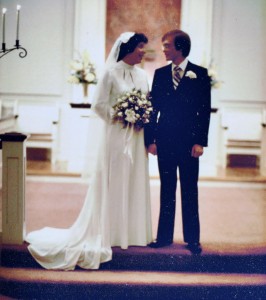
Happy Anniversary to my favorite person – may we keep falling in love for many more years.
-
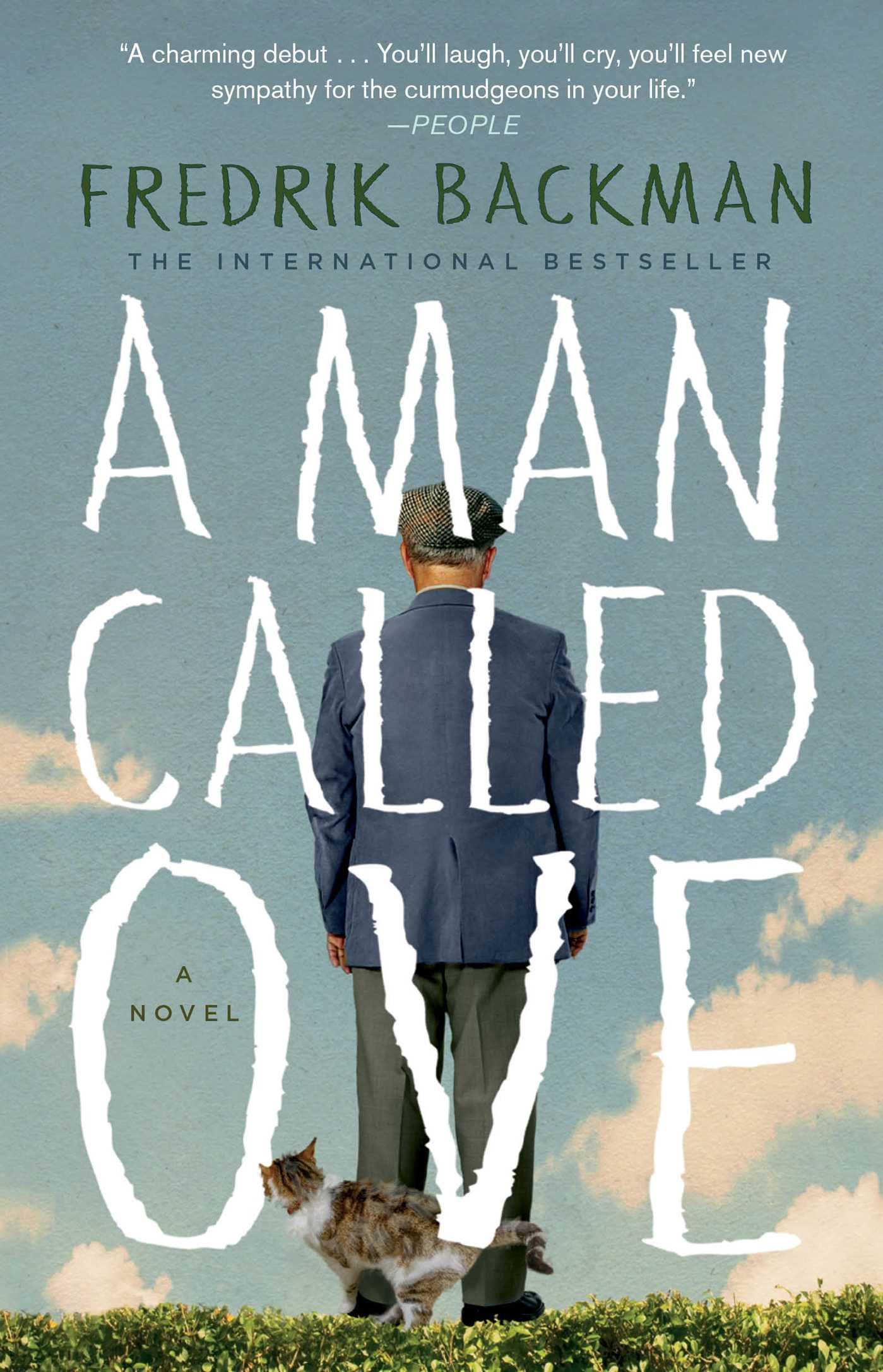
A Man Called Ove by Fredrik Backman
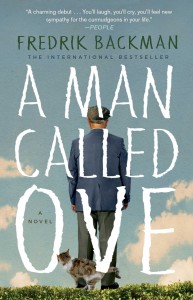 When I first met Ove in this charming novel, I couldn’t help but make comparisons to the men dearest to me … my grandfather, father and Husband. Like Ove, these are reliable and capable men of few words.
They are happiest with a project around the house, helping others fix things or puttering in their workshops. You’ll undoubtedly find such men restless at parties and bored with small talk — there are things to be done, wrongs to be corrected and projects to finish.
Like Ove, these men have firm convictions about right and wrong, quietly do what needs to be done and have no patience for the useless or foolish.
When you first open this Swedish novel, it’s hard to believe the reviews that praise A Man Called Ove as a joyful and heart-warming novel. Ove is a curmudgeon living in a Swedish housing estate who spends his days grumpily policing the neighborhood while plotting his own suicide. His charming and beloved wife, Sonja has died and he sees little point in carrying on.
So he spends his days making sure the neighbors have left their trash bins in the proper location, that no cars are driving in the residential-only areas and that the walkways are shoveled just so…
…it takes him fifteen minutes to free up the paving between the house and the shed. He works with care. Straight lines, even edges. People don’t shovel snow that way any more. Nowadays, they just clear a way, they use snow blowers and all sorts of things. Any old method will do, scattering snow all over the place. As if that was the only thing that mattered in the life: pushing one’s way forward.
As you get to know Ove, you start to sympathize with his on-going lament that people don’t see things his way, which is a shame because they’re missing out on the right way of life. These days, he surmises, everyone worries more about their newfangled computers and cell phones. People don’t take the time to learn simple things like how to fix household items or how to back a trailer into a driveway. (I had to chuckle here as Husband is consistently called upon to back trailers, a skill he possesses which few do not – [she says proudly].)
Ove just wants to be left alone to kill himself and he would have done so if it weren’t for a string of demands interfering with his plans. His hapless neighbors need a ride to the hospital. A mangy stray cat is attacked by a dog in his front yard. A buddy of his is ill and his wife can’t get the heat working, so Ove must stash his already noosed rope and go bleed her radiators.
While Ove fumes over the erratic intrusions into his various death plans (pills, hanging, gunshot…) we learn about his past. The author gently gives us peeks into his past and his personality with some marvelous writing.
He had a job with the railway —
He had liked working there. Proper tasks, proper tools, a real job.
And then he sees Sonja on a train and conspires to meet her by taking her train several hours out of his way each evening and then travels back to his own station alone, sleeping in the luggage room and washing his clothes in the staff washroom. When he finally gets up the nerve to talk with her, they make plans to meet for dinner…
And when she did finally turn up, in long floral print skirt and a cardigan so red it that it made Ove shift his body weight from his right foot to his left, he decided that maybe her inability to be on time was not the most important thing.
Sonja and Ove have a marriage of opposites but full of love and quiet happiness:
…she never managed to make Ove read a single Shakespeare play. But as soon as they moved into their terraced house he spent every evening for weeks on end in the tool shed. And when he was done, the most beautiful book cases she had ever seen were in the living room. “You have to keep them somewhere”, he muttered and poked a little cut on his thumb with the tip of a screwdriver. And she crept into his arms and said that she loved him. And he nodded.
There are some points where the plot strains credibility, but you will forgive. Ove reluctantly agrees to teach his neighbor to drive and for some reason the stray cat goes along in the car. This makes for some very funny observations (by the cat of course).
But the beauty of this novel is how the rag-tag group of supporting characters alter Ove’s life…neighbors, the stray cat, a love-struck letter carrier, a gay teen, a journalist — all keep interrupting his careful suicide plans.
His capable (there’s that word again) assistance is needed to prevent one disaster after another. So what does a grumpy old man to do when death is calling, but life just keeps demanding he put things right?
Get your tissues ready as slowly, Ove is pulled back into life – because he is needed, and in the end, he is loved. And if you’re like me, you’ll end up loving Ove too.
N.B. I must compliment the translation of this Swedish novel — it is nothing short of brilliant — all the colloquialisms are intact, the humor works on many levels and the characters jump crisply off the page.
A digital review copy was provided by Simon & Schuster via NetGalley.
-
So many books ~~
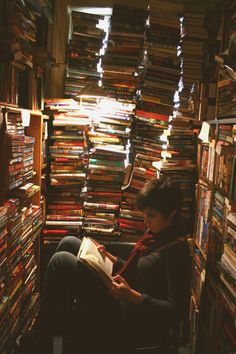
You know the saying, so many books, so little time…well it’s hit home for me. I’ve been clearing out, rearranging, and sorting my books…
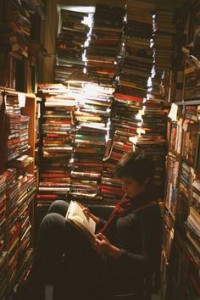
and I’ve done the math — I’ll never live long enough to read all the books I want to read. Very sobering.
It reminds me of this old Twilight Zone episode.
-
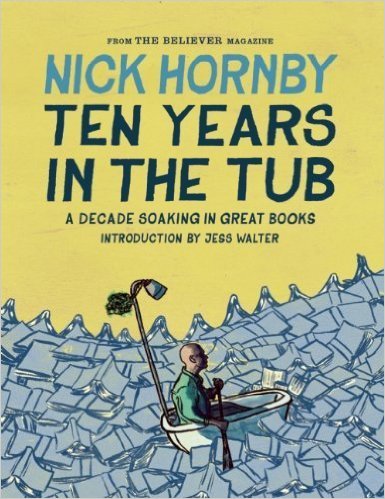
Ten Years in the Tub by Nick Hornby
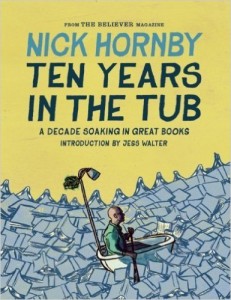 Ten Years in the Tub
 by Nick Hornby
A Decade Soaking in Great Books
I got two things during that most lovely week between Christmas and New Years — a lousy cold and this book. The combination made for a surprisingly enjoyable time. There I was, in my reading chair, wrapped up in my afghan with this 400 page tome. Trust me, it was not a pretty sight — my nose red – box of tissues at my side – laughing, sneezing, pondering, coughing, drinking some sort of herbal cold remedy tea (not recommended no matter how sick one feels) and scratching down yet another list of books I now want to read – most of which I know, full well, I will never get to.
The good thing is Nick Hornby would completely understand and forgive me for this intention versus reality dilemma. You see, his monthly columns always begin with two lists: Books Bought and Books Read — and these lists never sync up, which made me adore him on the spot.
Each column then continues with reviews of the books Mr. Hornby did read and funny chatter about how his life has gotten in the way of his reading – usually a soccer match or binge watching Friday Night Lights. He does much of his reading in the tub and recommends Body Shop’s Vanilla bath gel.
These Stuff I’ve Been Reading columns first appeared in September 2003, in The Believer – a literary journal published by McSweeny’s. This omnibus edition collects all of the columns published since then up to June 2013
It’s likely a sign of how
far I’m gonemuch of a reader I am — that I can happily pour through a 400+ page book about what someone’s been reading for the last ten years while nursing a cold and pondering yet another decongestant-fueled nap. Even before this Book Barmy blog, I always enjoyed reading about someone talking about reading books. (Apologies for that sentence – but it’s the true thought.)
Ten Years in the Tub shamelessly extols the pleasures of buying, owning, reading and writing about books;
I suddenly had a little epiphany: all the books we own, both read and unread, are (one of) the fullest expression of self we have at our disposal.
Admittedly, a bit of a self-serving statement by the author, but then again, I really like this guy and if it helps rationalize one’s book
hoardingcollection — well, why not? To add to the fun, because Mr. Hornby is a famous author and screenwriter (High Fidelity, About a Boy and he wrote the screenplay for the film Brooklyn – there’s talk of an Oscar…) — he shamelessly name drops his fellow author friends and plugs books written by other family members.
Just a browse through the table of contents is a giggle. Each essay is only 7-12 pages long and comes with such descriptions as:
April 2004: Utter rubbish; a truth bent out of shape; unkind words about Amazon reviewers; upcoming Dickensian nutrition
September 2007: The end of the world; kitchen gizzard experiments; a passable Mick Jagger impersonation; a blank-verse novel about werewolves.
See, how could you not want to dip in?
Admirably, the author recognizes that with serious readers, it’s not all sweetness and light;
…when reading is going well, one book leads to another and to another, a paper trail of theme and meaning; and how, when it’s going badly, when books don’t stick or take, when your mood and the mood of the book are fighting like cats, you’d rather do anything but attempt the next paragraph, or reread the last one for the tenth time. “We talked about books,” says a character in Charles Baxter’s Feast of Love, “just how boring they were to read, but how you loved them anyway”. Anyone who hasn’t felt like that isn’t owning up.
HA – isn’t that the truth? Later he goes on in the same vein…
I would never attempt to dissuade anyone from reading a book. But please, if you’re reading a book that’s failing you, put it down and read something else, just as you’d reach for the remote if weren’t enjoying a TV program. All I know is that you can get very little from a book that is making you weep with the effort of reading it. You won’t remember it, and you’ll learn nothing from it, and you’ll be less likely to choose a book over Big Brother (reality TV show) next time you have a choice.
Already smitten with Mr. Hornby, I fell into a deep comrade crush when I discovered he shares my love of biographies. Just read this passage from his description of Ball of Fire by Stefan Kanfer (a bio of Lucille Ball).
“Almost every Sunday night ended with a furious argument about each others’ intentions and infidelities. It happened that two of the town’s greatest magpies witnessed many of the quarrels. F. Scott Fitzgerald and his inamorata, columnist Sheilah Graham, used to watch the spats from Fitzgerald’s balcony.” (from Ball of Fire) ~~ F. Scott Fitzgerald used to watch Lucille Ball and Desi Arnez fighting? Why didn’t I know this before? If this story is true — and there’s no reason to doubt it — then all is chaos. No biography can be left unread, just in case there is a gem like this lying there, undiscovered within it’s pages. Maybe Thomas Pynchon repeatedly bangs on Sarah Michelle Gellar’s wall because she plays her music too loud! Maybe Simon Cowell and Maya Angelou are in the same book group!
Again on the subject of biographies, Mr. Hornby (in my mind I actually call him darlin, in a Mrs. Robinson husky voice) dedicates almost a whole column to describe a wonderful biography of Charles Dickens by Claire Tomalin. It’s on my list to be read and perhaps yours too after reading his column, here’s a snippet:
…this wonderful and definitive book is, above all, about a man (Dickens) who got the work done, millions of words of it, and to order, despite all the distractions and calamities. And everything else, the fame, and the money, and the giant shadow that he continues to cast over just about everyone who has written since came from that. There’s nothing else about writing worth knowing really.
Cheryl Strayed’s books Wild and Tiny Beautiful Things are reviewed with reverence (Hornby wrote the screenplay for the film, Wild). But he perfectly captures the spirit of her advice book Tiny Beautiful Things (coming soon to Book Barmy):
Pyschotherapeutic books have agendas, self-help books are usually cynically conceived and deal with single usually intractable issues — what else is there? Strayed deals with marital dissatisfaction, grief, ambition, self-loathing, sexual disasters, parental cruelty, and just about everything else that can go wrong during the course of our allotted time on this planet, and she simply refuses to accept that any situation is literally hopeless, it’s part of her belief to offer hope, even if that hope is a very faint light at the end of a very long tunnel.
It’s difficult to capture the variety of the essays in Ten Years in the Tub. Through many of them Mr. Hornby riffs on the differences between the British and Americans with snort aloud humor. He reads his forgotten copy of Ondaatje’s Running in the Family, while sitting on the floor, because one of his toddlers pulled it off a lower shelf and left it there. He tries to explain cricket and why the game can last for days without a score (I still don’t get it). He panics, after the birth of his third son, that he’ll never get to a bookstore again and mentions the UK’s version of the Oprah book club – called Richard and Judy. Just as clichéd as Oprah’s, but with the always classier British covers — judge for yourself HERE.
Mr. Hornby, darling, you had me with your voice – something we are still developing here on Book Barmy. Your easy tone, your wacky humor, the thought-provoking essays and I love your mind — overflowing with delightfully disparate ideas.
You make it appear that reading and reviewing books is so very easy. One just sits down writes what one is thinking and there you have it – a brilliant essay. (Sighh – or not).
Ten Years in the Tub is worth seeking out, keep it for a rainy day, or as I did, when that cold brings you down – it’s pure delight to just dip in anywhere for as long as you like…no pressure, just enjoy it.
Finally, someone who gets it — books and reading can, and should be sheer fun.
-
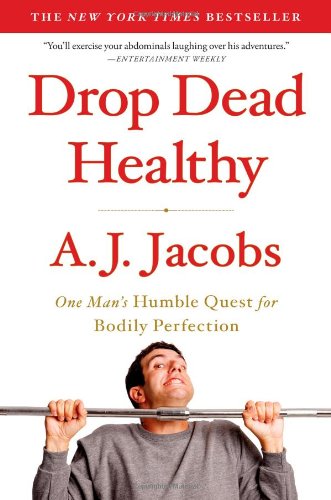
Drop Dead Healthy by A. J. Jacobs
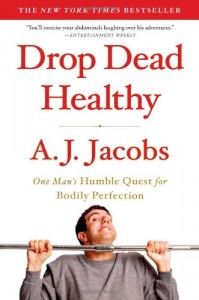 Drop Dead Healthy by A. J. Jacobs
One Man’s Humble Quest for Bodily Perfection
It’s January and all thoughts here at Book Barmy turn towards new beginnings. It’s time to clean out the fridge, toss the leftover Christmas cookies, make a salad or two and get back to the gym – or at least dust off and organize my gym bag — small steps, folks, small steps. So what better book to read than this?
In terms of dusting things off, I’ve had Drop Dead Healthy on my shelves for ages and never opened it. Strangely, I can’t remember where I got it. I wonder if it was a gift from a well-meaning fit friend? But then I remembered, I bought this book last January during what now appears to be my annual mission to transform myself. As one of quotes on this books says, “Why go to the gym when you can sit and read a funny book about it instead?” USA Today
During this month of repent and resolutions, we are bombarded with a myriad of health fads, hard-sell gym memberships, hundreds of different diets — not to mention, legions of healthy living articles, cook books and television shows. Mr. Jacobs, on his own quest to get healthy and fit, takes us through his experimental dips into many of these fads and trends .. all with very funny results.
He goes “Caveman” with the Paleo movement and enjoys their diet of nuts and berries (but passes on crushed insects, despite their reputed high protein value). I laughed out loud when Mr. Jacobs tries a pole dancing workout class where he was the only man among fifty women wearing high heels and sporting an alarming amount of cleavage.
In an attempt to combat the “Crimes of Excessive Sedentary Behavior” and consume extra calories while working, he bypasses the webpage advertisements for $400 treadmill desks and rigs up his own version — with his laptop perched on a stack of four cardboard boxes that teeter on an end table at the end of the treadmill — and he even dares to include a photo.
Mr. Jacobs mystifies his family by bringing home a toilet seat that requires a third world squatting pose to navigate, which he read was healthier than the conventional sitting position – again a photo is provided — thankfully, with the author fully clothed
Jacobs tries veganism, raw food, Atkins, juice cleanses, along with dozens of other diets. He tries Cross Fit, anti-gravity yoga, running barefoot though New York (ouch and yuck) and Stroller-cise with other new moms and dads — “I push Zane’s stroller through Central Park while jogging, jumping, stretching and getting stared at”.
What Drop Dead Healthy does best is detail the author’s personal experiences and reactions — much like sitting with friend over coffee (non-fat of course) and listening to his funny and self-deprecating stories of trying to get fit and healthy. However, we are laughing WITH him….not at him. In fact, we cheer along as he posts his periodic checkup results and his slow, but steady weight loss.
Even the appendixes are fascinatingly funny – from how to fit in exercise all day long; “wear a diving weight vest all day – be prepared for suicide bomber jokes” (or potential police arrest, I’d venture) to best food advice; “Don’t be so obsessed with healthy food that you end up alone in the corner eating organic kale and silently judging your friends.”
There is humanity to Mr. Jacobs story. He finds inspiration in his loved ones. His 90-year old grandfather who remained active in community affairs long after his formal retirement, his eccentric Aunt Marti, those adorable but rambunctious sons, and his endlessly patient wife, Julie–all are a constant reminder that healthy relationships are paramount in any well-lived life. In the end, we are motivated to get some exercise in any way we can and eat healthier — but the larger lesson is that health is highly personal – each of us must choose what feels right and healthy for us – a balance of body, mind and spirit.
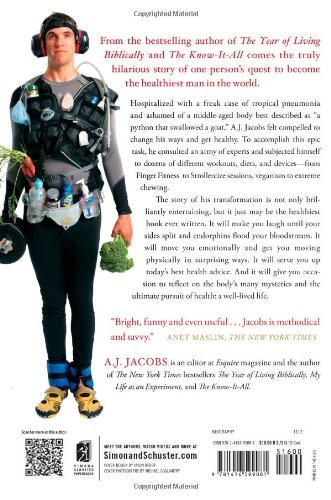
I just have to show you the back cover~~~
N.B. I also learned that drinking ice water burns 8 calories a glass. If you drink 8 glasses, that’s 64 extra calories a day. Now let’s see, a small glass of wine is 100 calories…
-
Missing ~~~
Book Barmy is only missing for now. I’ll back soon with more book recommendations and reviews. Watch this space.
-
Resolutions
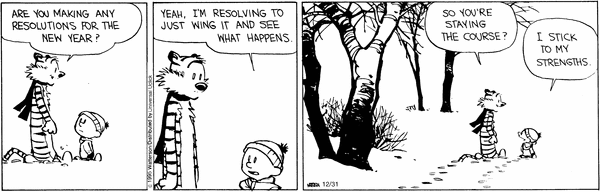
This captures it ~~ for me anyway ~~ Happy 2016.
-
Happy New Year
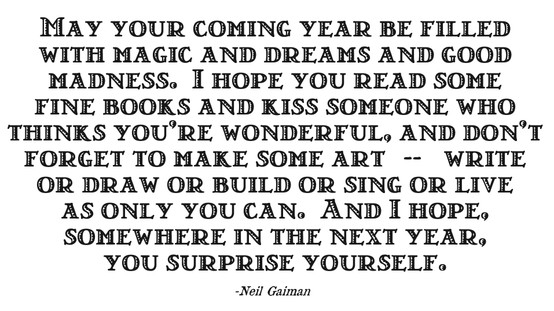
My favorite wish for all of you in the New Year…
Stay safe, please.