
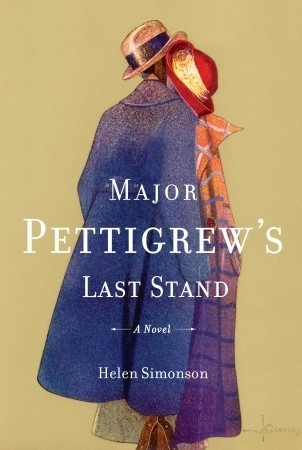
I picked up this novel expecting a cozy English village comedy. After all, it’s set in Edgecombe St. Mary, a small village in the English countryside filled with rolling hills, thatched cottages, and eccentric characters.
This novel opens with Major Ernest Pettigrew, retired, widowed, sixty-eight years old, opening his front door in a red flowery housecoat. He has just learned that his brother Bertie has died. He is crying. And there, on his doorstep, is Mrs. Jasmina Ali, the Pakistani shopkeeper from the village, who has come to collect the newspaper money because the paper boy is sick.
She takes his arm, walks him to a chair, and makes him tea.
That’s the moment when the entire novel turns. A stiff, proper Englishman in a housecoat, and a woman the village considers a permanent foreigner, sitting in his living room, sharing a cup of tea and the first honest conversation either of them has had in years.
From there, a friendship grows. They share a love of Kipling. They share the experience of losing a spouse. They share a quiet understanding that the world has moved on without them, and that they are both, in their own ways, outsiders in this little village they call home.
The Major is not a hero. He’s stuffy and opinionated. He’s so repressed that he makes tea before he can process grief. But Ms. Simonson peels him apart slowly, layer by layer, until we see the loneliness underneath. He’s not a saint. He’s just a man who has spent his whole life doing the proper thing, and who suddenly realizes he might have one chance left to do the right thing.
Mrs. Ali is the heart of the book. She’s dignified, intelligent, and quietly furious in ways she rarely lets show. She’s caught between two worlds, the Pakistani family that expects her to disappear after her husband’s death, and the English village that will never quite accept her as one of its own. Her patience is not passivity. It’s a survival strategy. Watching her slowly decide she’s allowed to want more is deeply satisfying.
The romance is gentle, and that’s what makes it powerful. This is not a passionate, sweeping love story. It’s two people in their later years, cautiously reaching for each other across a table in a tea shop. The Major agonizes over whether to hold her hand. He worries about what the village will think. He makes mistakes. He says the wrong thing. And then he tries again. It’s the most realistic depiction of late-in-life love I’ve read.
The satire is sharp without being cruel. The villagers of Edgecombe St. Mary are ridiculous, the golf club snobs, the gossiping ladies, the Major’s insufferable son Roger, but they’re recognizable. We all know these people. We’ve all dipped into being these people. Ms. Simonson holds up a mirror and lets us laugh, and then she lets us feel the sting.
Major Pettigrew’s Last Stand is not a perfect novel. It meanders. It gets a little tangled in its own subplots. But it’s a novel that believes in something important: that it’s never too late to change, never too late to love or to stand up for what matters. The Major spends most of his life hiding behind decorum. And then he meets Mrs. Ali, and he decides to stand.
It wasn’t just the cozy English village comedy I expected, it was that — but it’s also a novel that snuck up on me and opened my heart. By the final chapter, I wasn’t laughing at Major Pettigrew anymore. I was cheering for him. And I was thinking about my grandfather, and the ways we all build walls, guarding our feelings, and calling it dignity. That’s the simple, yet deeply human story in Major Pettigrew’s Last Stand— and it’s worth reading.
N.B: Just look at that cover – a very clever depiction of a coat stand – get it?