The Book of You by Claire Kendal

The Book of You


His name is Rafe, and he is everywhere Clarissa turns.   What could have been a formula stalker thriller, is luckily so much more.  It’s a creepy, often graphic read, and with my husband out of town, I checked the door was locked and read with several lights on in the house.

Clarissa, as the main character, develops as the book progresses.  She hides, cowers and seems vulnerable, but the reader will cheer the bravery in her relentless gathering of evidence against Rafe.  Upon police advice, she keeps a small journal “The Book of You” detailing every stalking move Rafe makes.  And while repulsed, she also keeps all his “gifts” and lurid photos – all in the hopes of gathering enough evidence to have him arrested.  The story is told interspersed between her journal entries and current time. 

The stalking soon becomes part of her everyday as she attends jury duty, meets another man and tries to carry on a normal life.  She keeps Rafe’s stalking, her journal and her fear a secret from everyone – adding to the suspense of the book.

Most compelling was how the author, little by little,  lets the reader fall into the mind and feelings of a stalking victim, how they try and maintain normalcy, how their lives are turned into a mine field of psychological terror, and how even the simple things that brought them joy (Clarissa’s sewing) can be made dirty.  This is what sets this debut thriller apart from the standard.   The ending was so good, I raced through the last few chapters and then  the next morning re-read them to savor the twists of the plotting.

In several instances the narrative breaks down and defies logic, and the dialogue can be stilted and poorly crafted – especially from the neighbor lady  — “You think I’m just a sweet old lady, Clarissa, a kindly spinster who knows nothing and has experienced nothing….”  arghhh.

But those two minor critiques did not stop me from devouring this chilling read and it still lingers in my mind.

Advanced Reading Copy provided by Harper Collins


We Are All Completely Beside Ourselves by Karen Joy Fowler

Weareall

I’d been hearing the raving reviews of this novel, and so was thrilled to receive an Netgalley review copy.  I started the novel and was immediately bogged down.   The novel begins in the center of the story and through flashbacks the secrets are revealed.  I stuck with it and learning the (not-so-secret) surprise that our narrator Rosemary was raised with a “sister” Fern who happened to be a chimp and disappeared when Rosemary was five years old.

This reveal turned out to be the most interesting part of the novel

Now I was intrigued but still having trouble slogging through the flashbacks, and overly complex story lines.

I get that this unusual chimp fostering  experiment had a long armed impact on various members of the family — especially Rosemary and often the writing is magical, funny and warm — but I could not finish this book.

I had trouble relating to any of the characters and found the this ever-churning tale of family loss, coming of age, and animal abuse extremely sad.   Beware — the last part of the book involves gut-wrenching and sickening animal experiments and that is where I stopped reading.

Review copy provided by Penguin Group via NetGalley.


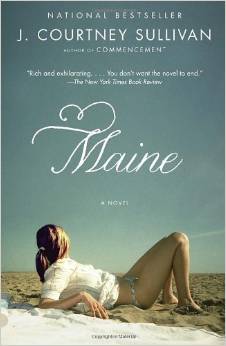
Maine by J. Courtney Sullivan

Maine

I’d had this book on my shelf for ages and could never get past the first few chapters,  so donated it to the Friends of the SF Public Library and forgot about it.

Then, I discovered I was going to be in Maine, so checked it out as a Kindle book from the library – that’s just how I roll folks.

This novel tells the tale of three generations of Kelleher women;  Alice – the cruel matriarch, Kathleen –  flawed, recovering alcoholic, Anne Marie – duty-bound daughter-in-law, and Maggie – the young hapless victim.

Because I planned to read this while at a friends camp (cottage) on a lake in Maine, I thought this would be the perfect novel.  But, turns out Maine (the state) does not really have any role or influence on Maine, the book.

Despite the back cover/inside flap copy this book is NOT a fun beach read about a family’s enjoyable summer days spent at their summer house in Maine — there’s no fun in this Maine. Where’s the lobster dinners eaten outside while slapping the mosquitoes, the chilly early morning swims, or the lazy hot afternoons reading on the porch?

Maine is a dark and grim expose of women joined by dysfunctional drama.  Told in alternating narratives, each chapter is the voice of a different character.   The author sets up the plot of past hatreds and buried secrets and then lets each character delve into their viewpoints, resentments and pain.

The book is extremely well-written and really starts to take off halfway through, when the women come together in Maine at the family summer house.  But, I found it hard to relax and just enjoy this book.  This is a book where motives have to be analyzed and resulting actions dissected  – a good book group discussion could result from the family dynamics.   And as a bravo to Ms. Sullivan, much of the family dysfunction is made real and familiar for anyone with a family — issues or not.

Perhaps  that’s what Ms. Sullivan meant to achieve – an deep, unflinching look into a flawed and dysfunctional family.

So, don’t be mislead by the book’s “summer beach read” promotional copy and do read Maine if you want a well-written, darkly real and unflinching family saga.

Quote:  

Ann Marie sat at every family dinner and listened to them tell the same stories over and over.  She never met a family so tied up in their own mythology.


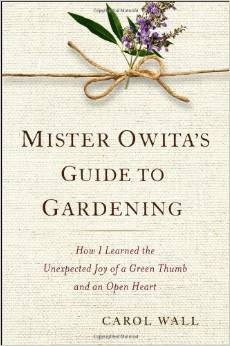
Mister Owita’s Guide to Gardening by Carol Wall

Mr.o

The subtitle, How I learned the Unexpected Joy of a Green Thumb and an Open Heart, struck a instant cord…I’m a sucker for gardening books – especially those wherein a garden is transformed.  (I secretly wish to be Vita Sackville-West.)  So this memoir seemed  just for me.

Turns out Mister Owita’s Guide to Gardening is not so much about gardening as friendship, cancer, life-lessons, and humanity.

Carol Wall forms a friendship with a local gardener, Mr. Owita, hoping he can transform her garden.  She is a difficult client and Mr. Owita does what he thinks is best for her garden ignoring her wish to have all the azaleas removed and giving her his bits of wisdom on gardens and life.

As the days progress, Ms. Wall’s cancer returns, she forms a closer friendship with Mr. Owita and learns more about his background.  He’s from Kenya and actually has a PhD in horticulture, but is unable to get a university posting and is forced to work several minimum wage jobs.  He has a daughter he had to leave behind and is working hard to save enough to bring her over to the US.

Ms. Wall’s troubles feel lighter and she becomes less self-involved, as she learns more and more about Mr. O’s burdens.  At the beginning of the book she is whiny and very self involved  – but then again, she is suffering greatly from a re-bout of cancer – so I didn’t find it too off-putting.

I did drink in this memoir filled with satisfying insights and reflections.  Ms. Wall has a lovely writing style – just perfect for the story told.  I found myself liking Carol Wall –she is far from perfect and is not afraid to display her missteps, foibles, and narcissist tendencies.

A really nice plot point about why she didn’t want azaleas or color in her garden left me sighing with pleasure…while an undeservedly nasty letter to her husband left me shaking my head.   Mr. Owita’s challenges seemed more interesting than hers, his character fascinatingly wise and I wished there was more development of his character.

Ms. Wall has a right to tell her story in her way and I will  not criticize a book for NOT being what I thought it would be. This is a lovely memoir about living with cancer (warning, cancer looms large), finding friendship, the joy of a garden (as opposed to actual gardening) and life lessons learned from someone who is suffering their own silent burdens and tragedies.

Review copy provided by Putnam Group via NetGalley.


The Hundred-Foot Journey by Richard C. Morais

100ft

The film is coming – the film is coming.  So I grabbed this book off my shelves where it has been ignored for several years now. As always, I want to read the book before seeing the film (with Helen Mirren – oh boy).

I bought this paperback several years ago, solely based on the cover, call me shallow, but isn’t it delicious? See the gold embossing up the edge of the spine?…sigh.  My copy doesn’t have the red circle announcing the film.

Anyway, now to the book.  The Hundred Foot Journey tells the story of an Indian boy, Hassan Haji, whose family is forced to move from Mumbai, to England and finally to Lumiere, a small village in the French Alps.

They purchase a large country house and because Papa Haji is a entrepreneur and the aunt excels at Indian cuisine, they blithely open an Indian restaurant.  Just across the street is the Michelin starred restaurant of famous French chef, Madame Mallory.  As expected the cultures and cuisines clash, an Indian restaurant in the French countryside – mon dieu!  The main storyline follows the coming of age and the making of famous chef – young Hassan.

I found the book interesting and often captivating, but many aspects fell short for me.  The glimpses into the various cultures and their cuisine were superb – Mr. Morais obviously knows and loves food. The descriptions of meals served and eaten are cinematic (thus the film adaptation).  The kitchen scenes felt very realistic, but be warned  some of the meat slaughter and preparation scenes will have you contemplating vegetarianism.

The narrative fluctuates from first person to third person which I found a bit jarring and the pacing is a bit sporadic.  The book glossed over any real hurdles immigrant families might face – language, assimilation and what about the endless paperwork?

In the end, however, the food is the only thing that comes alive in this novel.  I found the characters lacking warmth or depth and some are an actual mockery – Papa Haji has a manufactured Indian dialect that I found condescending.  A relationship between Hassan and Margaret lacks any warmth or passion.  Hassan, robot-like, ascends the heights of his star chef status, without enthusiasm.   Madame Mallory is the most developed character, as Mr. Morais gives us insight into her past and emotions.  She is the one who singles Hassan out for greatness:    ”That skinny Indian teenager has that mysterious something that comes along once a generation. He is one of those rare chefs who is simply born. He is an artist.”

So why  did I finish this book? – THE FOOD – read this book for the vivid and mouthwatering descriptions of hot, frenetic kitchens, food lovingly prepared, wines carefully chosen and meals savored.

The real heart and soul of this book is the joy of cuisine.

Hoping to see the film soon.


The Night Bookmobile by Audrey Niffenegger

night bookmobile

A gift from a friend who knows I love books, libraries and enjoyed Audrey Niffenegger’s The Time Travelers Wife.

This is an illustrated (illustrations by the author!) novel for adults – it is important to note that this is not a children’s book…which you will discover upon reading.

A beautifully haunting tale that speaks directly to those of us who keep lists and notes of every book we’ve read.  The Night Bookmobile mysteriously  appears one night carrying every book Alexandra has ever read — from her first picture book, to her cookbooks and even her diaries.  The encounter with the bookmobile and it’s reticent driver/librarian  helps her decide upon a career as a librarian, but she longs to work in the Night Bookmobile and wanders the streets at night hoping for its return.

Many years pass and Alexandra becomes more and more alone — reading ever more voraciously to try and impress the librarian to return with his mysterious bookmobile —  and then one night it does…

I will not reveal more about the story (no spoilers), and I surely didn’t like the ending, but this short book and its beautiful illustrations stayed with me long after I finished it.  As the author notes in the after words:  “this is a story about the claims that books place on their readers, the imbalance between our inner and outer lives, a cautionary take of the seduction of the written word.”

Book lovers – this book will enchant you, have you nodding in recognition, and then astound you with the ending.

A bittersweet, depressing, yet somehow uplifting book.  How can it be all these things?  You’ll just have to read it yourself.

The Goldfinch by Donna Tartt

goldf

This is the first book I purchased for my new Kindle (yes I’ve gone to the dark side – but I have room in my life for many reading methods).   The Goldfinch is over 700 pages and the hardback was almost $30 – while the Kindle version was $8.  Done!  I could not wait to read this.

Ms. Tartt is a precise and careful writer –her last book was 10 years ago, and her prior book 10 years before that, so I knew this would be well-written with a tautly crafted plot.  But at 771 pages I wondered how tight the storyline would be.

Well it turns out The Goldfinch has several story lines – it’s almost as if there are three books in this one novel.  But in her usual fashion Ms. Tartt keeps these narratives racing along without excess.

One of the reviews noted The Goldfinch was a Dickensian Bildungsroman , and yes, I had to look that word up.  

Here you go —  no charge:    

In literary criticism, a Bildungsroman, [a] novel of formation, novel of education, or coming-of-age story is a literary genre that focuses on the psychological and moral growth of the protagonist from youth to adulthood, and in which, therefore, character change is extremely important. 

At the risk of being hackneyed,  I could not put this book down.   I reluctantly went to sleep worried about the main character, Theo Dekker, as he moved from one miserable situation to a life threatening crises, to a hopeful place.

The detailed writing style requires a tenacious attention span but I was fully enthralled throughout the novel.  There are beautifully crafted scenes, vivid descriptions, wonderful characters – heartbreak, love and joy.

There are plenty of professional reviews out there,  go and read them and then please read this Pulitzer prize worthy novel.

(Edited later – The Goldfinch ultimately and deservedly did win the Pulitzer.)


Letters from Skye by Jessica Brockmole

skyex

Best to state this upfront, I’m a total sucker for epistolary novels, so I eagerly opened this novel on a weeknight with lots scheduled for the next few days.  Silly me, no early bed times for me for the next couple of nights.   And yes, I read this engaging novel in two evenings.

It’s 1912 and Elspeth, an isolated poet on the Isle of Skye, receives a fan letter from a young American, Davey, as he is about to start college.  Thus begins a  5-year correspondence that starts as a friendship and grows into a love affair.  The story spans two wars, and is intertwined with Elspeth’s daughter’s (Margaret) letters as she struggles to unravel the mystery of her mother’s early years, this correspondence (affair) with Davey and ultimately, the family breaking apart.

The story is told entirely via letters,  which is a very difficult format to pull off.  Many such novels can border on the gimmicky…but not Letters from Skye.  Ms. Brockmole deftly builds her characters, giving them depth, layers and feelings. With each letter, the story, the characters and their strong bond are slowly revealed.

I had to remind myself that this was fiction, that these weren’t real letters or real people.  The letters also are able to  convey the  beautiful  ruggedness of the Isle of Skye and the war-torn Edinburgh.

Importantly this book made acutely aware of the lost art of letter writing  — where the letter-writer captures the day’s weather, mundane bits of daily life and bare their secret feelings and dreams on good old-fashioned paper.  Letters that were eagerly awaited, opened and treasured. Not like today’s temporary emails, text messages, tweets and Facebook postings.  Our correspondences are no longer treasured – what will we have to re-open, re-read, re-live?

It is obvious that the author did a great deal of research, so it’s a shame that some of the letters didn’t ring true with some of the language a bit “off” for the time period  — but that’s a minor quibble.

An enchanting book with characters that work their way into your heart.

I almost never do this anymore, but I’m keeping my ARC copy to re-read.

A quote from the book:  “I should have told you, should’ve taught you to steel your heart. Taught you that a letter isn’t always just a letter. Words on the page can drench the soul…”

Advanced reading copy provided by Random House, Ballantine Books.

State of Wonder by Anne Patchett

10870072

The opening sentence:

The news of Anders Eckman’s death came by way of an Aerogram, a piece of bright blue airmail paper that served as both the stationary and when folded over and sealed along the edges, the envelope.  The single sheet had traveled from Brazil to Minnesota to mark the passing of a man – a breath of tissue so insubstantial that only the stamp seemed to anchor it to this world.

I read that opening line with my mouth hanging open at the beauty of the writing.   Full disclosure, I’m a Anne Patchett fan – Magician’s Assistant is one of my all time favorite novels…as is Bel Canto.    So after that opening sentence,  I was mentally cancelling all plans for the next few days so I could loose myself in this book.

Marina is a drug scientist who is sent to  Brazil find out what happened to her dead colleague.  She is set down in the middle of  the Amazon jungle and immediately faces unforeseen challenges at every turn.  The dramatic storyline takes many twists and turns.  She discovers an experiment taking place among the native women, wherein they chew a native tree bark while it’s still on the tree (really?) and this bark extends their fertility well into their senior years (no women, just say no!).

Marina finds dishonesty and false claims among the drug reports back to headquarters.  The tribal people themselves hold secrets.  She finds love (of sorts) and suffers from long drawn out, vivid dreams as a result of Malaria medication.  The dreams tended to bog down the flow of the story and I must say I kept hoping Marina wouldn’t fall asleep again so I didn’t have to read through another one of her tangled dreams.

I agree with other reviewers that the jungle itself plays a major character.  The vivid descriptions of the heat, humidity, insects, dirt, and torrential rains gripped me into believing I was there.  The story line under another author’s hand might seem incredulous, but as always Ms. Patchett allows you to suspend disbelief and journey with the characters.   I even believed it when they accidentally canoed down the wrong small river tributary and discover … well I won’t spoil it for you.

Bravos to Anne Patchett once again – a must-read adult adventure story, reminiscent of reading with a flashlight under the covers – too wrapped up in the story to go to sleep

Two of my favorite quotes (in addition to that grand opening line):

The question is whether or not you choose to disturb the world around you, or if you choose to let it go on as if you had never arrived. That is how one respects indigenous people. If you pay any attention at all you’ll realize that you could never convert them to your way of life anyway. They are an intractable race. Any progress you advance to them will be undone before your back is turned. You might as well come down here to unbend the river. The point, then, is to observe the life they themselves have put in place and learn from it.

But we cannot un-braid the story of another person’s life and take out all the parts that don’t suit our purposes and put forth only the ones that do.

Little Bee, by Chris Cleave

bee

My good friend was flabbergasted when she learned I hadn’t read Little Bee and she sternly ordered me to go home and read it NOW.

Susan you were so right. Why did I wait so long to read this?

This novel takes place in the summer of 2007, when Little Bee, a sixteen-year-old Nigerian immigrant escapes a UK detention center with little more than her wits, the clothes on her back, and a few fellow refugees. Her plan is to locate and live with Andrew and Sarah O’Rourke, former acquaintances from Ibeno Beach, where they shared a horrifying encounter two years prior.  Simultaneously, Bee makes plans for numerous suicide options for “when the men come”.  Bee and Sarah narrate, sharing their stories and their lies.  The horrific beach incident is eventually revealed but not without some major surprises.

The storyline gallops forward, but try not to read this book too quickly as the writing is exquisite.  The biggest surprise in the novel is the humor – an endearing humor that warms up the stark realities facing Bee, who is an old soul, wise beyond her years. 

Imagine a young woman cut out from a smiling ‘Save the Children’ magazine advertisement, who dresses herself in threadbare pink clothes from the recycling bin in your local supermarket car park and speaks English like the leader column of The Times.

This is a story of survival, interspersed with cruel reality, surprising plot twists, unforeseen revelations, humor and tragedy.  I loved it.

A great quote from Sarah about her husband (spoiler warning here):  

There was no quick grief for Andrew because he had been so slowly lost.  First from my heart, then from my mind and only and finally from my life.