-
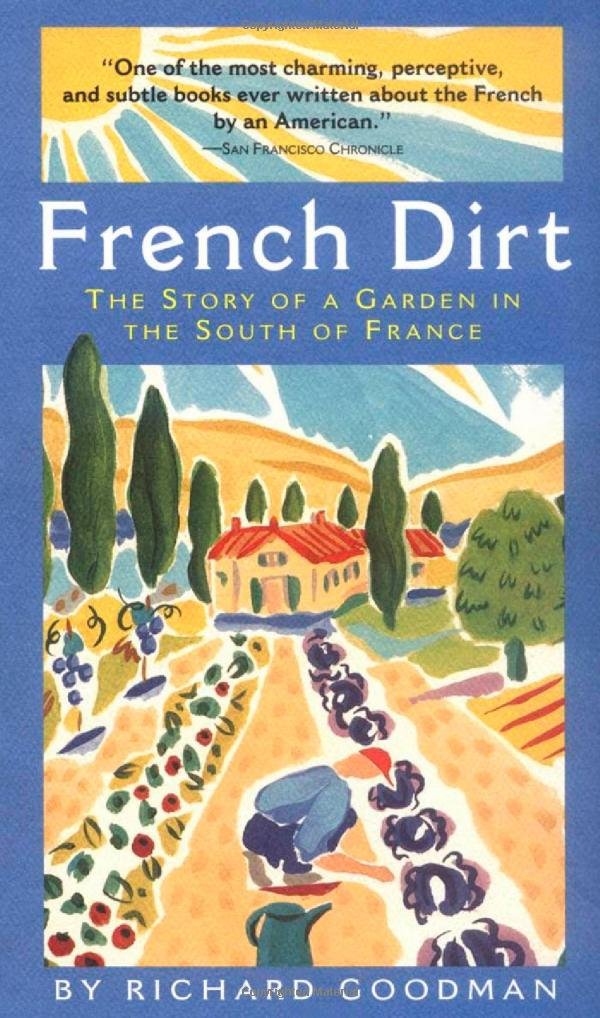
French Dirt by Richard Goodman
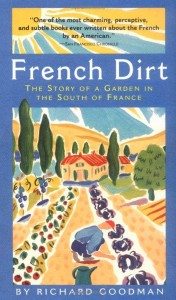 Richard Goodman saw the ad in the paper: “SOUTHERN FRANCE: Stone house in Village near Nimes/Avignon/Uzes. 4 BR, 2 baths, fireplace, books, desk, bikes. Perfect for writing, painting, exploring & experiencing la France profonde. $450 mo. plus utilities.
 And so, with his girlfriend Iggy, he leaves New York City to spend a year renting a two hundred year old stone house in Southern France. Located in a small village fictionally called St. Sebastien de Caisson, it doesn’t have a cafe, store or even a post office. Starry-eyed, Richard and Iggy soon discover they are having a tough time connecting with the locals. Out of necessity, Richard works in a vineyard in exchange for firewood. In the vineyard, he forms a solitary friendship with Jules, a handsome 25 year old, and through that relationship Richard borrows a small plot of land. Having a difficult time making friends in his little village, Richard determines to make a vegetable garden instead.
Oh no, you say, not another “my experiences in France book” — trust me, this one is different — part travelogue, part gardener’s journal, part pilgrimage and wholly enjoyable. I read French Dirt when it was first published in the 90’s and remember it fondly. It has recently been republished with a pretty new cover (shown here) and when I picked it up in the bookstore, I remembered I still had my copy lurking in my
towering chaoscollection of books. I dug out my older copy (Yes, I knew right where it was – I’m a “rainman” when it comes to locating my books) and re-read French Dirt over the last two evenings.What sets this tale apart from the plethora of “my life in France” books, is that Richard is such a hapless American on so many levels. His plans for his garden, forming friendships with the locals, and settling in to a new life often go awry. You chuckle and wince as he binge-buys plants and tries to sort out conflicting advice from the villagers — but then you cheer as he toils and worries over his garden, delights in its growth and is distraught by his garden disasters — all while the neighbors politely hide their amusement at the silly American.
It’s not all fun and games, there is quiet despair as Richard struggles to master the ancient house repairs and loneliness when they are housebound during an endless number of rainy days. But as his garden grows, slow friendships also develop. There is a heart-warming and funny description of a prank in which one of the least likely villagers secretly places perfect red, ripe tomatoes in his garden in early June.
Happily, the book does not parody the villagers — there are no caricatures of French people – they are treated gently and with respect in this memoir. And while Richard struggles and fails, he never feels sorry for himself or blames others. He is open and honest with his own shortcomings. Richard is also serious and perhaps even somber as he recounts the backbreaking hours in the brutal Southern French sun — all for a beloved garden which he knows he must abandon at the end of the year.
He writes; “I would crouch down on one knee, thrust my hand shovel in and turn the earth up and over, revealing its darker, humid underside. Then I would crumble it slowly in my hands to better allow the plant to breathe. In that sense I had a comradeship with the earth: I must be able to breathe, too.”
No question that this is a “gardener’s tale” — if you are not interested in gardens or gardening – this may not be a book for you. And admittedly, the writing is often far from perfect, but you won’t mind as Richard’s story is heartfelt and true.
French Dirt is a gentle adventure of sorts — the American as an immigrant and the searching for a new identity in an old place. If like me, you ever daydream, even just a little bit, about moving to a foreign country – this is a perfect afternoon-in-the-hammock summertime read.
-
Signs That Agatha Christie Is About To Murder You

Courtesy of Beulah Maud Devaney of The Toast
In your previous life you were a medical practitioner and accidentally killed a patient while drunk. Since then you have stopped drinking, changed your name to something with the same initials as your previous name, and moved within 5 miles of the original murder. You have also married the dead patient’s spouse.
You have received a letter from a recent murder victim. You read half of it before stopping to inform your guests and entire staff about the letter. You then wander off to read the rest in your study, next to your collection of antique blowpipes.
At dinner you decide to tell a lighthearted story about a gruesome murder. The murderer escaped but had an unusual physical defect by which you would be able to identify them anywhere. You refuse to disclose any more details but glance meaningfully around the table before heading up to bed.
You noticed something odd at dinner but can’t work out what it was. You informed the table of this and then wandered off to the summer house for a nap.
You began life as a homeless street urchin but, in a vulgar retaliation against your social position, you built your own business empire and now own all of New York.
You have a dazzling cousin with a boy’s name who wears short dresses and enjoys midnight swimming with your fiance. She appears to be in danger of being murdered. You have invited her to stay with you.
You are surrounded by foreigners.
You have a maid called Hilda, Tilda, Greeta, or Gretel who you are horrible to. She has ugly glasses and watchful eyes.
You suspect that a murder has been committed so you tell no one and invite the murderer to dinner.
You have a much younger husband. You met him on a cruise just two weeks after your husband died. Your family doesn’t like his paintings.
Your husband has died after drinking a poisoned cup of tea that only you and one other person could have prepared for him. You continue to doggedly drink tea and claim the whole thing is a misunderstanding.
You are a handsome woman.
You agreed to divorce your wife months ago, but she keeps sending detectives to ask you for a divorce and some of your personalized writing paper is missing.
You organize a big family gathering and use it to insult all your guests. You then whip out your will and alter it at the dinner table while everyone finishes their semolina pudding.
Your mousey little wife is extremely unattractive (those glasses! that schoolgirl bob!) but also bears a passing resemblance to the glamorous film star you are having an affair with.
Worried that your past is catching up with you, you have decided to fake your own death with the use of a dead tramp.
You receive a vaguely lewd poison pen letter and decide to have a bridge party to celebrate.
One of your neighbours accidentally donated a priceless work of art to the vicarage jumble sale. You brought it on a whim and are now drinking tea beneath it.
You are traveling to meet your young lover when you notice your estranged husband getting on the same train. You assume last night’s ugly scene (where you told him about Alfredo’s sensuous spirit) has been forgotten and he is taking a spontaneous business trip.
You insist on dropping hints to your guests about Bunny’s “frightfully interesting time during the war.” Bunny is glowering.
You are being blackmailed by a swarthy fellow. Rather than give in to his demands you make a speech about good old England and then turn your back to write a note to your tailor.
You habitually wear dark glasses, big hats, false teeth, bulky coats and speak with a unique yet easy to mimic accent. All of your friends, family and staff used to be on the stage.
Everything tastes horrible.
Everyone hates you.
-
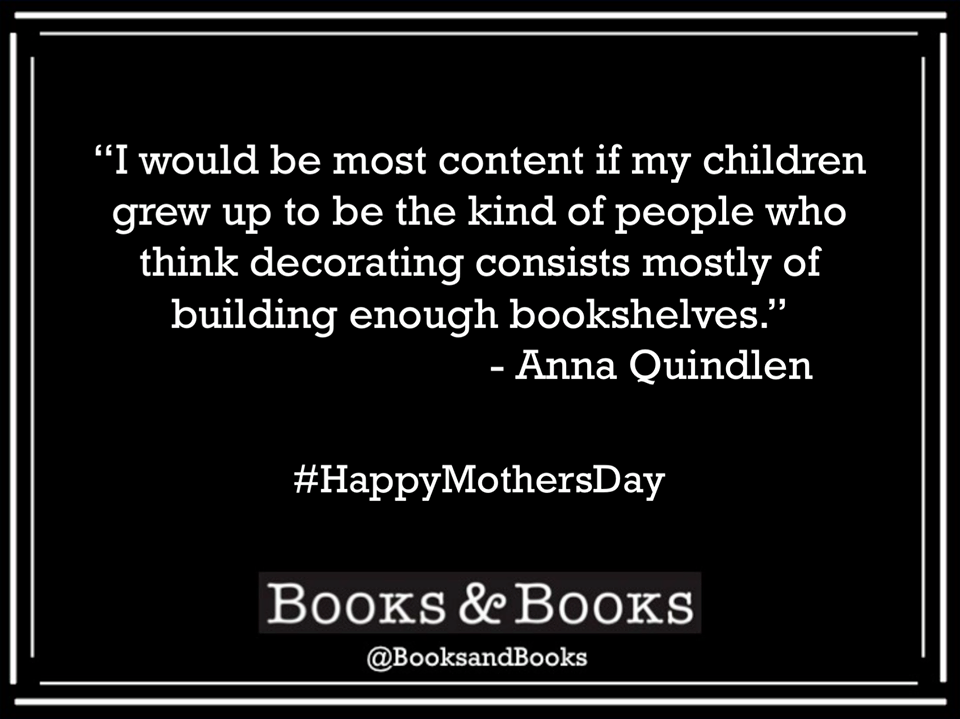
Decorating Advice From My Mom

Thank you, Mom
Happy Mothers Day.
-
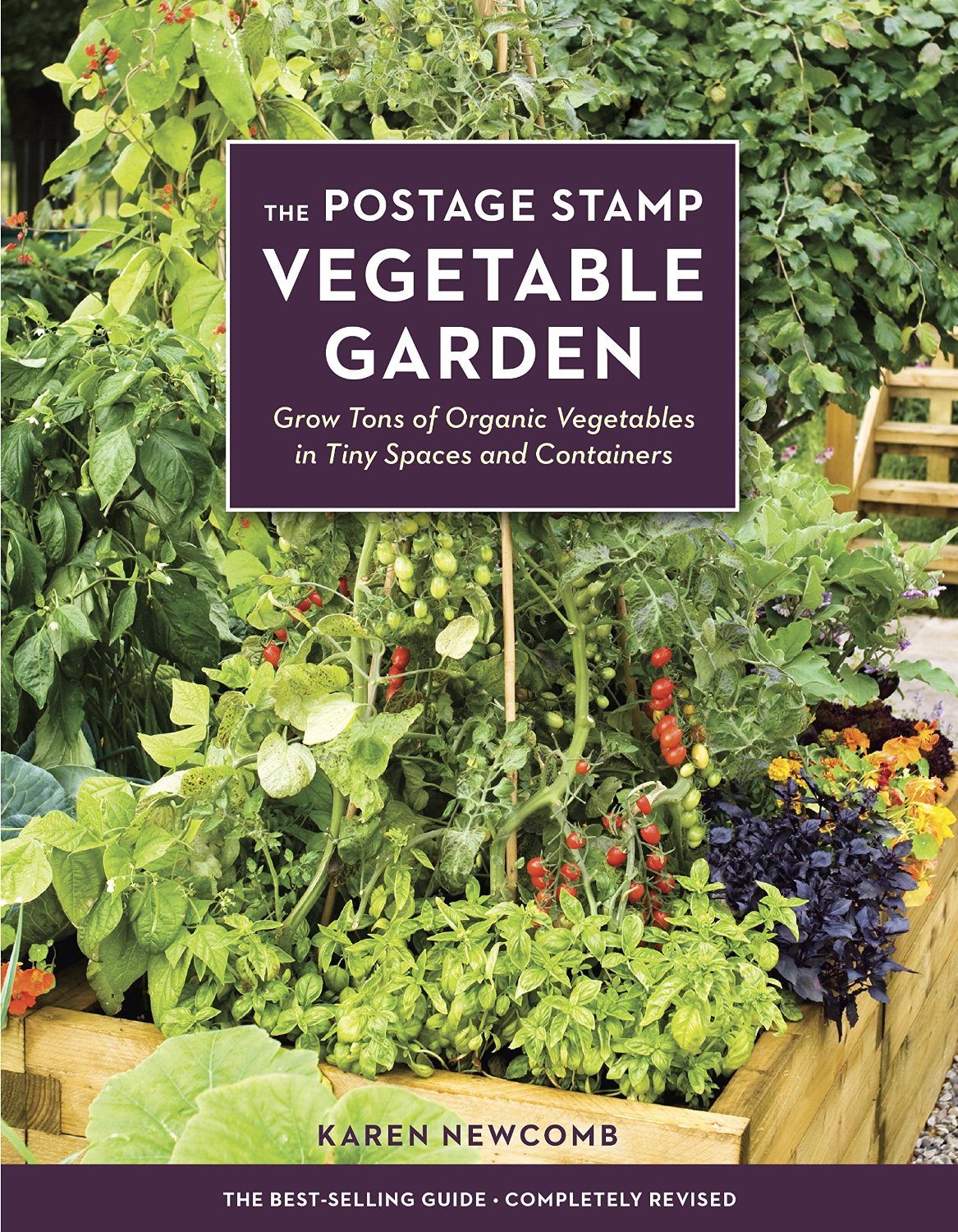
The Postage Stamp Vegetable Garden by Karen Newcomb
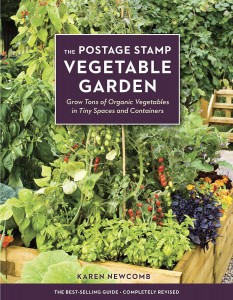 What, you say — a gardening book? Who sits down and reads a gardening book? True confession time, I do. This guide turned out to be ideal for my city-small garden and my raised vegetable growing beds.
The book opens with this great passage:
It’s a beautiful day. There’s not a cloud in the sky. The temperature is in the mid-80s. And there you are in your backyard, picking loads of vegetables from your own small garden tucked away in the corner of your property. Tomatoes, onions, corn, beans, you’ve grown them all—in fact, more than you ever dreamed possible from such a small space.
Impossible?Of course not. That’s exactly what a postage stamp garden is intended to do and what you will learn to do in the next several chapters. The techniques outlined here allow you to double or triple the quantities of vegetables you might normally grow in any given space.
First published 40 years ago, in this newly revised edition, Ms. Newcomb introduces us to a radical style of gardening tailored for “postage stamp” or small space gardens. She advocates planting seeds much closer than recommended on the seed packets, with no neat rows and succession plant so you have crops all year round (depending on your location).
She goes on to explain the history of this technique.
The history of this incredible gardening system began in the 1890s. Outside Paris, a few enterprising Frenchmen began raising crops using a new method they discovered. Over their land they spread an 18-inch layer of manure (plentiful in the day of the horse and buggy) and planted their vegetables so close together in this rich material that the leaves touched one another as the plants grew. Under this carpet of leaves, the ground remained moist, warm, and vigorous. During periods of frost, they set glass jars over the tiny plants to give them an early start. So good were the Frenchmen in devising fresh ways of growing things that they were able to produce nine crops a year. Such was the birth of the French Intensive method of gardening, an early form of what we now call intensive gardening.
The benefits of this technique, besides year-round vegetables, are quite attractive — you need less water (key here in California) and it requires less weeding (hear-hear!). Not to say that postage-stamp gardening doesn’t have it’s challenges – it does — but they are clearly and simply explained in this book.
She makes it easy to understand her concept of “crop stretching” — that is, when succession planting in an area that has frost and winter (poor you) you should alternate your crops – early spring planted crops (spinach) are replaced by later crops (beans). Also, if you’ve just harvested slow-growing crops (broccoli) in late summer you now have a short growing season left, so plant a quick maturing crop such as green onions. If your garden is in a temperate climate (like mine) you can plant the same crops in succession all year long (as with lettuce or spinach). She goes on to explain “intercropping” — planting quick maturing crops between slower maturing crops. You harvest the intercrops before the maturing crops have grown big enough to crowd the smaller plants out. That’s getting double duty out of your postage stamp bed.
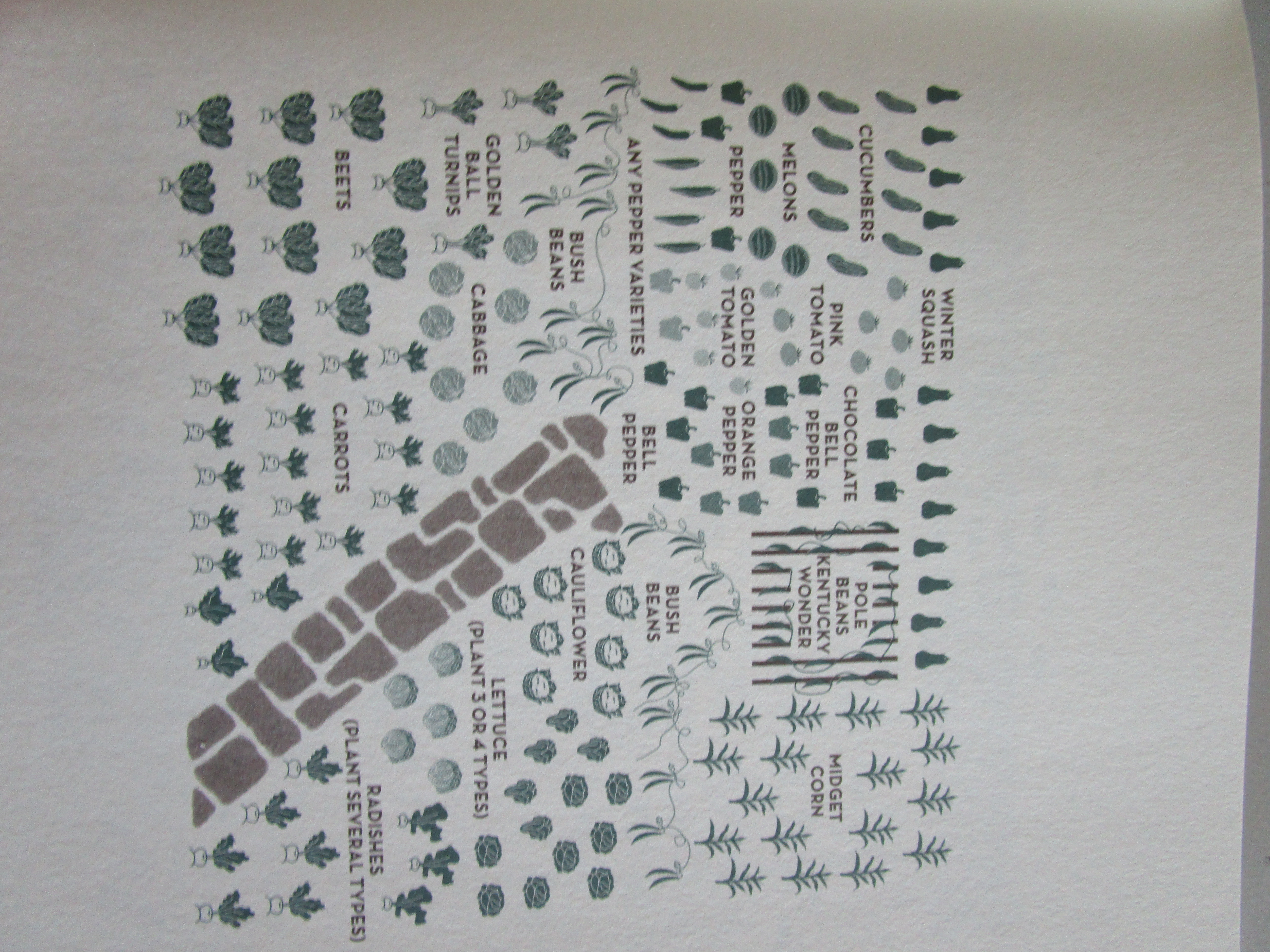
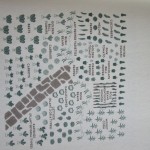 The author has given detailed drawings of sample garden layouts, (sorry for the poor photo) there are several designed to fit a 4×4 bed. Look at all the produce! Click to make larger.
The last half of the book is filled with a vegetable by vegetable guide – Ms. Newcomb recommends heirlooms and gives a cute little postage stamp rating (1 to 4 stamps) to indicate which are best for postage stamp gardens. And each section gives crop stretching advice — “you can follow beans with a planting of cabbage…”
There are additional sections covering: Plants That Like Each Other; Herbs; Companion flowers; Composting and Pest Control.
After reading this book, I felt like a beginning gardener all over again. Turns out I’ve been doing it all wrong — plant my vegetables once (or twice) during the year, always in neat rows, thin the small seedlings, and rejoice over what now appears to be very paltry results.
So, if you have a small garden or don’t want the work of a larger one, this is the book for you.
Now, if you’ll excuse me, I have seeds to plant.
-
The novels of Nicole Mones
Overheard in the bookstore the other day:
“Have you read this? It’s wonderful.”
“I don’t read novels, when I read I want to learn and educate myself.”
I’ve heard variations on this opinion before from smart and respectable non-fiction-only readers and I always nod and smile. In truth, however, I have to quell the urge to grab them by the arm, march them into a comfortable chair, give them a cup of coffee and demand they read an author such as Nicole Mones.
A newly launched textile business took Nicole Mones to China for the first time in 1977, after the end of the Cultural Revolution. She traded textiles with China for eighteen years before she turned to writing. Ms. Mones’ extensive knowledge of China’s culture, history and politics is woven throughout her books. Her novels are enthralling, but each one is an education as well. Ms. Mones is an author who obviously understands that there are readers who want to think and be entertained at the same time.
++++++++++++++++++
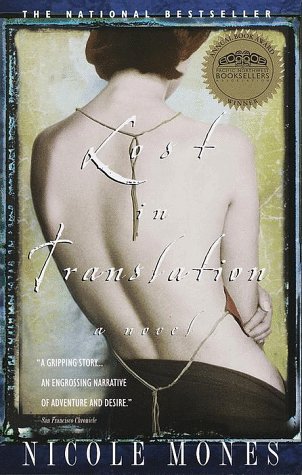
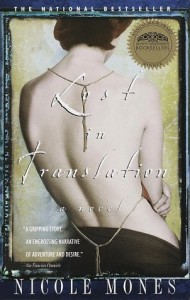 Lost In Translation, Ms. Mones’ debut novel takes the reader into the world of Alice, an unlikeable American woman living in contemporary China. Alienated from her Congressman father because of his overt racism, Alice seeks to leave America behind and become Chinese. She works as a translator by day and secretly haunts bars at night often having one night stands with Chinese men – trying to understand and connect with the xenophobic culture.
 But things change for Alice when she accepts a translator position with an archeological team tracking the remains of the ancient and important Chinese treasure — “the Peking Man”. Alice becomes close to Lin a member of the team, while they navigate mysterious secret meetings and the threat of arrest. Working with Lin, she forms a close connection and better understanding of Chinese culture and history
The novel not only mesmerizes with the fictional characters and storyline, but goes further to weave in the historical significance of Peking Man as the first ancestor of China and the important writings of the French Jesuit priest-philosopher, Tielhard de Chardin, from whom the archeological team gains clues as to the whereabouts of the bones. This novel has it all – an engrossing mystery combined with Chinese cultural history and a dash of sex and romance.
The title* captures the gist of the novel, namely the difficulties of trying to move between cultures, language, history and current society — never being sure what has been lost in translation. (*No relation to the Bill Murray film of the same name.)
+++++++++++++++++++++++
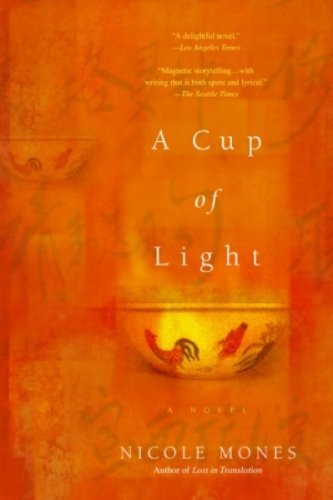
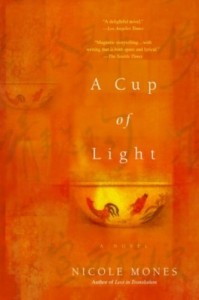 A Cup of Light transports us into the rarefied world of Chinese porcelain “pots” long treasured by emperors and collectors alike.
Lia Frank is an American appraiser of fine Chinese porcelain and is sent to Beijing to authenticate a collection of rare pots going up for international sale. As she unpacks the crates, holding each delicate piece and “feeling” the refined porcelain, she discovers there are many more pots than originally estimated and that some of them are “fakes”. But these are no ordinary fakes –these are forgeries so exquisite, so precise that she has to find the forger. In Chinese culture when the copy is as beautiful as the piece it imitates then the forgery and the forger are greatly admired.
Again an education here — with A Cup of Light you’ll discover the infamous Chenghua Chinese cups, visit the town of Jingdezhen where the truly priceless pots were manufactured for the emperors and learn how these pots were hidden and smuggled out (with some lost) during the 1931 Japanese invasion. Also, if you’re like me you’ll cringe in embarrassment as you learn that J.P. Morgan (yes that J.P. Morgan) tried to buy the entire contents of the Forbidden City in 1913 for twenty million dollars – so many of the priceless and culturally important pots were buried and hidden. Luckily, old J.P. died and the deal was abandoned.
Lia wears hearing aids and takes them out to achieve complete silence to exercise her memories. Lia is a mnemonist and has memorized not only every pot she has ever examined, but also every catalog and history. She uses the Greek/Roman mnemonic system to memorize and at first I found it unbelievable, but with a little research I found it was actually a real thing. Ms. Mones also based this on the real missionary Matteo Ricci who taught young Chinese scholars tricks to increase their memory skills–an important advantage in a nation with countless laws and rituals which had to be learned by heart. But I digress, when Lia goes into her memory files to help her determine which pot is real or fake, we get some fascinating Chinese porcelain history. Also fascinating is the current day political intrigue intruding into Lia’s world of beautiful pots contrasted with her researching (remembering) similar shadiness throughout the history of Chinese porcelain.
Ms. Mones was a textile trader in China for many years and her knowledge of the underworld of art smuggling and forgeries shines through. In each of her novels, the lead female characters have many flaws, but Ms. Mones always portrays them as competent, professional women with real work to accomplish.
+++++++++++++++++++++++
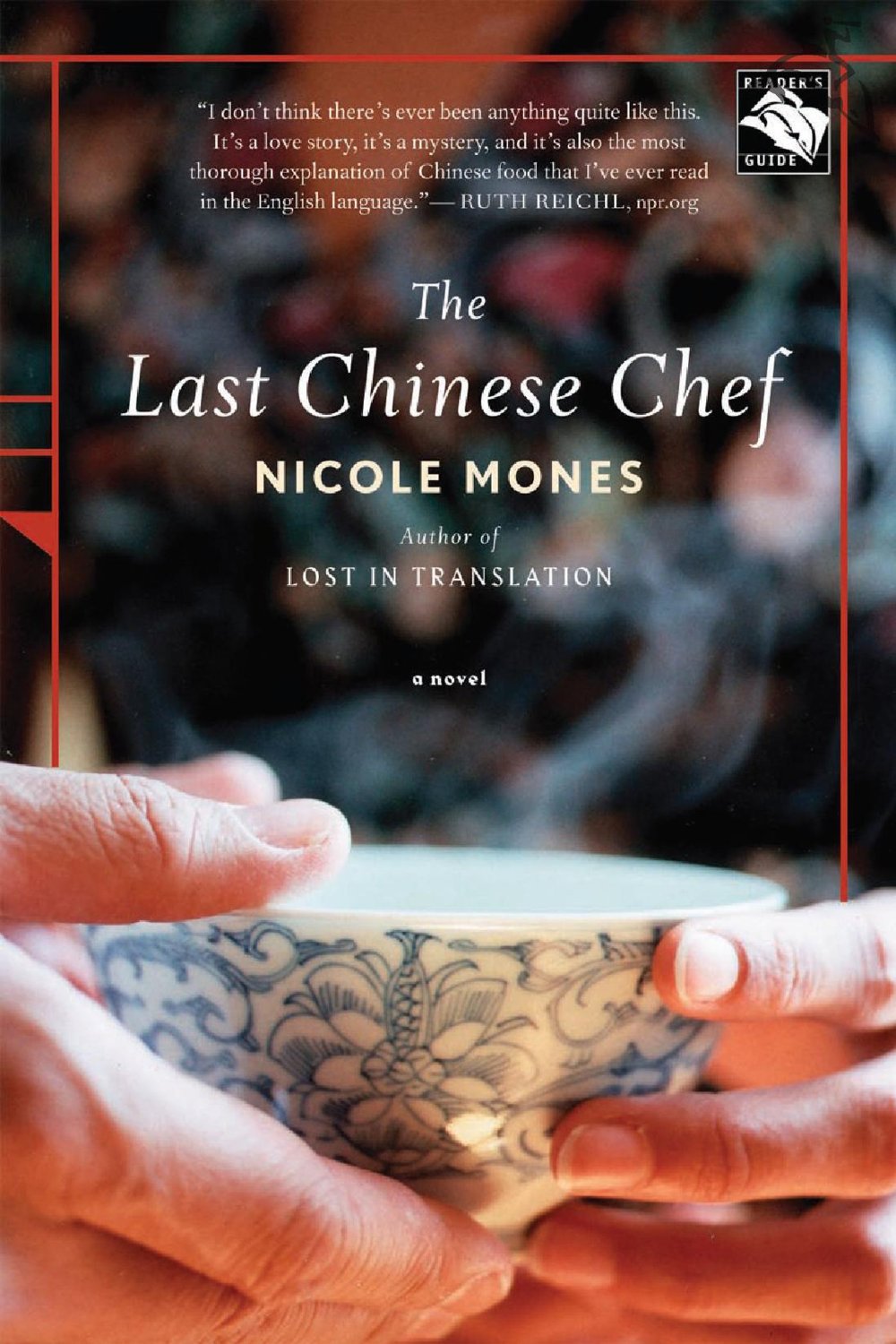
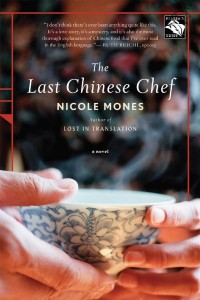 The Last Chinese Chef is probably my favorite of her novels. This time, Ms. Mones, a contributor to the now sadly defunct Gourmet magazine, takes us into the luscious world of Chinese cuisine.
When Maggie McElroy, a widowed American food writer, learns of a Chinese paternity claim against her late husband’s estate, she has to go immediately to Beijing. She asks her magazine for time off, but her editor counters with an assignment: to profile the rising culinary star, Sam Liang, who is about to open an imperial-style restaurant in Beijing. When the restaurant opening is delayed Sam, who is half Chinese, half American, acts as Maggie’s translator and helps her track down the child and unravel the mystery of the parentage.
But readers – it’s the backdrop of the FOOD that is the heart and soul of this novel.
We understand the intricacies of Chinese cuisine. The concepts of texture and appearance are as important as flavor on the Chinese table. We learn about “guanxi” — the Chinese concept of relationships. We see that food is at the heart of Chinese relationships, one reason why all meals are shared in China and never individually plated. Chinese cuisine is very much about presentation including symbols and references which are understood instantly and connect its people not only to one another but to their culture and history.
This is not to say that the characters or the plot of The Last Chinese Chef aren’t compelling — oh they are. Sam, the heir to the family’s cooking expertise, is sexy yet gentle – helping Maggie comprehend the often mystifying Chinese culture and re-awakens her interest in food by preparing her luscious dishes (I know… sigh). Sam decides to enter a Chinese cooking competition and we watch, smell and taste the tapestry of the food he prepares to practice. Sam’s grandfather, Liang Wei, had been one of the last generation of chefs in the Forbidden City and the author of a highly regarded tome on the art of Chinese cuisine. Each chapter of the book starts with quotes of wisdom from this fictional but very realistic Chinese cook book. Eventually, Maggie and Sam unravel the truth behind the child’s parentage, but by then Maggie doesn’t care so much, re-awakened from her grief and happily eating.
+++++++++++++++++++++++
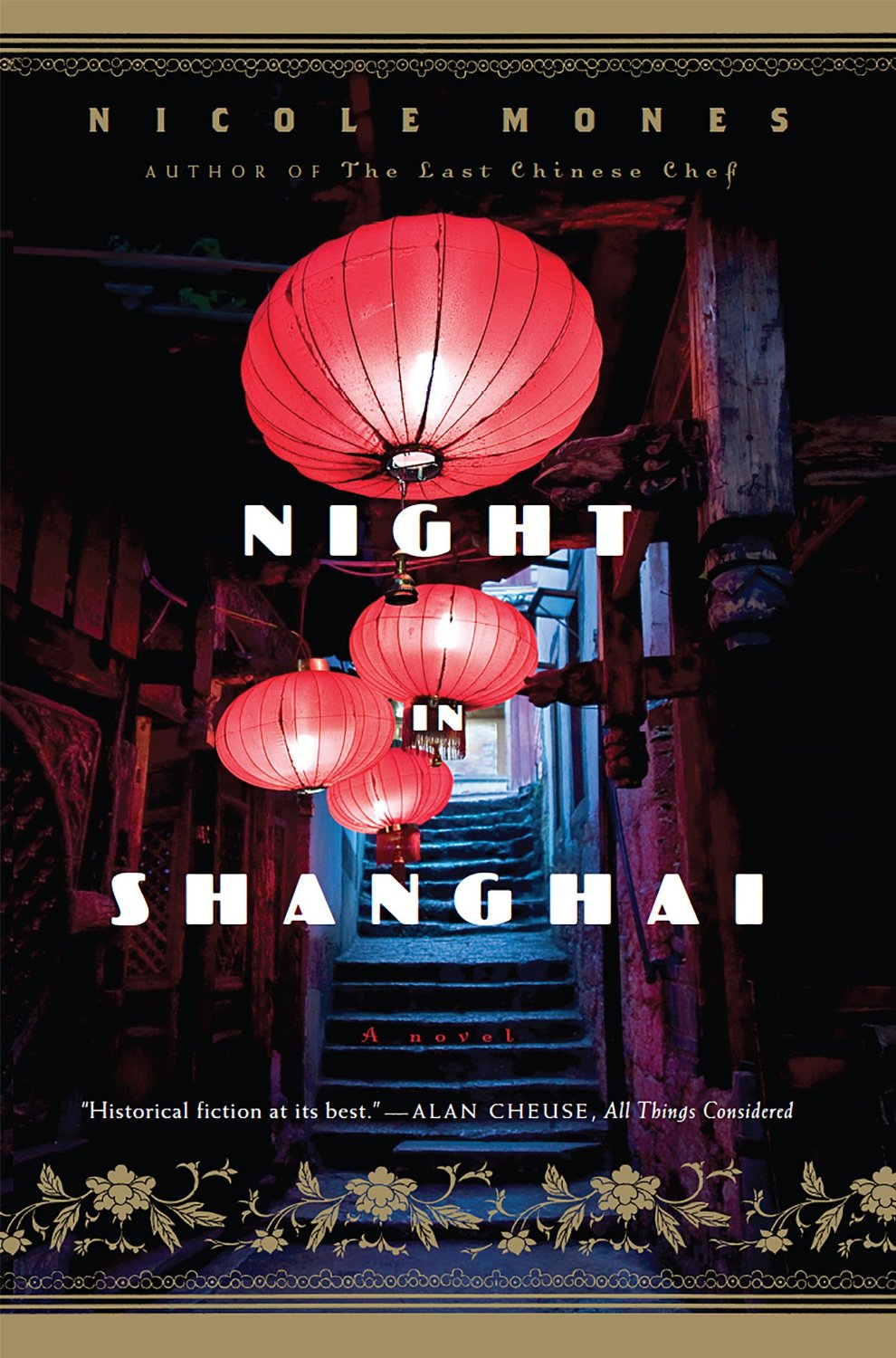
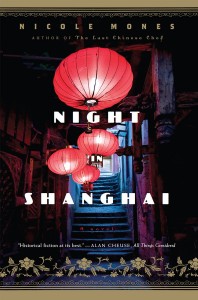 Night in Shanghai is Ms. Mone’s most recent novel. I haven’t read it, but it’s next on my list.
It’s about the little-known story of black musicians in the Chinese jazz age. You can watch the book’s trailer HERE.
(Who knew that one day book publishing/marketing includes film-style trailers.)
-
Independent Bookstore Day

Find your local independent bookstore celebrations HERE
A brutal recession can change the economic landscape, but not always in the way people assumed it would. Six years ago, independent bookstores seemed destined to follow travel agents into the remainder bin. In 2009, the American Booksellers Association dipped down to 1,401 members. Borders shuttered hundreds of stores across the country, and Barnes & Noble started to teeter. If those big guys couldn’t survive, the conventional wisdom went, what chance did Mom & Pop Bookseller have?
It turns out, better than most of us expected. Despite the nation’s lackluster recovery, the number of indie bookstores has increased by more than a 25 percent since those dark days of 2009.
What accounts for this burst of literary entrepreneurialism?
Instead of heralding the industry’s doom, the death of Borders may have helped clear away competition. Other observers point to new interest in farmers markets and all things local. And maybe, like the prospect of hanging, the possibility of bankruptcy concentrated the minds of bookstore owners and inspired them to smarter, more creative merchandising.
However we got to this happy state, it’s worth celebrating, which is exactly the point of Independent Bookstore Day on Saturday, May 2. This new nationwide holiday stems from a program started last year by California indie bookstores. Now, more than 400 stores from Alaska to Maine are preparing for a full day of programs, entertainment and food to highlight their value.
Bradley Graham, co-owner of Politics & Prose, says, “Independent Bookstore Day is meant to celebrate all that indies stand for: personal service, author talks, the experience of browsing, the joy of discovery, a sense of community.”
Graham confirms that the industry-wide gloom of a few years ago has lifted. “Indies are definitely back,” he says, “with revenues rising and the number of stores increasing, as well. That’s a testament to how much people continue to value not only physical books but the local, community-oriented bookstores that sell them.”Events director Sarah Baline describes the store’s business as healthy. “There seems to be a real increased awareness about the ‘shop local’ movement,” she says. “Customers come to us first, make us part of their routine. More people are coming to realize the value of independent businesses and want to become regulars.”For Baline, the secret is a diversified business model. “Independent bookstores are not just places to buy books,” she says. “We are community centers, gathering places and event spaces. Kramerbooks, especially with the full bar and restaurant, exemplifies the concept of a ‘third place’ for our community. A deep discount is no competition!”
-
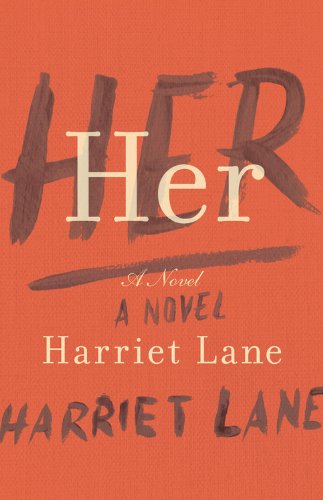
Her by Harriet Lane
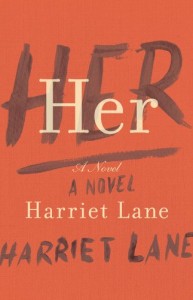 You may remember my review of Harriet Lane’s previous novel Alys Always.
I greatly admire Ms. Lane’s spare and visual writing style –she’s a writer who can paint so much in so few words.
Her is her second novel and like Alys Always it’s creepy minimalist writing at its best.
Told in the first-person narrative from two women’s perspectives, the novel teases you along in alternating chapters.
Nina spots Emma in North London — a woman she knows from her childhood and contrives a way to connect with Emma — we know not why.
Emma is a harried, scattered mother of two kids. She is also vulnerable and clueless – she doesn’t remember Nina and takes her to be a new friend. You cringe as Nina (obviously a psychopath) begins to orchestrate a series of devious and manipulative events to successfully insinuate herself into Emma’s life.
Emma’s messy, but ordinary domestic life is the perfect stage for Nina to play out her menacing plan. True friends – maybe not. Nina purposely messes with Emma — household items go missing, babysitting plans go awry, a child seems to get temporarily lost — these haphazard domestic incidents provide a ominous backdrop. The reader knows this is a household about to unravel in a most disturbing way.
And so we are intrigued…what’s going to happen? Why is Nina so intent on connecting with Emma? What was the past incident that is causing this evil charade?
As in her previous novel, Ms. Lane is very good at painting the seemingly normal, but creepy stalker. Slightly “off” people who seamlessly infiltrate themselves into innocent lives. You read along, nervously aware that something terrible is going to come of all this, but unsure what, how or why. That is the mark of an intelligently constructed thriller.
This book has been compared to the currently popular thrillers Gone Girl and Girl on a Train. I’ve read both books and Her is far superior writing and I think more thrilling and creepy. Again, it’s the minimalist writing – an around-the-campfire ghost story teller who pauses for utmost effect to let your imagination fill in around the silence.
My only quibble is with the reiteration of the same event from each woman’s point of view — there isn’t enough difference in the two voices to make the re-telling fresh and so at times the narrative seems to slow down – but perhaps this is Ms. Lane’s intention – maybe it’s supposed to be a slow burn.
Stick with it my friends, the author kicks up the tension and the last chapters are evil and frightening. To some, the ending may feel unfinished and you may be wondering WHY? — but that is the chilling nightmare.
-
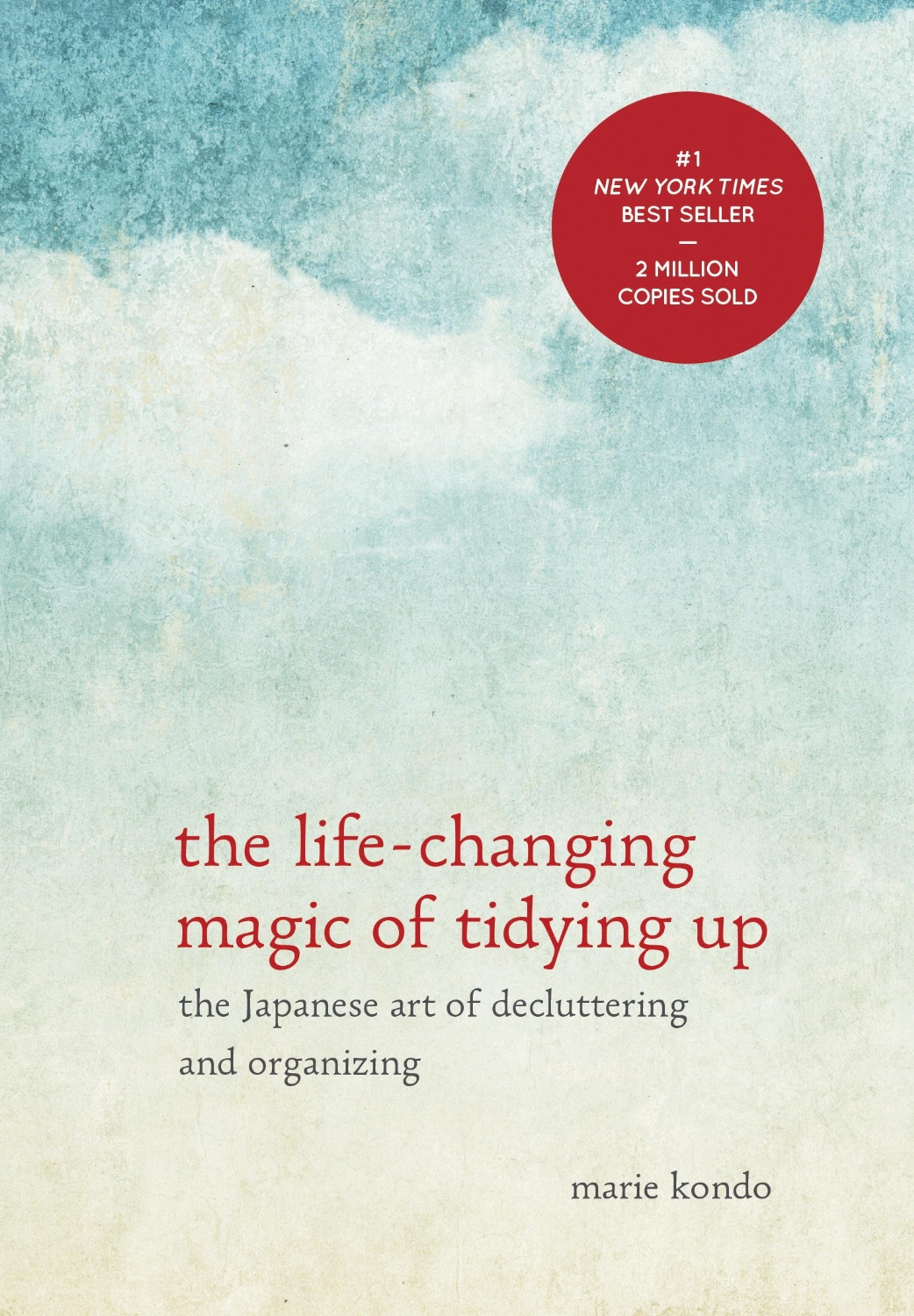
The Life-Changing Magic of Tidying Up by Marie Kondo
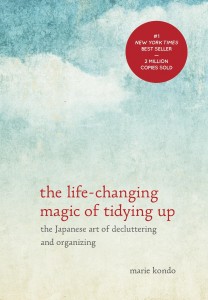 While reading this book, I kept thinking of my sister. From a very young age, she loved organizing and keeping things in order. Her room was always neat as a pin with everything in its place. She would put away the toys while we were still playing with them and loved organizing anything – mom’s kitchen drawers, my jewelery box…anything slightly messy was at risk of little sister putting it in order.
It’s no wonder I was reminded of my sister — Marie Kondo also grew up wanting to organize and tidy things – from her classroom, to her siblings rooms to her parents kitchen and has turned this lifelong passion (obsession?) into a phenomenon in Japan.
The Life-Changing Magic of Tidying Up is a small book – purposely designed to take up very little space. It has a calming clouds and sky image on the cover and easy to hold it in your hands. From the beginning I really warmed to the word “tidy” – such a sweet, old-fashioned word, which seems gentler and more approachable than many other guides and television shows focused on getting organized or how to clean out your
awful hoarding messthings. This book is translated from Japanese, so some of the writing is a bit clunky, but nonetheless, I gathered some new ideas, and shook my head at others, while making my way through this book.She divides people who can’t stay tidy into three types: “Can’t throw it away”, “Can’t put it back”, and “first two combined.” Well, that rang true right off the bat. Ms. Kondo goes on to bust the usual practice of cleaning one closet or one drawer at a time. She advocates cleaning out things (not spaces) in a certain order – and not putting anything back until you’ve finished the process of discarding. This may be practical in tiny Japanese homes, but I wonder how it would work for the multi-storied, many-roomed homes of America. For example, Ms. Kondo wants you to take every single piece of clothing in your home and place it on the floor – the mere thought gave me an instant headache. But it appears that’s the goal — to overwhelm her clients with the staggering amount of clothing they posses and seldom (or never) wear. As a person who changes sizes with regularity (I have three sets of clothes: fit me now, maybe fit me soon, and in my dreams…) this is a very scary proposition.
Storage solutions (sorry Container Store) are poo-pooed as just a method to perpetuate hoarding. OK that does make sense but Ms. Kondo goes too far when keeping a spare button box is discouraged because when a button falls off it is usually time to get rid of the clothing? The question mark is mine. Should we also not keep a sewing box to make repairs?
When it comes to childhood memorabilia and other things from the past – Ms. Kondo makes good sense with this advice; “It is not our memories but the person we have become because of those past experiences that we should treasure. This is the lesson these keepsakes teach us when we sort them. The space in which we live should be for the person we are becoming now, not for the person we were in the past.” Whoa — I had to write that down.
This book does point out that mess is often about unhappiness and that tidying can bring happiness – OK that, too is true. I always feel better when I’ve cleared out a drawer or a closet. But I’m not sure it’s linked to the spirituality that Ms. Kondo promises. This little volume is packed with some pretty “out-there” suggestions – greet your home when you enter it. Say thank you to items before you put them away. Folding clothes with an open palm transmits positive energy. Do my clothes really need energy of any sort?
Stockpiling is obviously discouraged (sorry Costco, Sam’s Club) and once again I thought of my sister – when she uses one can of tomato sauce, she replaces it with one can of tomato sauce. No impulsive buy 3 get one free sales for her. Even though my house is tiny, I have a pantry. I live in fear of running out of chicken broth. I just looked and currently have three cartons.
The book advocates only keeping things that truly give you joy – which I understand, but what about my the pragmatic things in your life? My food processor is ugly, it takes up space in my cupboard and it doesn’t actually bring me said “joy” –but when I need it – wow is it practical. Ms. Kondo lost me with her advice on clearing out books (natch), She advocates taking each book off the shelf and deciding if the book in your hands brings you joy before deciding whether to keep it. She feels books left on the shelves have a certain inertia and tend to stay there. Has she never wanted something to read, not sure what, and found the perfect book on your own shelf…now that’s joy.
I fear her OCD (she empties her purse every single night, placing each of the contents in its own little place, and puts her watch into a little box every night so it can “rest” overnight) — seeps into her advice, loosing credibility for the real world and the rest of us. I agree with other reviewers that the book only talks of throwing things away rather than donating, recycling or selling items you’re discarding. Does Japan have a bottomless landfill?
I shook my head over the impracticality of much of her advice. Ms. Kondo is obviously a single woman and able to keep everything she owns exactly in place …obviously she doesn’t live with messy children or a “I’ll find a use for this someday” husband. Her business is thriving in Japan and this book is a best-seller…but I must admit I only got a few good pointers from the book and overall I found it preachy and overly-simplistic. So do as I did – get this book from your library – gather what you will from reading it – and then return to your library — no need to add this book to your clutter.
-
A Flower Market Birthday
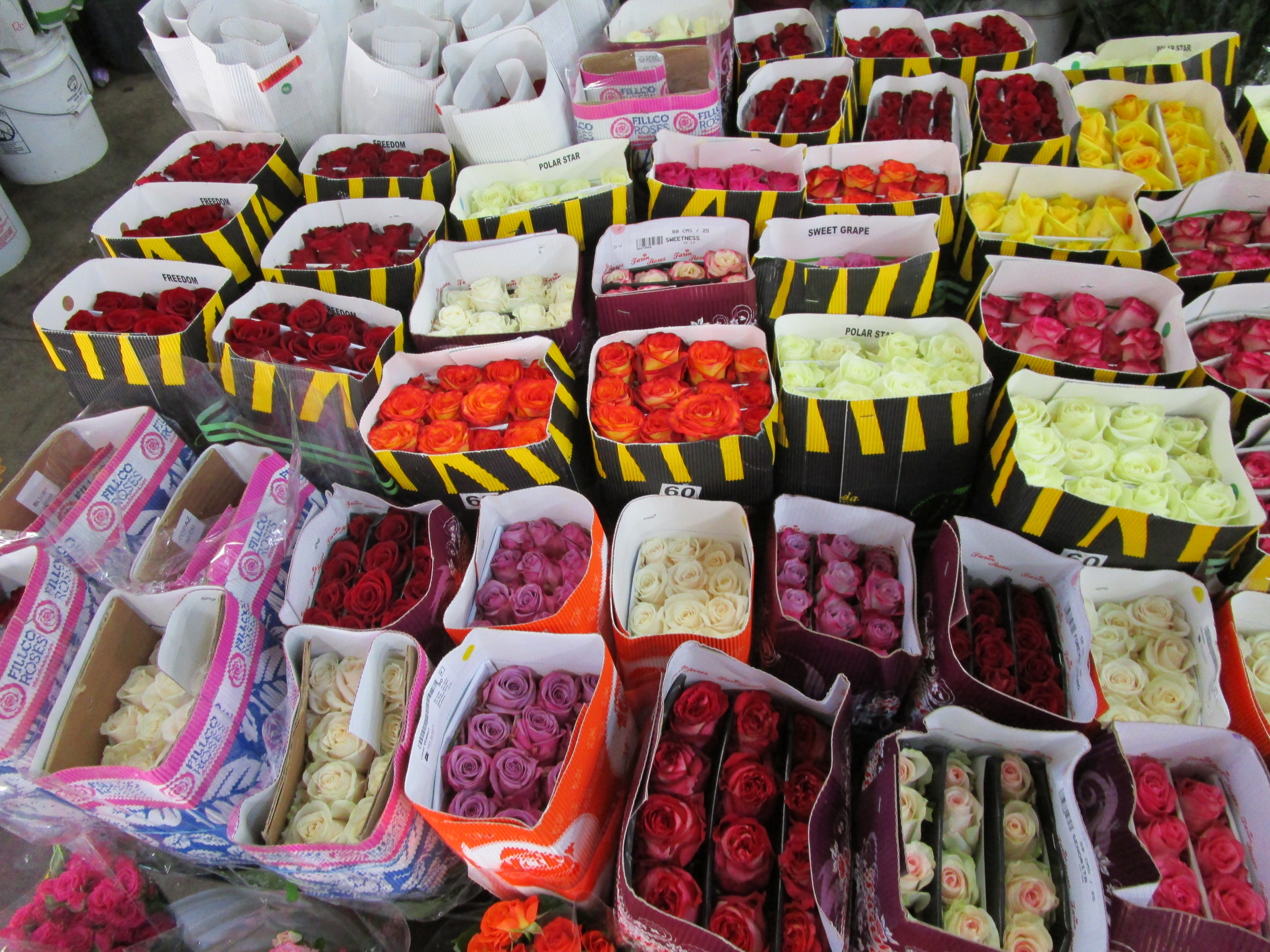
So my birthday was a few days ago and for several years now, at a loss for what to get me (I have everything I could ever want) my adorable husband takes me to the San Francisco Flower Market.
I go crazy buying flowers and he patiently pays for everything and follows me along holding my purchases. We then go out to breakfast and once home, I happily arrange my flowers and place vases throughout the house.
The best birthday gift ever.
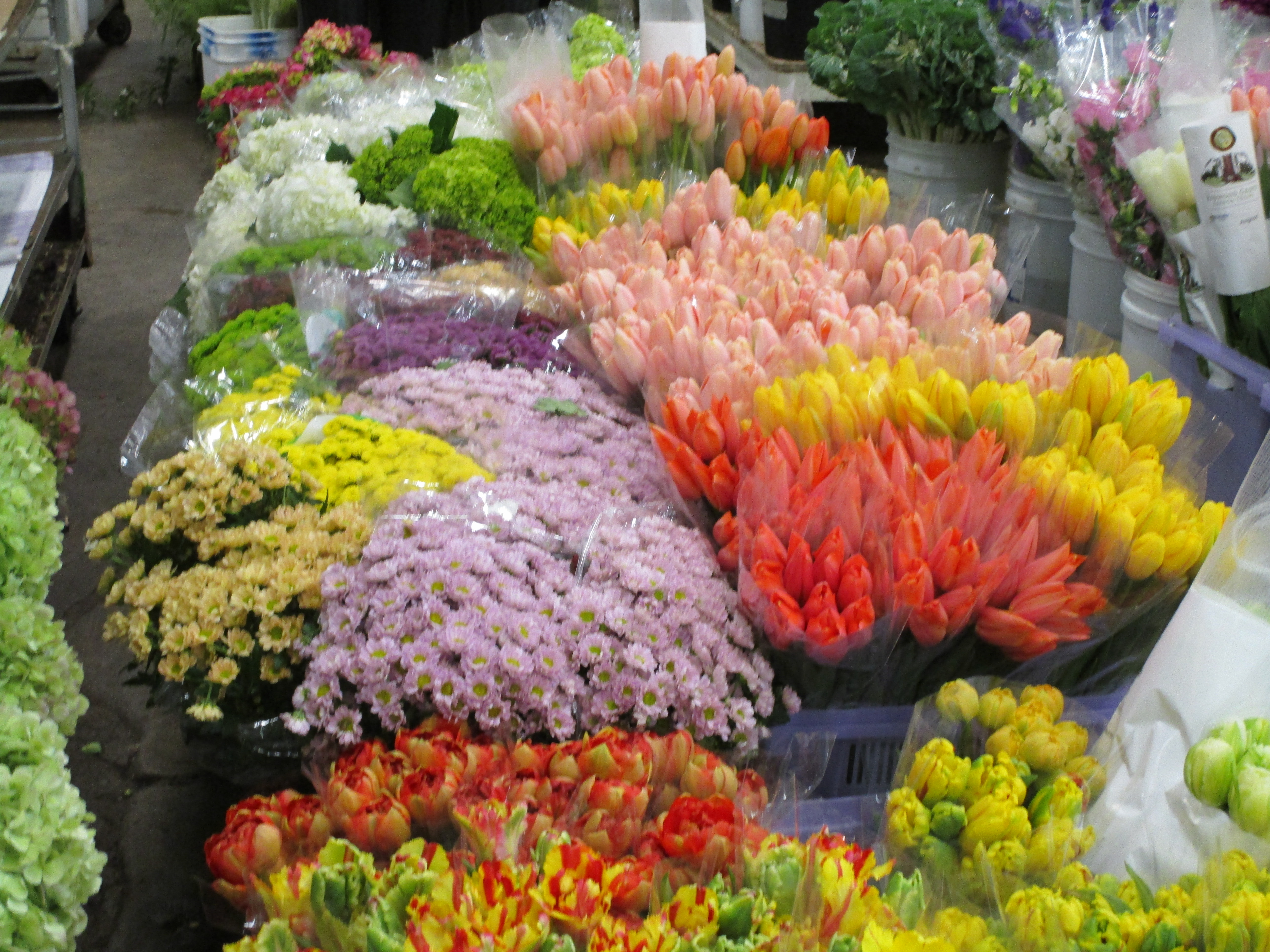
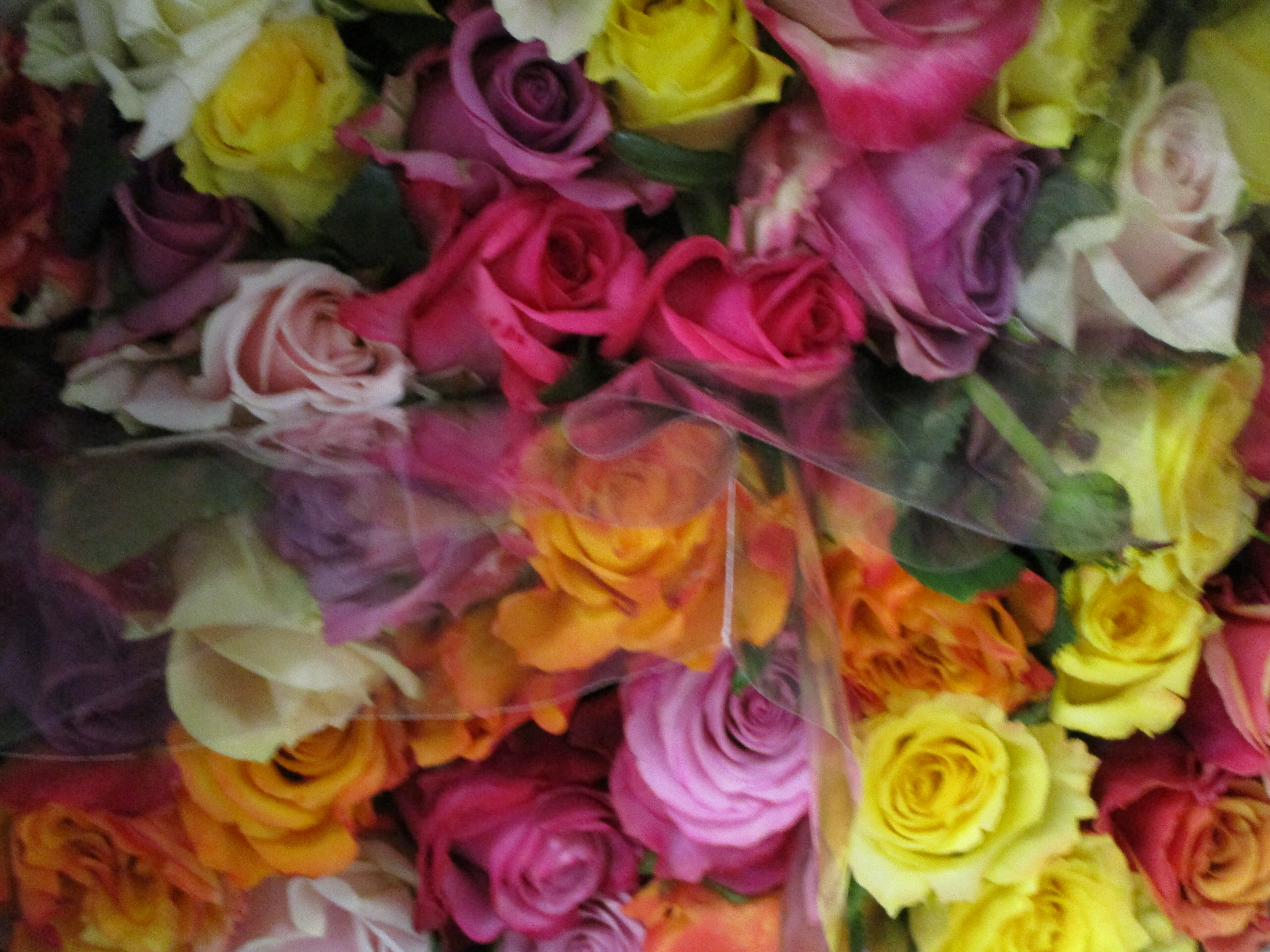
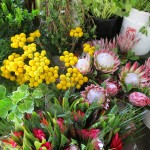
A treat for the eyes and the nose.
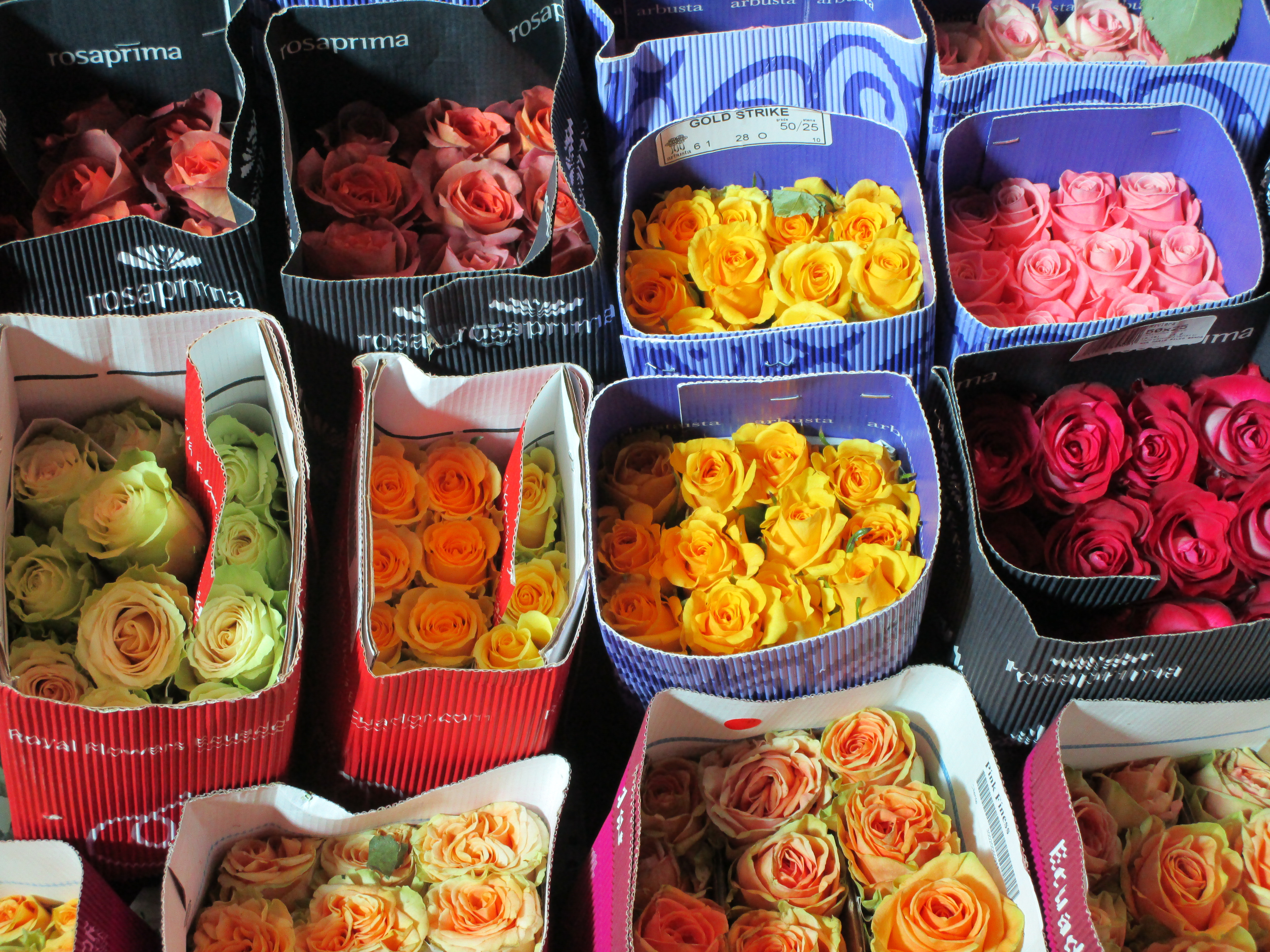
Promise me, you’ll click the photos to see the floral display in its full glory.

I wander from nursery stall to stall …the place is huge, nonetheless stalwart husband carries my spoils.
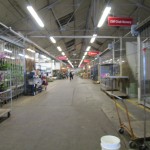
Such choices – such temptation…

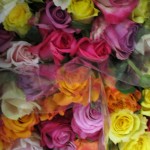
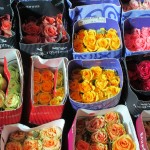
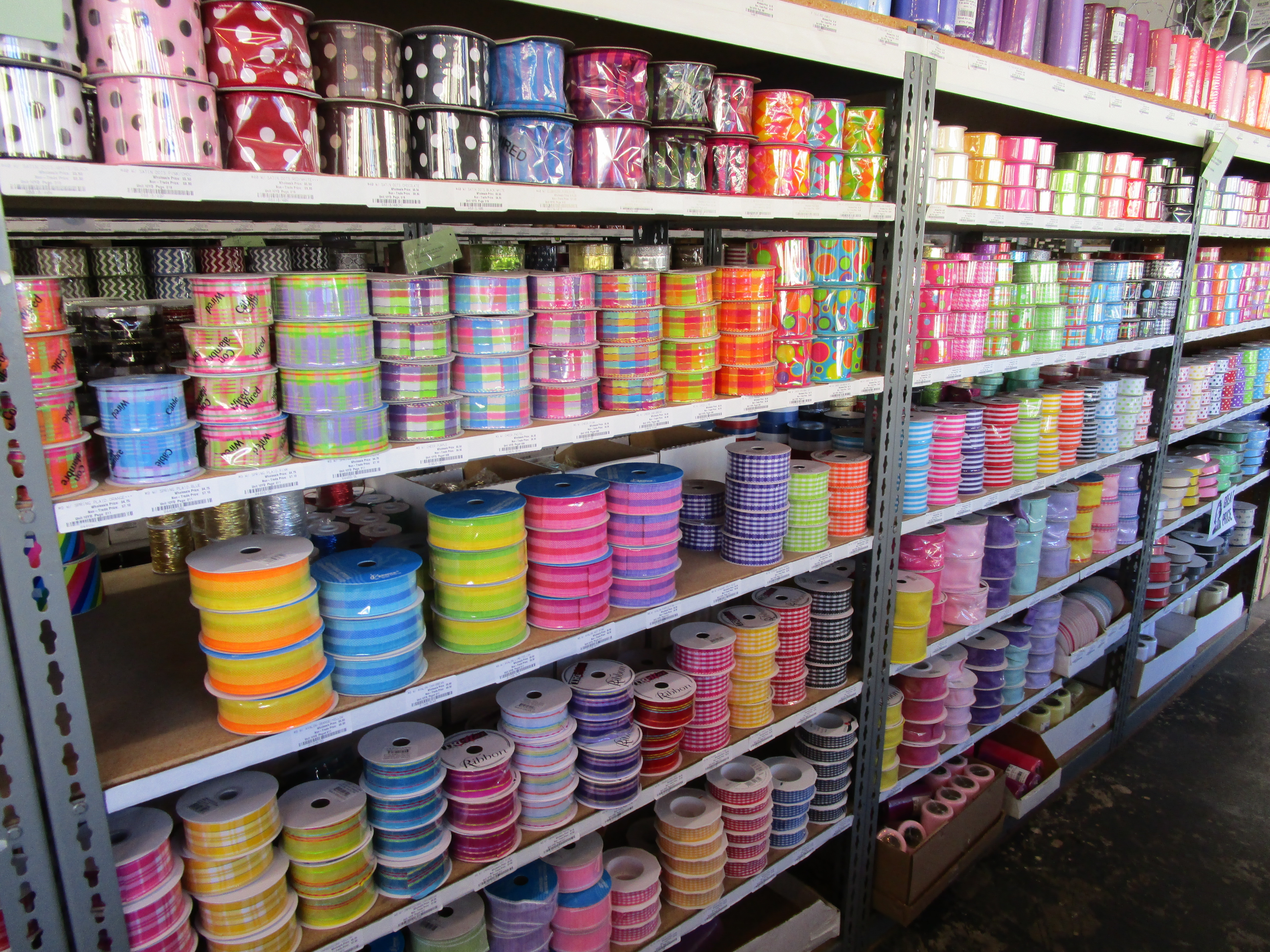
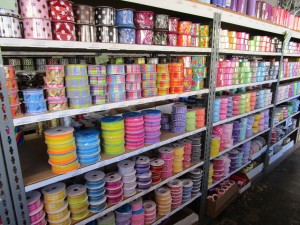
There’s a floral supply stall with amazing ribbon choices.
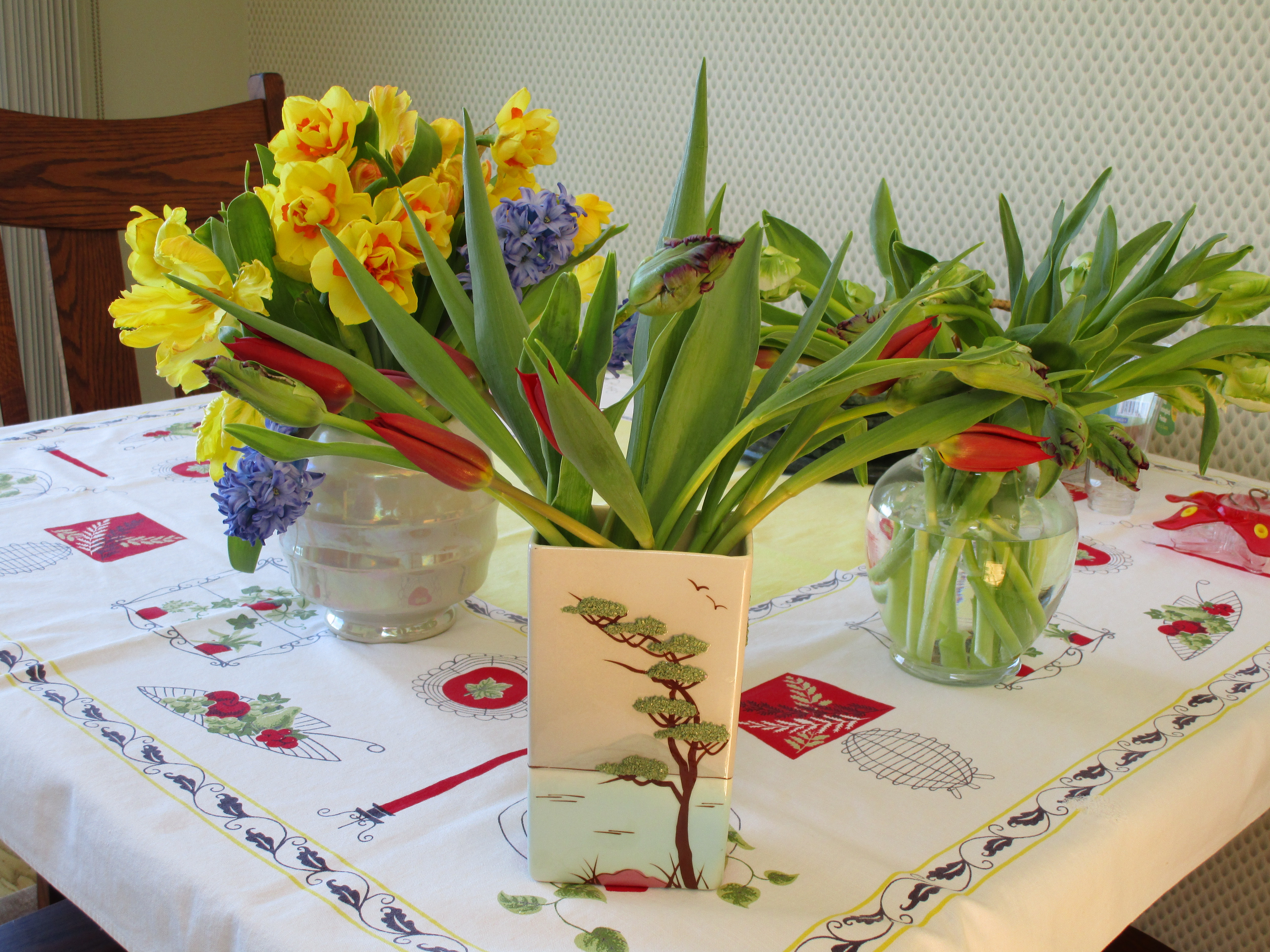
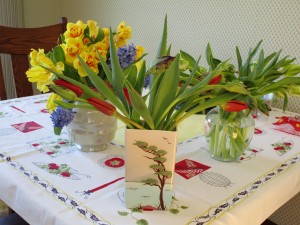
But, in the end, I have three lovely bouquets at home. Tulips are not yet opened – but had to show you anyway.
So here’s a question – what luxuries would you give yourself if you were very wealthy?
For me it would be fresh flowers in the house year round…and I’m lucky because with my garden, I am able to have them most all of spring and summer.
And while we’re fantasizing about luxuries – I would also require fresh towels and sheets every day.*
Maybe I belong in a hotel?
* Of course, not with our current drought – fantasy only.
-
The Book Tingle
 Just on the heels of my gushing post on Nora Ephron and her marvelous essay On Rapture…comes this.
Stop whatever you are doing and go to one of my favorite book blogs — HERE Savidge Reads.
He talks about “The Book Tingle” and to quote Mr. Savidge:
There is an almost unexplainable feeling from the start which lasts until the final full stop. Not for a single moment does the book let you down, or indeed out of its grasp, you are effectively spell bound by it. It feels like all the rest of the world goes completely out of your mind and all that is left is you, the book and the author’s words. It is the prose, the characters, the atmosphere, everything! You almost feel, without it sounding arrogant, that this book was written just for you.
Isn’t that wonderful? Doesn’t it just speak to any book lover? Can you blame me that I have a big old book crush on Mr. Savidge.
Got me thinking about my “Tingle” worthy books:
The Shadow of the Wind, The Magician’s Assistant, A Fine Balance, anything by Kate Morton, Prodigal Summer, The Amazing Adventures of Kavalier & Clay, The Thirteenth Tale, The Piano Tuner, Cutting for Stone, Gone with the Wind, and I’m with Savidge – Rebecca.
I’m sure I’m skipping many but in the meantime …
What are your “Tingle” books?