
I first spotted this book in a bookstore and was taken aback by it’s sheer size. It’s enormous…a real ‘chunkster’ as they say – 640 pages.

I decided to get on the wait list for my library’s digital edition. My hold came through the other week and I settled in with my very light Kindle.
The book is set in Oxford, Mississippi in 1933. Families are struggling as the Great Depression tightens its grip and Birdie Calhoun’s mother and grandmother have sent her to Oxford to ask her wealthy sister Frances to lend them some money. However, Birdie quickly discovers that her sister’s life isn’t as perfect as she would like everyone to believe and she and her husband are having difficulties of their own.
Meanwhile, in Oxford’s Lafayette County Orphan Asylum, eleven-year-old Meg Lefleur is still hoping that her mother will come to reclaim her. Abandoned on Christmas Eve, Meg has been living at the orphanage for two years and is now one of the ‘big girls’, considered un-adoptable as most people would prefer a baby or toddler. For no explanation, Meg has become the main target of Garnett Pittman, the cruel and abusive woman in charge of the orphanage.
Miserable and isolated, Meg is given a glimmer of hope when she meets Birdie, who has taken a job as bookkeeper at the orphanage. Birdie does her best to make life bearable for Meg, but knows it won’t be enough to save her without intervention.
To add to her burden, Birdie is tasked with helping Frances when her life falls apart after her husband has squandered all their money. Birdie also is firmly dedicated to trying to reunite Meg with her mother.
With no money, Birdie embarks upon a business venture that is unorthodox, but lucrative. The story then adds all sorts of new and memorable women characters. Together these women build a enterprise and form bonds. These are strong, scrappy women who have realized that no one is coming to save them.
The story gallops along and I couldn’t stop reading, worried about this gang of extraordinary women surviving despite everything. Intertwined with all this is a romance for Birdie that is unexpected and sweet, but not without its challenges.
I liked Birdie, who is outspoken, loyal and courageous, but it was Meg who really won me over. I thought Ms. Stockett perfectly captured her vulnerability, her longing to feel loved, and her desperation to get away from the orphanage and never be sent back. She’s also intelligent, resourceful and, due to her circumstances, often seems older than her years. A child character with depth and complexity.
There are other characters who, although much less sympathetic, are equally memorable: Garnett Pittman is a truly horrifying villain, while Birdie’s shallow, self-absorbed sister Frances is a constant source of frustration for both Birdie and the reader.
From the devastation caused by the 1929 financial crash, to gay conversion therapy, to prostitution, to section 213 of the 1932 Economy Act that effectively ousted married women from their jobs, to forced sterilization and eugenics, The Calamity Club barely takes a breath. My biggest quibble is that the ending is rushed and is rapidly condensed into the last 40 pages – as if someone told the author hey, you’re already at 600 pages time to wrap this up.
This is a compelling novel that depicts inconceivable grievous social injustices, sympathetic characters in dismal situations, social stigmas of that time period, and strong, determined, resilient women. (Sorry for all the adjectives but the characters are indeed all that and more.)
A quite lengthy(!), character-driven story that, despite its length, makes for an engrossing read. A novel of desperate women faced with impossible choices. Great historical fiction written with poignancy, humor, and empathy.
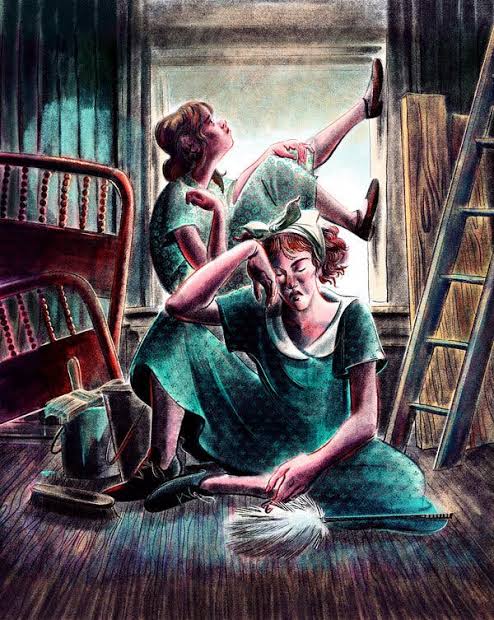
Here’s the illustration from the New York Times book review, which I just love and will make more sense once you’ve read the book.
N.B. Ms. Stockett is the author of The Help which I haven’t read, but I greatly enjoyed the film.
N.B. #2 The author references the actual 1928 Law that made it legal to sterilize any person in Mississippi deemed an imbecile — not only the insane, idiots, imbeciles or epileptics — but also the disabled alcoholics, prostitutes, and sexually promiscuous women. Children were tested for feebleness, and if found low intelligence were also candidates for sterilization. 26 other states had similar laws